
Types of research are the different ways a study can be classified, and the classifications answer different questions: why you are doing it (basic or applied), what evidence you use (quantitative, qualitative or mixed), what plan you follow (for example descriptive, correlational, experimental or case study), where the data come from (primary or secondary) and when you observe (cross-sectional or longitudinal). One project carries one label from each group.
Most students lose marks here not because they pick the wrong type but because they list types that contradict each other. UniDraft organises your confirmed methods, checked sources and supervisor instructions into an editable Word document. Start your project document with UniDraft, and bring the labels you can defend from what you actually did; it will not decide your research type for you.
Why does every textbook list different types of research?
Because "type" is not one question. Sources classify research on several separate axes, and a student who mixes the axes ends up comparing things that are not alternatives. "Quantitative" and "descriptive" are not rivals: one describes the kind of evidence, the other describes the aim of the design. The UNT Libraries design guide lists causal, correlational, descriptive, ethnographic, exploratory, experimental and quasi-experimental designs and says the list is not exhaustive. The USC Libraries guide adds case study, cross-sectional and longitudinal.
Departments also differ in which labels they ask for, so treat any list, including this one, as a map of the vocabulary and not as a rule.
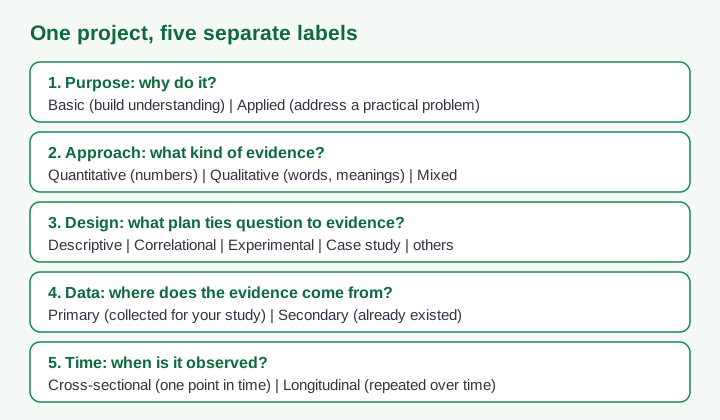
The rest of this guide takes the five axes in turn, then shows how to apply them to one fictional project. If you still need to decide on a plan, the research design guide is the decision tool; this page is the map.
Axis 1: What is the purpose, basic or applied?
Basic research is pursued to expand knowledge or develop theory. Applied research is aimed at something practical, such as solving a defined problem. The SAGE research encyclopedia entry on basic research makes a useful caution: the two terms describe the researcher's immediate motivation rather than a necessary outcome. In other words, they are two ends of a spectrum, not a strict split, and many student projects sit in between.
Most undergraduate projects in professional fields are framed as applied because they address a practical question in a business, school, clinic, farm or system. Say so only if that is how your department frames it; some departments simply do not ask for this label.
Axis 2: What kind of evidence, quantitative, qualitative or mixed?
- Quantitative works with measured data analysed numerically. See the quantitative methods overview.
- Qualitative works with words, observations and documents to understand meaning and process. See the qualitative methods overview.
- Mixed combines both and must explain where and why they connect. See mixed methods.
The USC guide describes mixed methods as an approach to examining a problem rather than a single method, combining numeric precision with narrative meaning. Remember that this axis describes the evidence, not the design: a descriptive study may be quantitative, qualitative or mixed.
Axis 3: What is the design?
The design is the plan linking your question to evidence. Short definitions, following USC and UNT:
- Descriptive: documents what exists (who, what, when, where, how) without manipulating anything. It cannot explain why something happens.
- Correlational: examines whether measured variables are related, without manipulating them. Association alone does not establish cause.
- Experimental: the researcher controls conditions, for example giving an intervention to one group and withholding it from a control group, then compares outcomes.
- Case study: examines one or a few cases in depth in their real-life context. Findings are hard to generalise.
- Exploratory: investigates an under-studied topic to generate ideas for later testing.
Dedicated guides exist for the survey design and the experimental design.
For a bounded organisation or process, the case study guide covers how to define the case and justify its selection.
Axis 4: Where do the data come from, primary or secondary?
Primary data are collected for your study. Secondary data already existed and are reused for your question. Downloading or cleaning an existing dataset does not make it primary. The primary and secondary data guide has a suitability worksheet for existing datasets.
Axis 5: When is it observed, cross-sectional or longitudinal?
A cross-sectional study captures a single moment, comparing existing differences among groups. It can show how common something is but not how it develops. A longitudinal study follows the same sample across repeated measurements, which helps show change over time but is slower, costlier and harder to sustain (USC guide). A final year project with one semester to collect data is almost always cross-sectional; claiming a longitudinal design requires repeated measurement of the same participants.
One table: the map at a glance
| Axis | Question it answers | Common labels | Typical mismatch to avoid |
|---|---|---|---|
| Purpose | Why is it done? | Basic, applied | Calling a theory-free problem-solving study "basic" |
| Approach | What kind of evidence? | Quantitative, qualitative, mixed | Calling a closed-ended questionnaire study "qualitative" |
| Design | What plan links question to evidence? | Descriptive, correlational, experimental, case study, exploratory | Calling it "experimental" when nothing was manipulated |
| Data source | Where did the evidence come from? | Primary, secondary | Calling downloaded data "primary" |
| Time | When is it observed? | Cross-sectional, longitudinal | Calling one-off collection "longitudinal" |
A fictional example classified along every axis
Fictional example: a student wants to know how second-year students in a department use a registration portal and what difficulties they report. She plans one questionnaire, given once to a selected group, with closed questions and two short open comments.
| Axis | Label she can defend | Why |
|---|---|---|
| Purpose | Applied | The aim is a practical picture of a service problem |
| Approach | Quantitative, with a small qualitative element | Closed items are analysed numerically; the open comments are read for themes. Whether to call this mixed methods is a decision for her supervisor |
| Design | Descriptive survey | It documents what students report, without manipulating anything |
| Data source | Primary | She issued the questionnaire for this study |
| Time | Cross-sectional | Data are collected once |
Notice what she cannot claim. It is not experimental, because nothing is changed. It is not secondary data, because she collected the responses. It is not longitudinal, because nothing is repeated. It also cannot say the portal "causes" difficulties; it describes what students report. If she later adds a plan to compare two cohorts, the design question changes and the plan should be discussed with her supervisor first.
How do I name my project's type in Chapter Three without contradicting myself?
Use this short routine, then write the section.
- Start from what you will actually do. List the question, the instrument, who or what is selected and how many times you collect.
- Pick one label per axis, only where your department asks for it. Do not add labels to sound thorough.
- Check each label against the evidence you hold. If a label requires something you do not have (a control group, repeated measurements, original collection), drop it.
- Use the same words everywhere. The terms in your objectives, instruments, sampling and analysis must match the terms in the design section.
- Justify in one sentence per label, tying it to your question or access, not to "it is commonly used".
- Say what the design cannot show. One honest sentence about limits is stronger than a claim that cannot be supported.
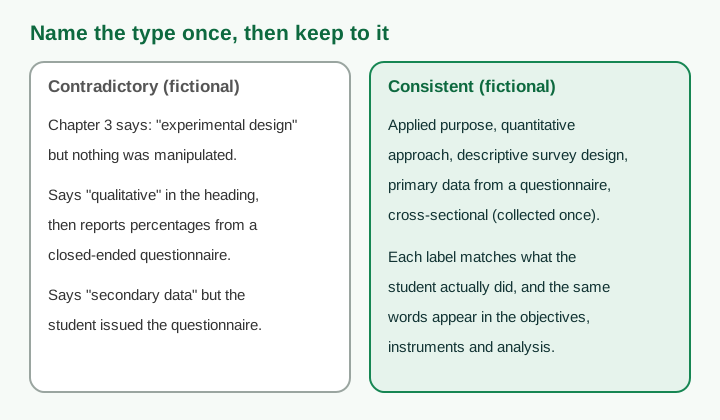
A sentence pattern you can adapt: "This study is applied research using a quantitative approach and a descriptive survey design. Primary data were collected once, so the study is cross-sectional." Replace every word with what is true for your project, and confirm the labels with your supervisor before using them. The full chapter is covered in how to write the methodology, and your chosen sample is explained in the sampling guide.
A second fictional example: a different project, different labels
Labels are not fixed to a department. Here is a contrasting fictional example to show that the same five questions can give very different answers.
A student wants to understand how a small group of market traders in one town decided whether to accept electronic payments. She plans semi-structured interviews with a limited number of traders, plus her notes on how one market association handled the question.
| Axis | Label she can defend | Why |
|---|---|---|
| Purpose | Applied or exploratory, depending on how her department frames it | She wants to understand a practical decision, not test a theory |
| Approach | Qualitative | The evidence is spoken accounts and notes, analysed for themes |
| Design | Case study of one association, with interviews as the method | The case is bounded and studied in its real context |
| Data source | Primary | She conducted the interviews |
| Time | Cross-sectional | The accounts describe one period; she is not tracking change |
Compare the two examples. The first student's results can be tabulated; the second student's cannot be reported as percentages of "all traders". The labels are not decoration: they tell the reader what kind of claim the findings can support. The interview guide and the thematic analysis guide show how to keep the trail from quotation to theme visible.
Which labels will an examiner actually look for?
There is no universal answer, and I cannot verify a single Nigerian rule, so the safe route is practical. Look at the department's project handbook or the marking scheme if you have one. Look at which labels appear in the headings of recent departmental projects your supervisor recommends. Then ask your supervisor one direct question: "Which of these classifications do you want named in Chapter Three?" Their answer outranks any guide, including this one. If your department only wants the design and approach named, do not pad the section with every axis; a short accurate description beats a long decorated one.
Common mistakes when stating the type of research
- Treating the axes as a menu. "My research is qualitative, quantitative and descriptive" lists three answers to three different questions as if they were alternatives. Name them by axis.
- Choosing "mixed methods" for status. Two methods without a plan to connect them is not a mixed design.
- Confusing the instrument with the type. A questionnaire is not a research type. State the design and approach; the questionnaire is the instrument.
- Using "experimental" or "effect" loosely. If you did not manipulate anything, say association, not effect.
- Mislabelling data. Reused records are secondary even if you cleaned them yourself.
- Copying a label from a past project. Different studies, different evidence. Write what you did.
- Changing labels silently. If your plan changes, discuss it with your supervisor and record the change.
What if my department uses different names?
Follow them. Some departments group everything into "research design", others separate "research approach", "research strategy" and "research method", and the exact classification varies between textbooks and institutions. The same applies to what Chapter Three must contain. Use your supervisor's terms and map the labels above onto them, keeping the logic the same. If you also need a literature base for the designs you name, the citations tool helps keep checked sources in the format your department expects.
Questions a supervisor or panel may ask
- Is your study applied or basic, and what in the report shows that?
- Why is this design suited to your question rather than another?
- Are your data primary or secondary, and who collected them?
- If you say longitudinal, what did you measure more than once?
- What can your design not show?
Fill in a one-page type sheet
| Prompt | Your answer |
|---|---|
| Main question | One sentence |
| Purpose label (if required) | Basic or applied, and why |
| Approach | Quantitative, qualitative or mixed, and the evidence that proves it |
| Design | Name and one-sentence justification |
| Data source | Primary or secondary, with provenance |
| Timing | Cross-sectional or longitudinal, with collection dates |
| Instrument | Questionnaire, interview guide or other |
| Limitation | One thing the design cannot show |
UniDraft helps organise your written project around confirmed methods, results and instructions. It does not run your analysis, choose your design on your supervisor's behalf or collect data for you. For interview-based and text-based projects, see the interview guide and the content analysis guide.
For the most common design in undergraduate projects, see descriptive research design.