Your final year project supervisor is the lecturer your department assigns, or approves, to guide your project from topic to defence. You work well with one by agreeing expectations at the first meeting, asking for approval in writing, sending drafts on a regular schedule with a short covering note, and emailing a summary after every meeting.
UniDraft helps with the writing side of this relationship. It organises your confirmed work, checked sources and your supervisor's instructions into an editable Word document, so you can start a project document and bring your supervisor something concrete to review. It does not replace your supervisor, and every instruction that matters comes from them and your department.
This guide covers the relationship itself, before any corrections arrive: what to bring to the first meeting, how to ask for a topic or approval, how to keep meeting notes, how often to send drafts, what to do when your supervisor is hard to reach, and how to stay professional. Once comments come back on a draft, move to managing supervisor corrections.
What does a final year project supervisor actually do?
A supervisor advises, challenges and approves. They do not do the research for you. One university project guide puts it plainly: the supervisor guides the project, but the student carries out the research and arranges the meetings (University of Reading project guide). That guide also says supervision is not intensive coaching, since supervisors have many students and other duties, and that feedback is usually on small pieces of work such as a short paragraph or a report plan.
Nigerian departments differ on details such as how many students a supervisor handles, how drafts are submitted and who signs which page. So treat the Reading guide as one example of a pattern, not as a rule for your school. Your department's project handbook, and your supervisor's own instructions, always come first. If you are unsure what the project is supposed to contain, what a final year project is sets out the standard idea.
In practical terms, a supervisor usually does these things:
- Helps you narrow a topic into something manageable.
- Approves your objectives and method before you invest months in them.
- Reads drafts and comments on structure, evidence and argument.
- Confirms, at the end, that the work is ready to be submitted and defended.
You do these things: choose and defend a direction, do the real work, keep your data and notes organised, meet deadlines and tell the supervisor early when something goes wrong.
What should you bring to your first meeting?
Go in prepared, even if the meeting is ten minutes in a corridor. A first meeting that ends with "come back with a topic" costs you a week. Bring:
- A short topic statement. Two or three sentences: the problem, who or what you will study, and where. Say that it is a first idea and that you want advice. If you have no idea yet, how to choose a final year project topic walks through a route, and UniDraft's free topic generator can give you directions to discuss. Whatever you find, ask your supervisor whether it is acceptable; do not present a generated idea as approved.
- Your department's project guideline or handbook, if you have it, so you can ask about anything unclear instead of guessing.
- A list of questions, ideally no more than five.
- A notebook or phone to write down what is agreed.
Student-supervisor guidance from several universities says the first meeting is the right time to agree how you will work together. The University of Ulster's dissertation guidance lists things worth settling at the start: how you will use email, how often you will meet, any periods your supervisor will be unavailable, the dates by which you will submit work, and how long you can expect to wait for feedback and in what form (Ulster dissertation guide). Those items translate well to any department.
A first-meeting agenda you can copy
Adapt this to the time you have. Everything below is a suggestion to put to your supervisor, not a department rule.
| Order | Item | Example wording |
|---|---|---|
| 1 | Introduce yourself | "Good morning, sir. I am a final-year student in the department, assigned to you for my project." |
| 2 | Share the topic idea | "My first idea is to study [problem] in [setting]. Would you advise me to continue with this or narrow it?" |
| 3 | Ask about department expectations | "Is there a project handbook or a template I should follow? Who is the project coordinator?" |
| 4 | Agree how to communicate | "Do you prefer email, WhatsApp, or office visits? How long should I wait before following up?" |
| 5 | Agree meeting frequency | "How often would you like to see me? Should I book a slot or come during office hours?" |
| 6 | Agree on drafts and dates | "When would you like the proposal and first chapters? How should I send them?" |
| 7 | Agree on next steps | "So by next [day], I will bring [specific item]. Is that right?" |
How do you ask for a topic or approval?
Ask for approval of a specific thing, in writing, with enough information for a quick decision. Approval of a vague idea is worth little because it can quietly change later.
A good approval request has four parts: the proposed topic, a one-line statement of the problem, how you plan to collect your evidence, and the decision you need. If your supervisor says yes in a corridor, send a message afterwards that records it: "Thank you, sir. To confirm, you approved the topic [title] with the objective [objective], and asked me to submit the proposal by [date]." If you misunderstood anything, the supervisor can correct it in a line.
If the supervisor says no or "narrow it down", that is information, not rejection. Ask what specifically makes it unsuitable (too broad, no accessible data, too much for the time available, overlaps with another student's work) and propose a fix. The proposal itself is covered in how to write a final year project proposal, and if your project involves people, ask early whether your department needs ethical approval or consent forms; research ethics and consent for student projects explains the principles.
Never forge or rush approvals
Your project document will probably have pages that record approval, such as a declaration, certification or approval page. Those pages exist because people actually reviewed and accepted the work. Do not sign for your supervisor, copy their signature from another document, backdate a date, or ask a friend to sign for them. That is a form of academic dishonesty and the consequences are decided by your institution, not by you. If a deadline is close and approval is not yet given, say so to your supervisor immediately and ask what your department allows. For what those pages normally contain, see the certification page and the declaration and approval page.
How do you keep meeting notes and follow up?
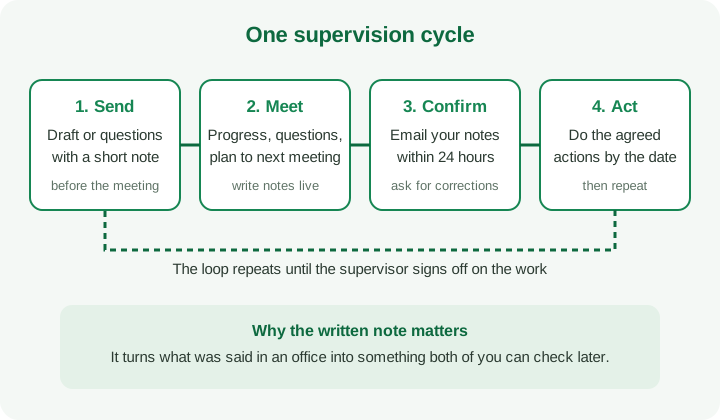
Write notes during the meeting, then send them back the same day or the next. This is the single habit that prevents most supervisor misunderstandings. SDU, a Danish university, suggests agreeing the formalities for meetings (notice, agenda, minutes and the materials to send beforehand), and describes writing agreed minutes at the end of each meeting so that the next one builds on them (SDU, matching expectations). That guidance is aimed at doctoral students, but the principle is simple and works at any level.
A meeting notes template
Keep each meeting to one page:
- Date, time, place and who was there.
- What I reported: two or three lines on progress.
- What was decided: each decision as a short sentence.
- Actions: who does what, by which date.
- Next meeting: date, or "to be agreed by [date]".
A follow-up email template (fictional example)
The names and details below are invented. Replace them with your own.
Subject: Notes from our meeting on Tuesday, project topic (Adaeze Okafor, 20/XXXX)
Good afternoon, sir.
Thank you for your time today. I want to confirm what we agreed so I do not misunderstand anything.
- You advised me to narrow my topic to one department rather than the whole faculty.
- You asked me to send a one-page proposal with the problem statement and objectives by Friday, 6 November.
- You suggested I read the department handbook section on project format before our next meeting.
- Our next meeting will be next Tuesday at 10 a.m. in your office.
Please tell me if I have recorded anything incorrectly. Thank you, sir.
Adaeze Okafor
Three points on tone. Be brief. State the facts and the deadline, not your feelings about them. And give your supervisor an easy way to correct you, because you want a corrected record rather than a polite silence.
How often and how should you send drafts?
Ask your supervisor, and then follow the answer. The University of Reading guide mentioned above says students should agree a meeting schedule, that supervisors reply to emails within about two days, and that they prefer feedback requests on small pieces such as a paragraph, a figure or a plan, with repeated rounds on the same section discouraged. Those are one university's expectations. A Nigerian supervisor may prefer a full chapter at a time, or weekly short visits. What matters is that you ask and agree.
A routine that works for most projects:
- Send before you meet. Give the supervisor time to read. Do not hand over fifty pages at the door.
- Send a complete unit. A chapter, a section, or a plan with headings. Half-finished fragments get half-useful comments.
- Include a covering note with three things: what is attached, what changed since last time, and your most important questions. Targeted questions get better answers than "please check".
- Name files clearly, for example
Project_Ch1_v3_2026-11-04.docx. A new number for each version means you can always say which one your supervisor saw. - Do not resend the same section unchanged. If the supervisor has commented, fix the points first.
A covering note can be short:
Good morning, sir. Attached is Chapter 1 (v2). Since last time I narrowed the objectives from four to three as you advised and added the scope. Two questions: is the problem statement specific enough, and should the significance section be shorter? I am available on Thursday if you would like to discuss.
To plan the writing itself, how to write a final year project step by step gives a chapter order that helps you decide what to send first. Keep copies of everything you send and receive; your own folder and email trail are your safest record.
What if your supervisor is not available?
Supervisors are busy, sometimes travelling, sometimes on leave, and in some years affected by strikes or other disruption. A slow reply is not necessarily neglect. But your deadline does not stop, so protect yourself calmly and in order.
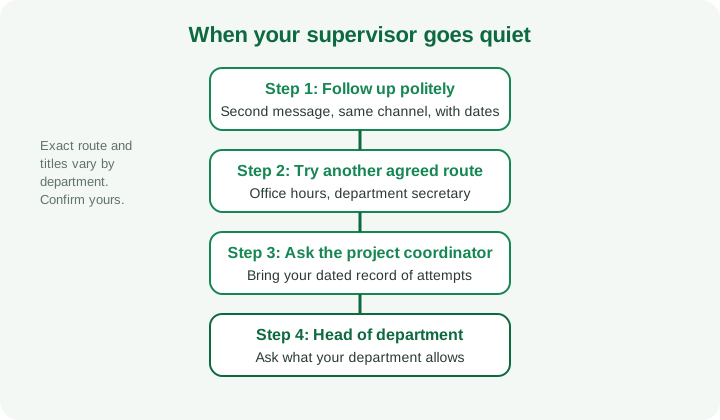
- Follow up once, politely. Reply on the same channel with the date of your earlier message and a single clear question. "Good morning, sir. I am following up on my message of 12 November about the proposal. Please let me know when I can see you."
- Use any other route you agreed: office hours, the department secretary, or a note left at the office. Ask in your first meeting which routes the supervisor prefers so this is not awkward later.
- Keep a dated record of every attempt: date, channel, what you asked. It is not for blaming anyone. It lets the department see that you acted responsibly.
- Ask the project coordinator or head of department what happens when a supervisor is unavailable. Do not arrange a replacement by yourself.
I could not find a published Nigerian rule that applies to every university, and the route clearly varies by department. One example from outside Nigeria: Newcastle University's enquiry page says that if a supervisor does not attend a scheduled project meeting because of industrial action, the student should keep a record and tell the Head of School, who then assesses the impact (Newcastle University Student Enquiries). Use that as a reminder to keep a record and go to the person responsible, not as your department's procedure. Ask what yours is.
While you wait, keep working. Read, collect sources, draft the parts that do not depend on the missing decision, and write down the questions you will ask. Do not change your objectives or method on your own to "save time" and then present it as approved. If your department has a handbook that names a co-supervisor or an alternate, follow it.
What does a professional tone look like?
You are asking an experienced person for scarce time, so make it easy for them to help.
- Address them correctly: by title and name, as your department expects.
- Use a clear subject line: topic, your name and matric number.
- Write short messages with one request each. Avoid long voice notes for decisions; follow up with text so there is a record.
- Respect the agreed channels and hours. If the supervisor prefers email, do not send ten WhatsApp messages at night.
- Be on time, and if you will be late, say so in advance.
- Accept criticism without argument in the meeting. Ask a clarifying question, thank them, and think before you respond. If you disagree, bring evidence later and ask for a short discussion.
- Do not promise what you cannot deliver. A realistic date you keep is worth more than an ambitious one you miss.
- Do not go around your supervisor. If you have a concern, raise it with them first; if it cannot be resolved, use the department's route.
When a long list of comments comes back on a draft, that is a different stage: managing final year project supervisor corrections shows how to triage and answer them.
Common mistakes in the supervisor relationship
| Mistake | What goes wrong | Better |
|---|---|---|
| Disappearing for weeks, then arriving with a full draft | The supervisor cannot steer early, and big problems surface late | Send small, regular pieces |
| Relying on verbal approvals | Later disagreement about what was agreed | Confirm in writing the same day |
| Changing the topic or method silently | The supervisor reviews something different from what they approved | Ask before any change |
| Sending the same unchanged section repeatedly | Feedback stops being useful | Fix the comments, then resend |
| Chasing too often | Irritates a busy person | One follow-up, then escalate through the department |
| Asking for a signature on unfinished work | May compromise the approval record | Ask what the department allows |
| Treating the supervisor as a ghostwriter | The work is no longer yours | Bring your own drafts and questions |
Questions your supervisor may ask you
Supervisors often test whether you understand your own work. Expect questions such as:
- What problem are you solving, and why does it matter?
- Why did you choose this method?
- What have you read that supports your approach?
- Where will your evidence come from, and can you access it?
- What will you have by our next meeting?
Prepare an honest answer to each. The same habits help later at the defence, where a panel asks similar questions; see common project defence questions to rehearse.
A realistic timeline to propose
Offer your supervisor a simple plan and ask them to adjust it. This is an illustrative skeleton, not a department calendar; your department's dates always win.
| Stage | What you send or bring | What you want from the supervisor |
|---|---|---|
| First meeting | Topic idea, questions | Direction, expectations, communication rules |
| Proposal | One-page or full proposal | Written approval or required changes |
| Early chapters | Introduction and literature plan | Feedback on scope and structure |
| Method | Method and instruments | Approval before you collect data |
| Results | Real data and tables | Check that claims match the evidence |
| Full draft | Complete document | Comments and readiness for submission |
| Pre-defence | Presentation outline | Practice questions |
Notice that method approval comes before data collection. Changing a method after you have collected data is much harder than changing it on paper.
Where UniDraft fits
UniDraft is for the writing part of the process. You give it your confirmed topic, your real results, checked sources and your supervisor's instructions, and it organises them into an editable Word document you can take back to your supervisor. You review everything, you confirm what is true, and your supervisor still decides whether the work is ready. For an extra check on your references, the free citation finder can help you locate real sources, which you should still open and read.
If you are ready to build your document, start your project document.