AI and academic integrity come down to honesty about who did the thinking. In general, using AI to understand ideas or check your own grammar is more widely accepted than using it to produce findings, sources or whole sections. Rules differ by institution, so confirm with your supervisor and department, and disclose any help they ask you to disclose.
UniDraft takes the same position. It organises the work you have confirmed, the sources you have checked and your supervisor's instructions into an editable Word document, and the facts stay yours. If your department allows that kind of help, start your project document and keep a note of what you supplied and what you changed. UniDraft makes no promise about detectors, approval or grades.
This guide is not about getting past a detector. For that question, read why a detector score alone proves little. If you want to compare tool types by task, see general AI tools compared with UniDraft's workflow. Here the focus is narrower: what is generally acceptable, what is not, and what a careful Nigerian student should do before, during and after using AI.
What does "academic integrity" mean when AI is involved?
Academic integrity is the expectation that the work you submit is honestly yours, that you credit what you took from others, and that anything you present as evidence really exists. AI adds one new question to an old list: how much of the thinking, writing or finding was done by something other than you, and did you say so when you were supposed to?
Three older principles still do most of the work:
- Authorship. Work submitted under your name should be work you can explain, defend and, if asked, reproduce.
- Attribution. Ideas, wording and data from others are credited. AI help is increasingly treated as something to acknowledge too, where the rules ask for it.
- Truthfulness. Results, activities, participants, references and approvals must be real. A tidy invented number is still fabrication.
A fourth idea matters especially for Nigerian final-year, seminar and SIWES work: the evidence belongs to you. Your questionnaire responses, lab readings, logbook entries and workplace experience cannot be supplied by a language model. A tool can help you phrase them. It cannot have them.
Is there a Nigerian rule on AI use?
Do not assume one rule covers everyone. Searches run for this guide found commentary saying Nigeria has no single binding national rule on AI in coursework and that many universities have yet to publish clear student guidance. That commentary came from secondary news and guide pages, and the search did not turn up the text of a specific Nigerian university's student AI policy, so treat it as a reason to check, not as settled fact.
What that means in practice:
- Look for a written statement from your university, faculty or department: a student handbook section, an academic misconduct policy, a project guideline or a notice.
- If there is none, your supervisor's instruction is the working rule for your project, and it outranks general advice from anyone online, including this guide.
- If nothing is written anywhere, ask and keep the answer. Unacknowledged AI-produced work is commonly handled under existing plagiarism and misconduct provisions, so "no AI policy" is not the same as "no consequences".
Your own institution's wording always wins over any example in this article.
What do real policies say? Four examples (not Nigerian rules)
The policies below were opened for this guide. They come from other countries and are named only to show the pattern. They are not Nigerian rules and do not apply to your university.
| Source | What it says (summarised) | Pattern for you |
|---|---|---|
| UT Dallas, university generative AI policy | Faculty decide whether AI is permitted, prohibited or partly allowed, and must explain it before work begins. Students must verify AI output and document and attribute any AI use in the citation style the instructor requires. Prohibited use is a conduct violation. | The instructor's written rule decides; you verify and attribute. |
| Regis University, student use of generative AI | Course or supervisor rules override the general policy. Students should not paste AI output directly into coursework, must edit it and treat it as a non-primary source, and may be required to say which parts came from AI. Users are responsible for inaccuracy and other harms. | Supervisor rules first; AI output is a source to check, not a finished answer. |
| COPE position on authorship and AI tools (as summarised by EDP Sciences, a COPE member) | AI tools cannot be listed as authors because they cannot take responsibility for the work. Authors must be open about whether and how they used AI and remain fully responsible for the content. | You are accountable for every sentence, whoever or whatever drafted it. |
| Journal of Forensic Sciences statement on AI | AI cannot be an author. Use in developing a manuscript must be described transparently in the methods or acknowledgements. Tools used only for spelling, grammar and general editing fall outside the statement, with some English-improvement uses permitted if declared. Wholly or partly AI-generated manuscripts are rejected. | Even a journal that is relaxed about grammar tools forbids AI-generated content. |
Notice the shared shape. The decision sits with the person who sets the assignment, disclosure is expected where AI is used, the human stays responsible, and checking comes before trusting. The details differ, and they will differ again at your own university.
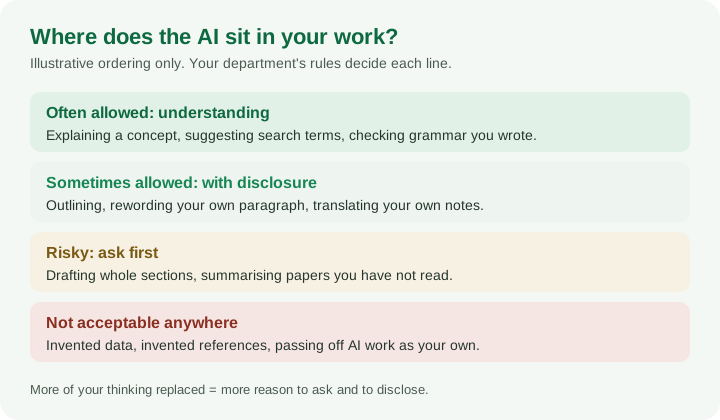
What is generally acceptable, and what is not?
There is no universal list, but the examples above and ordinary academic practice point in a consistent direction. Use this as a starting map, then confirm each line with your supervisor.
Usually the safest uses
- Asking for a plain-language explanation of a concept you are trying to understand, then checking it in a textbook or paper.
- Generating search terms or questions to ask your supervisor.
- Checking grammar, spelling and clarity of text you wrote, and keeping your meaning intact.
- Explaining an error message or a statistics output you produced yourself, so you can interpret it.
Use only if your rules allow it, and usually with disclosure
- Suggesting an outline or heading order that you then change to fit your brief.
- Rewording a paragraph you wrote, when your department permits paraphrasing help.
- Translating your own notes.
- Drafting passages from material you supplied, which you then rewrite and verify line by line.
Do not do this in any case
- Inventing or "estimating" data, survey responses, interview quotes, test results or workplace activities.
- Using references you have not opened, including ones an AI tool supplied.
- Letting a tool write the analysis of results it has never seen, or the discussion of findings you do not have.
- Submitting text you cannot explain and calling it entirely your own work.
- Uploading confidential workplace material or participant data to an online tool without clearance. See research ethics and consent for student projects.
The middle group is where students get hurt, because the answer really is "it depends". That is exactly when a one-line message to your supervisor helps.
Your own findings and claims stay yours
The strongest integrity rule for a Nigerian student is simple: every claim in your report should trace back to something you did, observed, measured, read or were told. AI can change how a sentence sounds. It cannot change where the claim came from.
Here is a fictional illustration. A student on a hypothetical SIWES placement at a small printing business keeps a logbook. She asks an AI tool to help describe her week.
- Prompt without evidence: "Write a paragraph about what an intern learns about colour calibration at a print shop." The tool returns fluent, generic text, possibly describing tasks she never did. Using it would put activities in her report that did not happen.
- Prompt with evidence: she pastes her own logbook line ("Tuesday: watched supervisor calibrate the large-format printer with a test strip; I recorded the settings used") and asks for clearer wording. The facts are hers, the sentence is cleaner, and she reads it to confirm it says nothing she did not do.
The second approach is what her department would most likely call acceptable, subject to its rules. Even so, she would check whether she must declare the wording help. The same logic applies to final-year projects: your questionnaire, your readings, your code and your interviews are the evidence. For help turning those into prose without drifting from them, see writing the results chapter from your own evidence.
Never fabricate citations
This is the single most common AI-related integrity failure in student writing, so it gets its own section. Language models can produce a reference that has a plausible author list, a believable journal title and a convincing year, yet points to no real article. Students then copy it into a literature review.
A real source passes four tests:
- You can find it in a library, publisher page, repository or database.
- The authors, year, title and journal match what you wrote.
- You have read at least the abstract and the passage that supports your claim.
- The claim in your report is what the source actually says, not what the tool said it says.
If any test fails, remove the reference and the claim that depended on it. The citation finder is one way to locate real papers, and how to find research papers covers search habits. A search result is a lead. Reading is what makes it a source, and how to read a research paper shows how to do that quickly.
Wrong paraphrasing is a separate risk: a reworded passage that still follows the original closely can be treated as plagiarism whether a tool or you did the rewording. Read how to paraphrase without plagiarising and, for what similarity reports do and do not show, plagiarism and similarity reports for final-year projects.
Should you disclose AI use?
If your institution or supervisor asks for disclosure, yes, and be accurate. If they have said nothing, asking is better than guessing. The policies above lean toward transparency: UT Dallas expects students to document and attribute AI use as instructed, Regis lets instructors require students to show which parts came from AI and which tool, and COPE-style publisher rules expect authors to be open about whether and how AI was used.
A plain disclosure is short and factual. A fictional wording you could adapt only if your rules permit the use:
"I used an AI writing assistant to suggest clearer wording for paragraphs I wrote in Section 2.3. I checked every sentence against my notes and sources, and I take responsibility for the content."
Include what the tool did, where, and what you checked. Do not claim less than you did, and do not invent a more impressive process. If the department gives a form or a required sentence, use theirs.
How do you ask your supervisor about AI?
Many students avoid the question because they fear it sounds like an admission. It does not. A supervisor would rather answer a clear question than discover a surprise at the defence. Keep it specific and keep the reply (message or email).
A short message you can adapt:
"Good afternoon, sir/ma. Before I continue with Chapter 2, may I ask what use of AI tools is acceptable in this project? For example: understanding concepts, grammar checking my own text, suggesting an outline. Is a disclosure statement needed, and where should it go? I will keep to whatever you advise."
When corrections come back, keep the record organised so you can show what you changed and why; handling supervisor corrections walks through a practical way to do this.
What can you say at your defence?
Integrity shows up live. Panels often probe whether you understand your own report, and you cannot defend text you did not understand.
Be ready for questions like these, and practise answering without notes:
- Why did you choose this method, and what else could you have used?
- Where did this number come from, and how was it collected?
- What does this reference say, and why did you cite it here?
- What would change in your results if the sample were different?
- Did you use any tools to help with the writing, and how did you check them?
If you can answer all five calmly, you are in a strong position whatever tools were involved. If you cannot, the fix is to go back to your evidence, not to polish the wording.
A five-check routine before submission
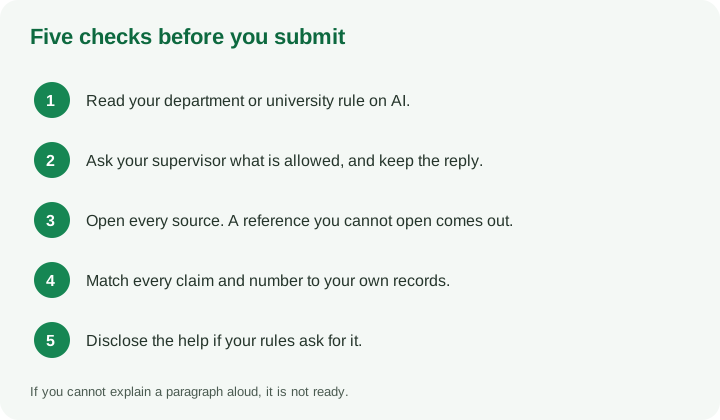
- Rule. Re-read your department's or university's current position on AI, and any instruction in your project brief.
- Supervisor. Confirm what you did is covered by what they told you, and that you have the reply saved.
- Sources. Open every reference. Delete any you cannot find or confirm.
- Claims. Match each result, date, name and number to your own records. Keep the original data separate from the cleaned version.
- Disclosure. Add the statement if required, worded accurately.
Then read the whole document once as a stranger would, including tables and appendices, and check the layout separately with the free formatting checker. A tidy layout says nothing about whether the work is honest or permitted.
Common mistakes to avoid
- Treating "everyone does it" as permission.
- Assuming a grammar tool and a drafting tool are the same thing for disclosure purposes. Your rules may treat them differently.
- Pasting a chapter into a tool and submitting what comes back with only light edits.
- Keeping references you cannot open because they "look right".
- Deleting evidence of tool use after the fact. If a concern arises, accurate records help you; hidden ones do not.
- Sharing participant details or a company's internal documents with an online tool.
- Believing a detector score, high or low, settles anything about integrity.
Where UniDraft fits
UniDraft is built for students who already have their work and need it presented as a proper document. You choose the document type and institution, supply the work and guidelines you have confirmed, and it organises your confirmed work, checked sources and supervisor instructions into an editable Word document. Whether any AI-assisted step is acceptable for your project is a question for your department, and the answers in this guide apply to UniDraft as much as to any other tool.
If your rules permit it, start your document with UniDraft, review every line against your own records, and disclose as required. UniDraft does not claim to avoid or beat AI detectors, and it cannot promise approval or any grade.
Sources
Policies and statements opened for this guide. They are examples from other jurisdictions and publishers, not Nigerian rules. Policies change, so check the current versions.