An agriculture SIWES report should explain the farm, plant or office work you actually went through: where you trained, the unit you were attached to, what you saw and did day by day, the quantities and records involved, the hazards you met, and what you learnt. It must trace back to your dated logbook. Use your real dates, authorised records and honest role instead of borrowing activities from a sample report.
Your institution's SIWES guide and your supervisors set the chapter order, layout and evidence rules. Start from the general SIWES report guide and use this article for the agriculture-specific parts: what to record, how to describe farm and laboratory work, and how to deal with safety.
Your farm or laboratory records should become a report you can explain and check. UniDraft helps organise the placement facts, quantities and guidelines you confirm into an editable SIWES document. Start your agriculture SIWES report, then check the draft against your logbook and permitted evidence. You supply the real work and safety observations; the software does not perform training or grant approval.
The short answer
- Keep a dated farm or lab record from week one: date, place, task, input, quantity with its unit, who did it, and the result.
- Label every task observed, assisted or performed under supervision and keep that label identical in the logbook, the report and your defence.
- Quantities belong only where they come from real measurements, authorised records or clearly attributed information from the responsible person. State the source and unit; otherwise describe the process without numbers.
- Describe relevant safety steps you actually saw or followed, plus genuine gaps or uncertainty. Do not invent a control to fill a checklist.
- Your department's approved template beats any outline you read online, including this one.
What SIWES is, so your introduction is accurate
The Industrial Training Fund (ITF) describes SIWES as a skills training programme that prepares students of universities, polytechnics, colleges of technology, colleges of agriculture and colleges of education for the work situation they are likely to meet after graduation. Its stated objectives include giving students industrial skills and experience in their course of study and helping them apply theory in real work. In its published guidance, the ITF says students record training activities in a logbook that is vetted and signed by the institution's supervisor and the industry-based supervisor. See the official ITF SIWES guidance, including sections 2.6 and 4.6. Confirm your institution's current recording and endorsement process.
Do not claim in your report that your programme is funded or approved in a particular way unless your SIWES office told you so. Confirm eligibility, funding and required processes with your institution; do not infer them from a generic report example. If you want the basics first, read what SIWES is.
Build the report from agricultural records
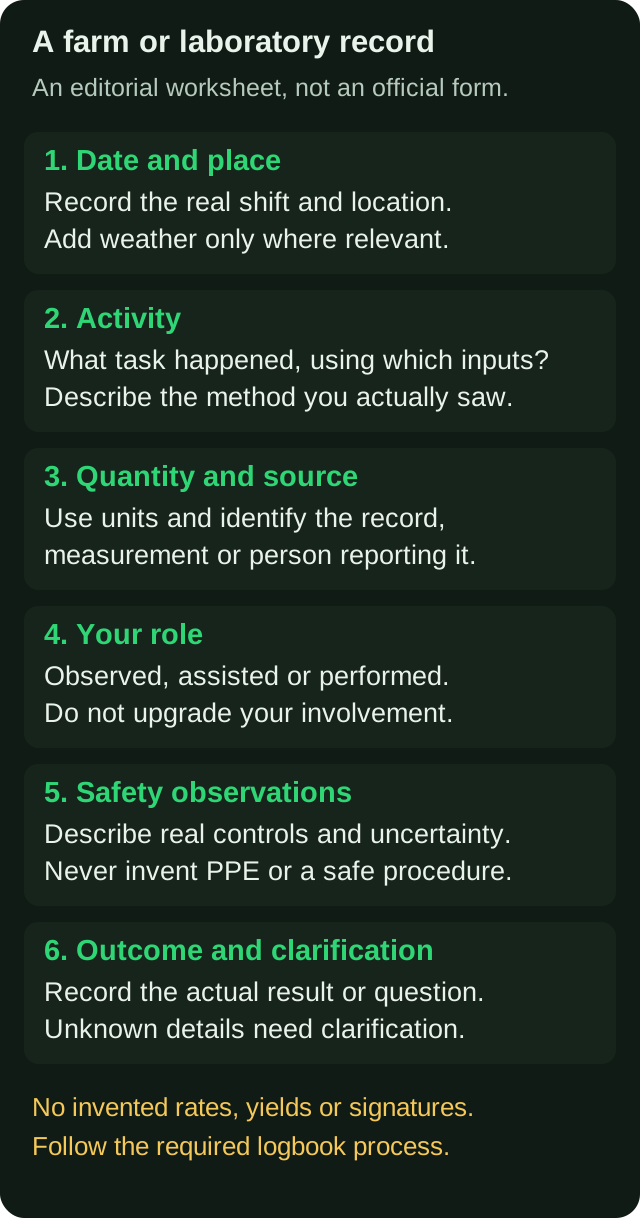
On a farm or in a processing plant, almost everything is a record: a feed register, a vaccination or treatment card, a spraying schedule, a planting date, a harvest weight, a batch number. Use a dated working notebook to record the activities you actually observed or performed, alongside the official logbook. The worksheet below is an editorial suggestion, not an institutional form.
Take that habit into your placement. A plain notebook that lives in your pocket beats memory every time, and it is the raw material for the formal logbook. If you are unsure how entries should look, how to fill your SIWES logbook covers the weekly routine.
What to record every week
Use the same pattern for every entry. Add the details your unit actually deals with.
All placements
- Date, shift, location (pen, pond, block, plot, line, laboratory bench).
- Task and method, in the order it happened.
- Inputs: feed type, drug name, fertiliser, seed variety, chemical, packaging material. Copy names from the label or delivery note, not from memory.
- Quantity with its unit, and whether you measured it, read it from a register or were told it.
- Who did the work, and your role: observed, assisted or performed.
- The safety step taken and any incident or near miss.
- Supervisor review and endorsement according to the required institutional process; never add someone else's signature yourself.
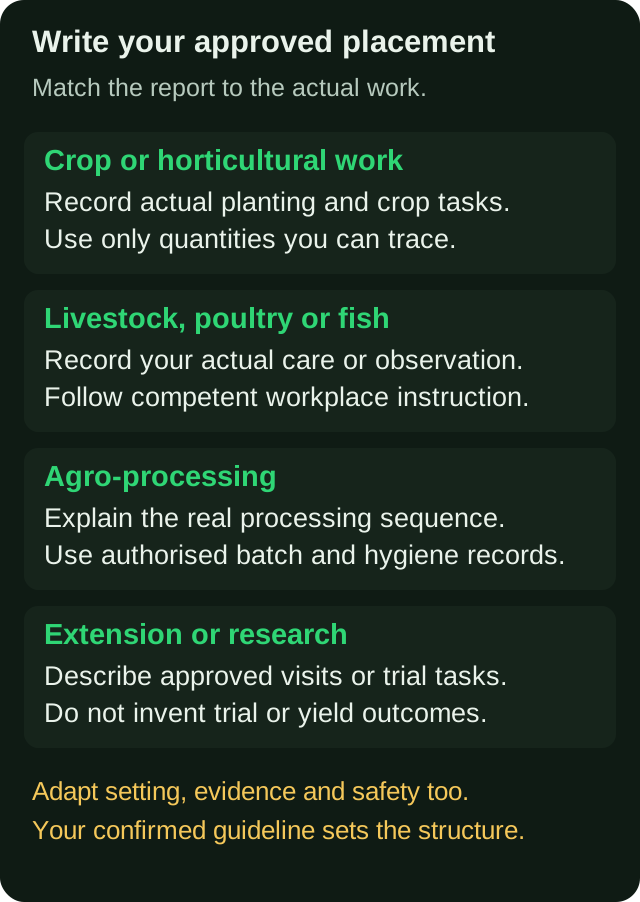
Crop and horticulture units also note land preparation method, plot or bed size, planting date and spacing, seed or seedling source, weeding dates, irrigation, pest or disease signs, harvest date and recorded weight.
Livestock, poultry and fish units also note house, pen or pond identity, number of animals at the start of the day if you were told or counted, feed and water routine, health observations, mortality records, treatments given by the responsible person, and cleaning or disinfection steps.
Agro-processing units also note raw material received, batch or lot number, processing steps, equipment, hygiene checks, packaging and storage, and quality checks you saw.
Extension agencies and research institutes also note field visits, farmers or communities met, demonstrations, trial layouts, data sheets, laboratory analyses, meetings and reports prepared. If your institution approved a research or extension placement, write about its actual trial or visit rather than a farm you never worked on.
A sample logbook entry table
The table is a made-up illustration of format. It describes no real farm. Use it for layout, never for content.
| Date | Unit and place | Activity and input | Quantity and source | My role | Safety step |
|---|---|---|---|---|---|
| Mon, illustrative | Layer house 2 | Morning feeding, feed bags from store | Quantity written in feed register by the attendant; I copied it | Assisted | Boots, face mask, washed hands after |
| Tue, illustrative | Maize plot B | Weeding between rows with hoe | Plot size told by the farm manager; not measured by me | Performed under supervision | Gloves, long sleeves, water break |
| Wed, illustrative | Processing room | Sorting and weighing dried cassava chips | Weights read off the scale by me and entered in the batch sheet | Performed | Hairnet, apron, clean hands |
| Thu, illustrative | Fish ponds | Water-quality checks | Instrument reading taken by the technician; I recorded the value | Observed and recorded | Handwashing, no wading alone |
| Fri, illustrative | Extension office | Farmer group visit | Number of attendees from the sign-in sheet | Observed | Travelled with the agent, sunscreen |
Notice the "source" column. It forces you to separate what you measured from what you were told, so the reader can understand the evidence behind each quantity.
A working chapter outline for the report
Some departments use four chapters, some five, and colleges of agriculture often have their own layout. Treat this as a starting point.
Preliminary pages. Title page, certification, declaration, acknowledgements, abstract if required, contents and lists of tables and figures. Do not add a supervisor's signature or stamp you have not received. If your front matter needs Roman then Arabic page numbers, use the page-numbering walkthrough for Word.
Chapter 1: Introduction. The approved SIWES period, the host organisation, your unit, the objectives of the scheme as your institution states them, and the scope of the report. One short paragraph on the organisation's work is enough.
Chapter 2: Organisation and setting. Location, size where you were told it, enterprises (for example crop production, a hatchery, a feed mill, a processing line, a research programme), staff structure as it existed, and where your unit sits. Draw the real structure, not a textbook organogram.
Chapter 3: Training activities. Give the actual work enough detail for a reader to understand your role. Group your logbook entries into processes and describe each one using the same pattern: purpose, sequence, inputs and equipment, quantities and records, safety step, your role and what you learnt. A few examples of how that reads in different units follow below.
Chapter 4: Challenges, skills gained, conclusion and recommendations. Name real problems, such as irregular water supply, pest outbreaks, equipment breakdown or poor storage, and say what the team did. Recommendations should follow from what you saw and be addressed to the right party, whether that is the host, your department or the SIWES office.
References and appendices. Cite any manual, standard or textbook you quoted. The free citation finder helps you find real sources instead of guessing details. Appendices can hold blank record sheets or approved photographs.
Writing the activities so they read as agriculture
Crop work
Describe the stage you saw (nursery, land preparation, transplanting, weeding, fertiliser application, harvesting, drying, storage). Give the plot or bed identity, the date, the tool or machine used, and any dimension or rate only if you have the record. If a fertiliser was applied, write the product name from the bag label, say who calculated the rate, and say whether you applied it yourself. Mention the weather or soil condition if it affected the work, because that shows you were really there.
Livestock, poultry and fish
Describe the housing or pond, how animals were fed and watered, how health was monitored and what the attendant looked for. If a vaccination or treatment was given, say who gave it, what product was used as read from the label or card, and your role. A student who only held birds or recorded the date should say exactly that. The FAO-hosted 2007 report on small-scale poultry biosecurity in Kenya provides contextual reading on poultry production and disease prevention. It is not a Nigerian institutional protocol or a substitute for competent veterinary or workplace instructions. In your report, describe the separation, cleaning, visitor controls or other procedures you actually observed; do not infer safe chemical use or treatment doses from this writing guide.
Agro-processing
Trace a product from reception to dispatch: raw material quality checks, cleaning, processing steps, packaging, labelling, storage. Quote batch sheets and weights only from records you saw. Hygiene is part of the technical content here, so describe protective clothing, handwashing, cleaning of equipment and pest control as steps in the process.
Extension and research placements
Describe the field visit or trial in order: the purpose, who attended, what was demonstrated or measured, the data sheet or form used, and what you wrote up. If you helped enter data into a spreadsheet, say so and say who checked it. Do not invent results. A trial you only helped lay out has no yield results for you to report.
A short illustrative paragraph
This is invented to show the pattern. It describes no real student or farm.
Illustrative only. During the second week I was attached to the layer unit. In the morning I assisted the attendant with feeding by carrying feed from the store and writing the quantity he read from the feed register into my notebook. I did not measure the quantity myself. Before entering the house I put on boots and a face mask and washed my hands at the entrance, as the supervisor required. I observed him collect eggs and record the day's count on the sheet; I did not handle the vaccination that week. What I learnt was that small records, kept every day, are how a farm notices a problem early.
It states the role plainly, separates measured from reported, includes a safety step, and ends with a lesson.
Safety: write what you actually saw
Agricultural work carries real hazards. The UK Health and Safety Executive (HSE) lists on its agriculture page topics such as vehicles, machinery, work at height, electricity, manual handling, noise, dust and disease. Its livestock handling guidance warns that handling cattle always carries a risk of injury and stresses suitable facilities, trained workers and proper restraint equipment. These are UK documents, so use them as a benchmark to compare with your own site, not as proof of what Nigerian regulations require.
Turn that into specifics from your placement:
- Personal protection. Boots, gloves, masks, aprons, hairnets, long sleeves, eye or ear protection as the task needed.
- Chemicals. Whether labels were read and followed, how pesticides, drugs and disinfectants were stored, who was allowed to handle them, and what was done with empty containers. If you only watched spraying, say so and do not describe application rates you were not given.
- Animals. How animals were restrained or moved, and whether you were allowed near them unsupervised.
- Machines and tools. Who operated tractors, mills, choppers or sprayers, and what guards or switches you saw.
- Hygiene and illness. Handwashing, footbaths, changing clothes, and what happened if someone was hurt or unwell.
- Your conduct. Whether you were inducted, what you were allowed to touch, and who watched over you.
Explain a real safety observation with its context rather than copying a generic safety paragraph. If you did not observe a procedure or do not know why it was used, say so and seek clarification.
Common mistakes
| Mistake | Why it fails | Fix |
|---|---|---|
| Copying feed rates, spacing or yields from a sample | The panel asks where you saw the number | Use only values from your records, or describe the process without numbers |
| "I vaccinated the birds" when you only held them | Inflated role | Write exactly what you did |
| Describing activities from another unit | Contradicts the logbook | Match every activity to a dated entry |
| Photographs with no explanation | Reads as padding | Caption, refer to each in the text, say what it shows |
| Long organisation history | Not your training | Follow the assigned length and retain focus on your training |
| Generic safety paragraph | Does not explain the actual site or task | Describe real relevant controls, gaps and uncertainty |
| Writing results from a trial you only helped plant | You have no results | Report your tasks and learning, not the outcome you did not see |
Defence questions to prepare for
Use these practice questions to rehearse explanations grounded in your own logbook. How to defend your SIWES report explains how to answer without bluffing. Typical examples:
- Which unit were you attached to and what did you do in a normal week?
- Where did that quantity or date come from? Did you measure it?
- Why was that step done (for example, why is the footbath at the entrance, or why is a label read before mixing)?
- What went wrong, and how did the farm respond?
- What would you do differently, and what did you not get to see?
- Which part of the report was observed, and which did you perform?
If you do not know, say so and describe what you did observe. Do not fill a gap in your knowledge with an invented explanation. How marks are split between the logbook, the industry supervisor and the report differs by institution, so check how SIWES is graded and your own handbook.
Plan writing around your actual deadline
Adapt this sequence to your actual deadline and required review process; the suggested weeks below are not institutional rules.
- During the placement: update your notebook daily, ask permission before taking photographs, and keep a list of figures you still need to confirm.
- While records can be checked: ask the industry supervisor to clarify dates, unit names and figures reported to you. Obtain endorsements on the required schedule.
- First week back: draft the activities chapter while memory is fresh.
- Second week: write the other chapters, lists of figures and tables, and references.
- Before submission: run through the submission checklist for IT reports and send the draft to your supervisor. If corrections come back, managing IT and SIWES report corrections explains how to keep versions straight.
Still looking for a place? How to find a SIWES placement covers the search.
Engineering students can compare structure in the civil engineering SIWES guide. Many students also confuse the report with the SIWES form, and what SIWES Form 8 is explains the difference.
Pre-submission checklist
- Every activity matches a dated logbook entry and carries an observed, assisted or performed label.
- Every number is on a record you can produce, or is marked as reported to you.
- Each figure and photograph is numbered, captioned, permitted and discussed in the text.
- Relevant safety controls, gaps and uncertainty are described from actual observations.
- Chapter order, headings and length match your approved guide.
- Font, spacing and margins follow your institution's rules. The free formatting checker reads a .docx and flags mismatches, and the format directory lists university rules.
- No signature or approval appears that you have not actually received.
When the body is done, how to write the SIWES report conclusion and recommendations shows how to close it without generic wording. Students in laboratory-based agriculture placements may also find the laboratory science guide useful.
If you are separately preparing a literature seminar on crop losses, the Agriculture seminar question guide helps distinguish published evidence from your own placement observations. Keep the seminar sources and your SIWES activity record clearly identified.
Where UniDraft fits in
UniDraft builds the written IT/SIWES report as an editable Word (.docx) document from the placement facts you confirm. Supervisor instructions and student-confirmed guidelines take priority over general departmental and university patterns. Check every activity, quantity, reference and result against your real records. UniDraft does not fill your official logbook or Form 8, supply approvals or produce slides. If your supervisor sends corrections, you provide them, confirm the changes, and a new version is created while earlier versions are kept. You still supply the real farm or lab details, because those are what you will be asked about at your defence.
Sources
ITF: SIWES guidance: training objectives, records and supervisor responsibilities.
FAO-hosted report: poultry biosecurity in Kenya, 2007: contextual poultry-production and disease-prevention reading, not Nigerian institutional rules.
HSE: agriculture: hazard categories on farms.
HSE: livestock handling: safe handling of cattle and facilities.