If you are a NOUN student, your SIWES report is written the same way as everyone else's, by describing the training activities you actually did, in dated order, with your honest role in each. What differs is the administration around it: NOUN is an open and distance learning university, so you deal with a central SIWES Directorate and a study-centre desk officer, not with a department two buildings away. This article separates what NOUN publishes about SIWES from what you must still confirm locally, and then shows you how to build a report from the training itself.
Every claim about NOUN's arrangement below comes from a NOUN page we opened, and anything we could not verify is flagged as something to ask. For the writing mechanics that apply everywhere, keep the general SIWES report guide open beside this one.
The short answer
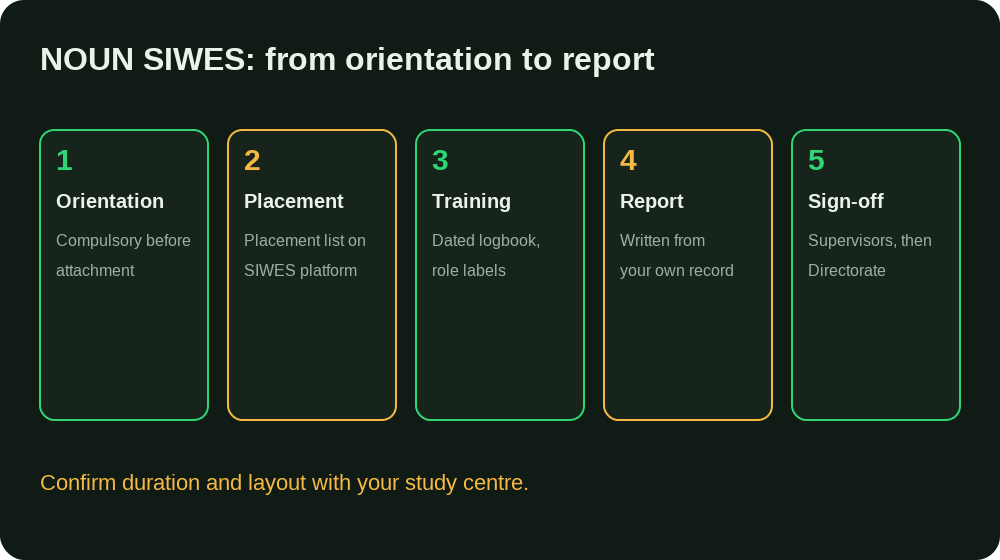
- Check whether SIWES applies to your programme. NOUN says it is part of the approved minimum academic standards for some degree programmes, not necessarily all.
- Attend the compulsory orientation before you start the attachment.
- Your placement list is generated on NOUN's SIWES platform, and your study-centre SIWES desk officer is your first contact.
- Keep a dated logbook from day one and a role label (observed, assisted, performed under supervision) on every task.
- NOUN's published pages do not give a duration, a report layout or a grading scheme. Ask for the official guide instead of trusting a number from a forum.
Writing it up with UniDraft. Once your training is done, UniDraft builds your written SIWES report as an editable Word document from the placement details you confirm, your supervisor's instructions and your school's format, applied in that order of priority. You supply the real activities from your logbook and it handles the structure and formatting. Start your SIWES report with UniDraft
What NOUN itself says about SIWES
Here is what we could confirm from NOUN pages we opened, with the date where it matters.
- Where it applies. NOUN's SIWES page says SIWES is part of the approved Benchmark for Minimum Academic Standards for some degree programmes, and that it targets fields such as engineering, science, agriculture and technology. The page does not list the courses.
- Orientation is compulsory. The same page says attendance at the orientation is compulsory for students before they undertake industrial attachment.
- Placement. The SIWES Directorate identifies placement opportunities, and the SIWES platform produces a placement list showing where each student has been accepted. Study-centre SIWES desk officers guide students through the process, and the Directorate submits master and placement lists to the coordinating agencies, the NUC and the ITF.
- Logbook and report. The Directorate processes students' logbooks and reports after SIWES is completed. The page gives no format.
- Stipend. The page says the ITF pays a stipend to students who successfully complete SIWES in certain funded programmes, and names B.Sc. Computer Science, B.Sc. Agricultural Sciences and B.Sc. (Ed.) Business Education. Whether your programme is funded is a question for your desk officer.
- Why it matters. At a 2022 orientation reported by NOUN News, an ITF representative called SIWES a "sine-qua-non" for the award of certificates and diplomas, told students they would be closely monitored, said defaulters would retake the course, and urged them to choose placements relevant to their studies and to acquire real skills rather than run errands.
- Orientation content. In August 2026, NOUN News reported an ITF briefing for NOUN students at the Port Harcourt Study Centre on the programme's objectives, requirements and expectations, procedures and student responsibilities.
- Monitoring. A July 2026 NOUN News report describes the SIWES Directorate visiting 29 organisations in Port Harcourt to check that students were placed in relevant organisations and engaged in meaningful training.
What we could not find on NOUN's pages: the duration of the attachment, the assessment scheme, the report chapter layout, and whether a student's existing employer can serve as the placement. We have left those out on purpose. Put them to your desk officer, and write the answers into your own planning notes with the date.
What this means for a distance learner
An open-university student usually has a different life from a campus student, and the report should reflect the training, not the circumstances. Three practical differences are worth planning for.
- Distance from your supervisors. Your academic contact may be at a study centre or in the Directorate rather than in a department you see weekly. Agree early how and when your logbook is reviewed, and keep a copy of every dated entry.
- Placement search is your responsibility to start. The platform generates the list of accepted placements, but you still need an organisation willing to take you. The placement guide covers approaching organisations, and the application letter guide covers the letter.
- Time and records. If you juggle work or family, the one thing you cannot reconstruct later is the record. A short entry written each evening is worth more than a polished one written in a rush months afterwards.
Before you start: the confirmation list
Print this, take it to your study centre or send it to your desk officer, and note each answer with the date. It turns the gaps above into a short conversation.
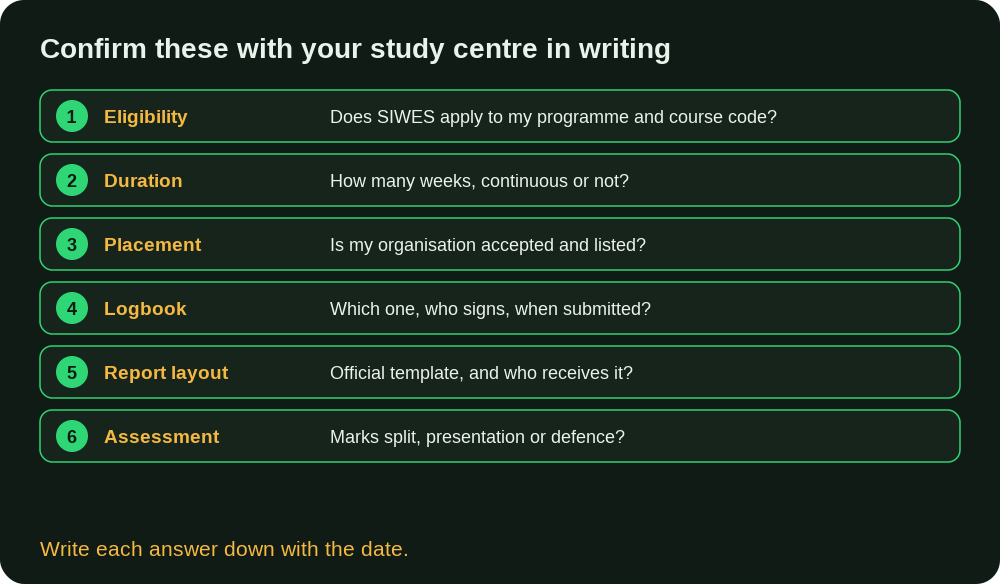
- Does SIWES apply to my programme, and under which course code do I register?
- How many weeks is the attachment, and does it have to be continuous?
- Is my proposed organisation acceptable, and how is it added to the placement list?
- Which logbook do I use, who signs it, and when is it submitted?
- Is there an official report layout, and who receives the report?
- How is SIWES assessed, and is there a presentation or defence?
If the answer to the fifth question is a template, use it. If your desk officer says there is none, follow the layout of the general SIWES guide and tell your academic supervisor which layout you used.
Records that make the report possible
Reports fail on memory. You have the same job as any SIWES student: keep a dated, specific record while the work is happening, and keep your role label honest.
An entry that works has five parts:
- Date and place. The day, the department or site, and the supervisor present.
- The task. What you did, in one specific sentence, such as "traced a faulty circuit on the distribution board" or "reconciled a day's receipts against the cashbook".
- Tools, systems or materials used. Named, not generic.
- Your role. Observed, assisted or performed under supervision.
- What you learnt or what went wrong. A single concrete line.
The logbook guide explains weekly sign-off in detail, and the difference between logbook and report is clearer once you have read the basics. The logbook is the evidence. The report is the narrative built on it. When the two disagree, assessors notice.
Choosing and describing a relevant placement
NOUN's own reported advice, as quoted above, is to choose a placement relevant to your studies. That has a direct effect on your report, because the report can only be as good as the training. Ask yourself, before accepting a placement:
- Will I touch work connected to my course, or only run errands?
- Is there a named person who will supervise me and sign my logbook?
- Can I describe what the organisation does without copying its website?
- Will I be allowed to describe the work, or is some of it confidential?
If the placement is thin on content, write honestly about the part that was substantive. A short, real account beats a long, padded one. Read the guide to SIWES conclusions and recommendations for how to turn a weak placement into honest recommendations.
A working chapter outline
Use this only where your Directorate or study centre has not given you a template. An official layout always comes first.
Preliminary pages. Title page, certification, acknowledgement, abstract if required, table of contents, and lists of tables and figures. Do not add a signature or stamp you have not received.
Chapter 1: Introduction. Background to SIWES in brief and accurate terms, the aim of your attachment, and the scope of your report. You can describe SIWES as a scheme coordinated by the Industrial Training Fund with the NUC, as NOUN's own pages describe it, and avoid copying an older student's wording.
Chapter 2: The host organisation. Name, location, what it does, how it is organised, and the unit you were attached to. Write it from what you saw, not from a brochure.
Chapter 3: Training activities. The core of the report. Organise it by period or by unit, and for each block state the task, the tools used, your role and the outcome. This is where your logbook turns into prose.
Chapter 4: Experience gained and challenges. Skills built, tied to specific weeks, and real challenges with how you dealt with them. If you are a working student, this is also where you can honestly describe the difficulty of balancing responsibilities, as long as it is true and relevant.
Chapter 5: Conclusion and recommendations. A short summary, your judgement of the training and recommendations addressed to a named party: the host, the university, or the ITF.
References and appendices. Sources you cited and anything your host allows you to include.
Figures, tables and appendices
Good figures are modest and yours. A table of the weeks and units you covered, a labelled sketch or workflow of a process you took part in, or an organisation chart you drew from what you were told are all fine. Number each one, caption it and refer to it in the text. Do not paste an image from the internet and present it as your own, and do not include anything your host has told you to keep internal. If your report is typed in Word, the free formatting checker reads a .docx and flags mismatches with the format you have to follow, and the format directory lists university rules where they are on record.
Writing the report in an honest four weeks
- Week one: rebuild the record. Lay your logbook out by week. Mark gaps honestly. Ask your industry supervisor to confirm anything you are unsure about.
- Week two: draft the activity chapter from the record, block by block, with role labels.
- Week three: the rest. Host organisation, experience gained, challenges, conclusion and recommendations.
- Week four: figures, formatting and consistency. Number and caption figures, apply the required formatting, and compare every claim with the logbook.
If your academic supervisor sends corrections, managing IT report supervisor corrections shows how to track each change so nothing is missed.
Common mistakes
- Assuming rules from another school. A friend at a campus university tells you the duration or the layout. Those are their school's rules, not NOUN's.
- Skipping the orientation. NOUN's page describes it as compulsory before attachment.
- Role inflation. "I managed the project" when the record shows you assisted.
- A brochure for Chapter 2. A host description pasted from the organisation's website.
- Entries written in one sitting. A backfilled logbook is easy to spot.
- A report that disagrees with the logbook. A unit or date that one shows and the other does not.
- Generic skills lists. "Teamwork, communication, punctuality" with no week or task behind them.
- Fake signatures. Never add a signature or approval you have not received.
Preparing to defend or present
NOUN's pages we read do not describe a defence format, so ask your desk officer whether there is one and what it looks like. If there is, prepare for these questions, which panels ask everywhere:
- Describe a typical day at your placement.
- Which task taught you the most, and why?
- What was your own part in it, and what did you only observe?
- What went wrong, and what did you do?
- How does this connect to what you studied?
- What would you change about the programme or the placement?
The guide to defending your SIWES report shows how to structure each answer, and how SIWES is graded explains why you should ask your own institution for its weighting instead of relying on a number you saw online.
Pre-submission checklist
- You have confirmed the duration, the layout, the submission route and the assessment with your desk officer.
- Every activity in the report matches a dated logbook entry and carries a role label.
- Chapter order, headings and length follow the official guide, or the layout you agreed with your supervisor.
- Figures and tables are numbered, captioned and discussed in the text.
- The host description is in your own words.
- No signature, stamp or approval appears that you have not actually received.
- Your logbook is signed by the people who are supposed to sign it.
Where UniDraft fits in
UniDraft builds the written SIWES report as an editable Word (.docx) document from the placement facts you confirm, your supervisor's instructions and your school's format rules, applied in that order of priority. Bring the real details of what you did, because those are what you will be asked about at your defence.
Start your SIWES report with UniDraft
Sources
- NOUN: Students Industrial Work Experience Scheme (SIWES): programme scope, compulsory orientation, placement list, stipend and Directorate role.
- NOUN News: SIWES prerequisite for award of certificates, diplomas (ITF): 2022 orientation remarks by an ITF representative.
- NOUN News: ITF orientates NOUN students at Port Harcourt Study Centre: August 2026 orientation content.
- NOUN News: NOUN reaffirms commitment to quality SIWES administration: July 2026 monitoring tour.