SIWES assessment and CGPA treatment depend on the applicable institutional rule; see whether SIWES affects your CGPA. This article answers the next question: once it is being assessed, what actually goes into that score, and who is holding the pen?
Your mark scheme decides the assessment; your report should explain the placement evidence you actually have. UniDraft helps turn confirmed activities and guidelines into an editable SIWES report. Start your SIWES report, then review it against your logbook and requirements. A document purchase cannot change an employer rating or guarantee a grade.
The short answer
Published schemes can assess SIWES through a combination of: your logbook, your written report, an evaluation from your industry (employer-based) supervisor, and, at many institutions, a supervisory visit and an oral presentation or defence. How much each part carries, and whether the result is a percentage score or a plain pass/fail, is decided by your own institution. There is no single national mark scheme that every school follows.
That is not a cop-out. Two institutions that publish their schemes (shown below) weight the same ingredients quite differently. So treat any breakdown you see online, this one included, as a pattern to recognise, not as your school's policy. The one document that settles your score is your department's SIWES handbook or marking guide, and your SIWES coordinator can tell you where it is.
Who is actually scoring you
Students often muddle this, so separate it clearly.
Your industry-based supervisor (someone at your placement) judges what happens during the placement: punctuality, task competence, professionalism, and how seriously you applied yourself. Published institutional instructions describe this supervisor as the person who signs your logbook weekly and completes an evaluation form at the end of the programme. The standard ITF end-of-placement form, Form 8, is built around this: you complete your part, the employer completes an assessment part, and your institution completes its own section after supervision. That student, employer and institution structure is fairly consistent across the scheme, even where the mark weights are not.
Your institution-based supervisor or coordinator judges what you bring back and whether it matches reality. They visit your workplace (often more than once), examine the logbook, and mark or moderate the report. Their responsibilities and assessment criteria come from the actual institutional scheme.
Your department usually collates everything. At some institutions the department itself marks the logbook, the written report and the oral presentation, and the university-based supervisor submits a sealed assessment form after each visit.
The practical consequence is that a weak workplace rating and a weak report are two different problems with different causes. One is about your conduct on the job; the other is about your paperwork. Do not assume a disappointing result means you performed badly at placement. Ask for the actual component breakdown rather than assuming the cause.
Two real published mark schemes
Because "it depends" is not very satisfying, here are two schemes that the institutions themselves publish. Both are attributed examples, not standards; this pass could not reopen the Daura page, so confirm its current scheme with the institution. Your own school may look nothing like either.
Nigerian Army University Biu (NAUB) describes a 100-mark scheme on its SIWES activities page: logbook entries 10, university-based supervisor's visit 20, industry-based supervisor's daily supervision 25, written report 20, and oral presentation 25. It also says departments collate the logbooks and Form 8 and cross-check that the logbook is fully completed, and it describes two supervisory visits during the second semester.
Federal Polytechnic Daura, on its SIWES page, publishes a different breakdown for ND students: student logbook 20, polytechnic-based supervisor's assessment 15, committee evaluation 25, work-site supervisor's evaluation 20, and written technical report 20. The same page shows a grading table on which a score of 50 to 59 is a C grade and a pass.
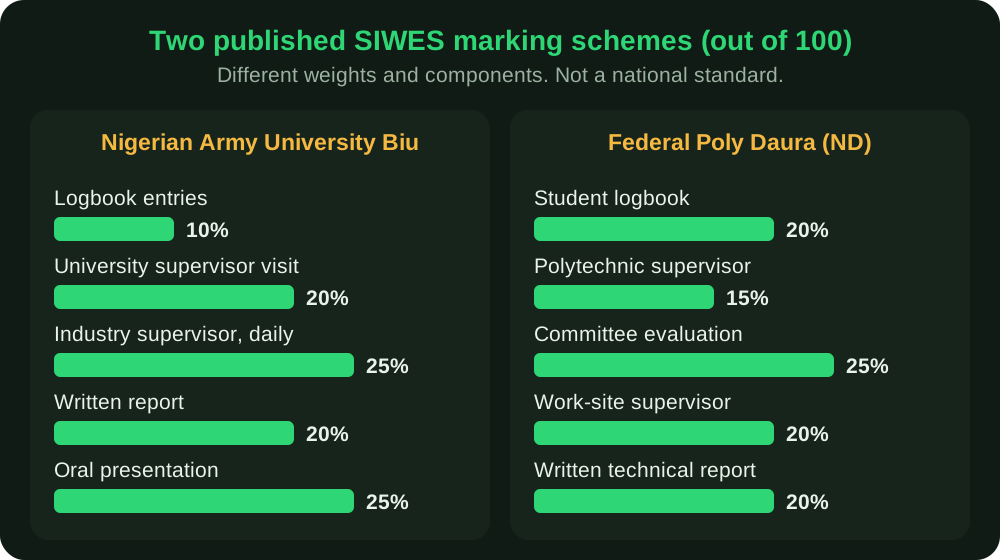
Compare them and three lessons appear.
- The employer's voice is worth a lot at both schools, but in different ways: 25 marks for daily supervision at NAUB, 20 marks for the work-site supervisor at Daura.
- Logbook weight swings from 10 to 20. If yours carries 20, that component has 20 marks available, not an automatic deduction for any one issue.
- An oral component may exist or not. NAUB gives it 25 marks; the Daura ND breakdown lists a committee evaluation instead. Do not assume you will have a defence, and do not assume you will not.
Some programmes go a different way entirely and record SIWES only as pass/fail or as a condition for graduating. If that is your case, none of the arithmetic above applies, but completeness still does.
The components you will commonly see
Logbook. Assessed for completeness, consistency, honest detail and regular endorsement by your supervisor. Published instructions from institutions such as the National Open University of Nigeria say the logbook should be completed daily, signed weekly by the industry-based supervisor and will be examined during supervision visits. If you are unsure what a good entry looks like, how to fill your SIWES logbook walks through it by department, and the computer science logbook examples show entries at full length.
Technical or SIWES report. Assessed for structure, depth, and whether it describes your actual placement instead of generic filler. The report must describe your actual placement and follow the brief; how to prepare a SIWES report exists as its own guide.
Employer or industry supervisor evaluation. Workplace conduct and task performance, submitted on the ITF form or the institution's own form. NOUN's published instructions, for example, say the evaluation form is to be completed by the employer at the end of the programme.
Supervisory visit. A visiting lecturer checks that you are actually there, that the work matches your logbook, and how you conduct yourself. Visits are not a formality. They give your institution supervisor first-hand evidence for the mark they later award.
Oral review, seminar or defence. Where required, a short session where you explain your placement to a panel. See how to defend your SIWES report for original rehearsal prompts.
Some departments weight the report and logbook most, because those are tangible and reviewable. Others weight the employer's evaluation most, because it reflects the point of SIWES: real work experience. Both choices are defensible, which is exactly why guessing your split from a blog post is a bad plan.
Participation gates: before marks are counted
Marks are not the only thing that can hurt you. Several institutions attach conditions before your SIWES is even scored. NOUN's instructions, for instance, say a job reporting form must be submitted within two weeks of starting, and that failing to return it is taken as non-participation. Other schools have a registration or logbook fee, a placement confirmation deadline, or a rule that your logbook must be fully completed before the department will process your result.
Check three things in the first fortnight of placement:
- Have you registered or reported your placement in the way your institution requires, and in the time it requires?
- Do you know your form set? Ask your coordinator whether you also need documents such as the SCAF form before you start.
- Do you know the deadline for submitting your logbook and report, and who receives them?
Missing a gate can matter more than losing five marks on report formatting.
A preparation worksheet for the required components
The following is an original preparation worksheet, not student marks, measured assessor behaviour or a grading rubric.
| Component | Useful evidence to check | Issue to investigate |
|---|---|---|
| Logbook | Dated entries, specific tasks, weekly signatures | Backfilled entries, copied weeks, blank signature lines |
| Report | Chapters that match your placement, real tools and processes named | Generic company history, text lifted from a textbook |
| Employer evaluation | Reliable attendance, questions asked, tasks completed | Absences, no contact with your supervisor, rushed final week |
| Supervisory visit | Able to explain today's task without notes | Cannot say what department you work in or why |
| Oral presentation | Own words, honest about what you did versus observed | Reading slides word for word, claiming team work as solo work |
Notice that most of the "loses marks" column is about preparation and honesty, not talent.
What you actually control, and what you do not
This distinction matters more than any exact percentage.
You control:
- Report quality: structure, clarity, and whether it accurately documents your placement. Before you submit, you can also run the document through the free formatting checker to see whether font, spacing and margins match your university's rules.
- Logbook completeness and consistency: filled in regularly, not reconstructed from memory the week before submission.
- Your professionalism and effort during placement: punctuality, asking questions, taking tasks seriously, and keeping your own notes.
- How well you can speak about your own work, if your institution includes an oral review.
You do not fully control:
- Your industry supervisor's subjective rating: their workload, their standards, how much they saw of you.
- Whether your placement organisation completes the assessment form promptly, or at all.
- How your institution weights the components.
Since you cannot control the employer's side, put real effort into your side. An accurate report and genuine complete records help explain your work, but the actual mark scheme determines their contribution. There is also something you can influence on the employer side: make yourself easy to assess fairly. Give your supervisor a short weekly summary of what you did, present the logbook on the required signing schedule, and ask what they would expect from you in the final week. A factual summary can help make the work visible; it cannot guarantee a particular or more generous rating.
A simple plan by stage
Weeks 1 to 2. Confirm your institution's assessment breakdown, deadlines and form set with your coordinator. Report your placement in the way required. Start the logbook on day one.
Through the placement. Keep genuine dated entries and obtain signatures on your institution’s required schedule. Keep a private notes file of tools, procedures, problems and how they were solved; it becomes your report's raw material.
Two to three weeks before the end. Ask your supervisor when they will complete the evaluation form and how it should reach your institution. Do not leave this to the final day.
After placement. Draft the report while your memory is fresh. If your institution has a defence, rehearse answering questions about what you personally did. Cross-check with the department's guidance in submitting an IT report that passes departmental review.
If something goes wrong
Your industry supervisor will not complete the assessment form. Do not wait until submission week to notice. Ask early, follow up through HR or a manager above your direct supervisor if needed, and if it is still unresolved tell your coordinator. Ask which procedure applies; do not assume an alternative assessment is automatically available.
Your placement ended early. Tell your coordinator as soon as it happens. Ask which interruption or change process applies and what evidence is required. An early message does not itself establish approval.
You are worried your workplace rating was weak. Ask whether a clarification or review process applies. What you can do is make the report and logbook, which are still in your hands, as strong as possible. A thin, scattered report costs marks on its own component, and it also makes it harder for a coordinator to see that a rough patch at placement was the exception.
You lost or damaged your logbook. Report it at once instead of quietly rewriting weeks from memory. Fabricated backdated entries are a bigger risk than an honest gap, because supervisors compare the logbook against what they saw on their visits.
You suspect your score was added up wrongly. Ask your coordinator for the marking guide and a breakdown by component. Do this politely and with your documents in hand; a specific question about one component gets further than a general complaint.
Where UniDraft fits in
UniDraft cannot touch the part of your SIWES score that comes from your workplace conduct or your industry supervisor's rating. That is determined by what you do on the job, and no document tool changes it. It also does not fill in Form 8 or logbook signatures, and it does not guarantee any grade.
What it can help with is the part you control most: turning your real placement details and logbook notes into a complete, properly structured SIWES report in an editable Word file, formatted to your institution's rules, so the written side of your score reflects the work you actually did. Check current pricing and included correction rounds before checkout, and you can check your formatting first with the free tools.
Sources
- SIWES Activities, Nigerian Army University Biu: 100-mark scheme, supervisory visits, logbook and Form 8 collation.
- Student Industrial Work Experience, Federal Polytechnic Daura: ND assessment breakdown and grading table.
- General Instructions, NOUN SIWES: logbook completion and signing, employer evaluation form, job reporting form.