
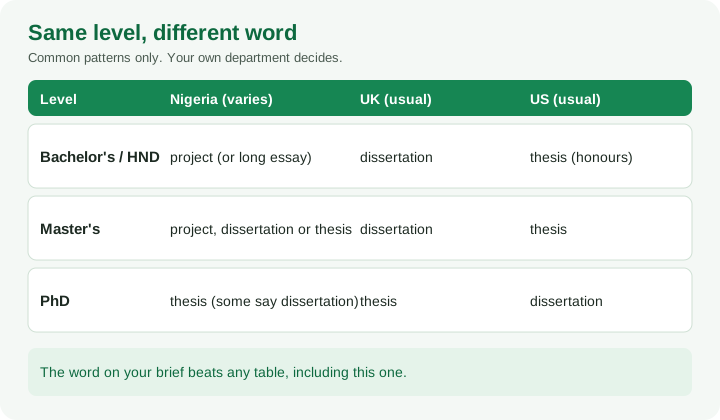
A project, a dissertation and a thesis are all long, supervised pieces of written research, but the words are used differently depending on the country and the level of study. In Nigeria, "project" is the common word for undergraduate work, "dissertation" and "thesis" tend to appear at postgraduate level, and each institution has its own habits. Follow your department's word.
If your department says "project", UniDraft can help you turn your confirmed topic, work, checked sources and supervisor instructions into an editable Word project document. Start your project document once you know what your department wants, and review every claim against your own evidence. UniDraft organises what you have confirmed; it does not carry out the research for you.
This post is only about the naming. For the full picture of the undergraduate capstone, read what a final year project is, and for the shorter literature-based exercise read seminar paper vs final year project.
The short answer
- Project: the usual Nigerian word for the final-year undergraduate (and ND/HND) write-up. Some Nigerian institutions use it for master's work too.
- Dissertation: in the UK, the usual word for undergraduate and taught master's work. In Nigeria it often appears at master's or MPhil level, but not everywhere.
- Thesis: in the UK and in most Nigerian usage, the PhD document. In the US, a thesis can be a bachelor's or master's document, and the PhD document is the dissertation.
- The rule that matters: the term on your own department's brief. Not a website, not a senior's title page, not a UK guide.
Why do the words get mixed up?
Because they were never one global vocabulary. Three conventions overlap on the internet, and a student searching "dissertation vs project" lands on all of them at once.
- UK convention. The Essex library guide notes that "dissertation tends to be the preferred term at undergraduate and taught postgraduate level" while "thesis" is used for original research at doctoral level. It also points out that American usage reverses this.
- US convention. The University of Illinois library guide states that in the US dissertations are for doctoral work while a thesis can be for a bachelor's or master's degree, and that in Europe the usage is often reversed.
- Nigerian practice. It follows no single national standard. A ThisDay report on the question quotes Professor Akin Odebunmi of the University of Ibadan describing UI's own convention and adding that practice varies from institution to institution.
So when one site says "a dissertation is for a PhD" and another says "a thesis is for a PhD", both can be right, because they are describing different countries.
What does each word mean in Nigeria?
Nigeria borrowed from both British and American academic traditions, and institutions then settled on their own habits. That is why there is no safe one-line rule.
Undergraduate and ND/HND: usually "project"
Most students searching this topic are asking about the document they write in their final year. In most departments the working word is project (or "final year project", "research project" or "project report"). Our final year project guide covers the usual shape: a supervised investigation or build, a formal multi-chapter report, and usually an oral defence.
The ThisDay interview is a useful reminder that even this is not universal. Professor Odebunmi said that at the University of Ibadan, first-degree students write long essays rather than "projects". Another department elsewhere may say "undergraduate thesis". So if your lecturers say "long essay", "project" or "thesis", they are describing your final-year document in their own language.
Master's: project, dissertation or thesis
This is where the biggest differences appear. In the same ThisDay article, the Ibadan professor described UI's convention this way: at master's level students write a project, at MPhil level (which he described as a terminal degree) a dissertation, and at PhD level a thesis. He also noted that some institutions have PhD students write dissertations, and that at Ife a master's work is called a thesis if it must be defended and a project if not.
That single article is evidence of variety, not of a national rule, which is exactly the point. If you are a postgraduate student, your postgraduate school's style manual or handbook is the authority.
PhD: usually "thesis"
The doctoral document is most often called a thesis in Nigerian and British usage and a dissertation in the US. Whatever it is called, the defining feature is the expected original contribution to knowledge and the oral examination that normally follows.
Dissertation vs project vs thesis: comparison table
This table describes the usual pattern at each level. It is a map for orientation and not a set of institutional rules, so I have deliberately not put page or word counts in it.
| Undergraduate project | Master's dissertation / project | PhD thesis | |
|---|---|---|---|
| Typical Nigerian label | Project, research project, project report (sometimes long essay or thesis) | Project, dissertation or thesis, depending on the institution | Thesis (some say dissertation) |
| Typical UK label | Dissertation | Dissertation (taught) or thesis (research) | Thesis |
| Typical US label | Thesis (often honours) or capstone | Thesis | Dissertation |
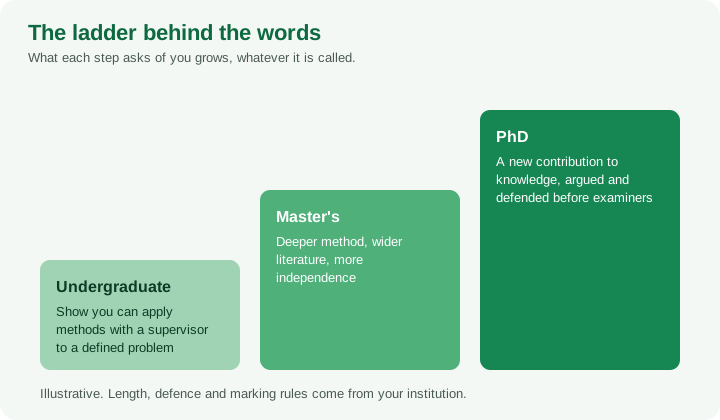
| Level of originality expected | Apply methods properly to a defined problem; show you can do supervised work | Deeper method, wider reading, more independence; a research master's may expect a genuine contribution | A significant original contribution to knowledge |
| Original research | Often yes (data, build, design or critical analysis) as set by the brief; sometimes mostly literature-based | Usually yes, shaped by the type of master's | Yes, required |
| Length | Set by your department's guideline | Set by your postgraduate school or department | Set by your postgraduate school or department |
| Supervision | One supervisor, regular meetings | Supervisor, sometimes a committee | Supervisor or panel, often a committee |
| Oral defence | Often, but ask your department | Often, but depends on whether the work is defended | Almost always an oral examination |
Notice the length row. Nobody can honestly give you a universal page count for "a project" or "a thesis", because the number lives in your department's guideline. The generic UK numbers you may see online do not bind a Nigerian programme.
How is a dissertation different from a project in practice?
Set the vocabulary aside and compare what the examiners are looking for.
Scope of the question. An undergraduate project asks a defined, manageable question and shows that you can answer it with a method your supervisor approves. A master's dissertation or thesis usually widens the literature, the justification of the method and the independence expected. A PhD thesis is expected to add something that was not known before.
Depth of the literature review. A project needs enough literature to locate the gap and justify the study. A higher-level document normally argues more critically across a broader body of work. If you need help with that layer, read how to write the literature review and how to identify a research gap.
Independence. At undergraduate level the supervisor shapes a lot; at doctoral level you are expected to defend your own choices. As a general pattern, undergraduate work mainly shows that you can find, organise and apply existing knowledge, a research master's usually needs a genuine contribution, and a PhD must make a significant original contribution.
The oral part. US programmes call a final oral exam a "defense" and UK programmes often call it a "viva". In Nigerian departments the word "defence" is common (our post on defence vs defense spelling explains why you will see both), but whether your undergraduate work is defended, and how, is a departmental decision. See project defence: what it is and how to prepare once you know your department's process.
What about "thesis vs project" for undergraduates?
Some students ask whether their final-year document should be called a thesis. A few reasons the question comes up:
- A senior's title page says "A Thesis Submitted to the Department of...". That is that department's choice of wording.
- A US or Canadian website says an honours thesis is an undergraduate requirement. That is the US convention.
- A lecturer says "your project" in class but the faculty template says "dissertation".
None of these tells you what to put on your own title page. Look at your department's project guideline or the most recent approved format sheet. If none exists, ask your project coordinator in writing which word the department uses and how the cover page should read. Our formatting guide for Nigerian final year projects explains the general idea of following the local template, and UniDraft's format pages and formatter are where university-specific layout questions belong.
A worked example: one student, three possible labels
This is a fictional illustration, not a real department.
Ada studies Mass Communication. Her friend at a UK university sends her a screenshot titled "Undergraduate Dissertation Handbook". An American blog tells her she is writing "an undergraduate thesis". Her own department's project coordinator sent a WhatsApp message saying "Final Year Research Project: submit your proposal by Friday".
What should Ada do?
- Identify the authority. The coordinator's message and the departmental handbook are the authority, not the screenshot or the blog.
- Use the department's word. She writes "Final Year Research Project" on her proposal and talks to her supervisor in the same terms.
- Borrow ideas, not rules. The UK handbook may have a helpful way to structure a methodology section. She can use the idea only if her supervisor agrees, and she does not copy its rules about length or deadlines.
- Keep a written record. She screenshots the coordinator's message and the section of the handbook that states what the department expects, so she can show it if a question arises later.
Ada ends up with the right label, the right brief and no wasted weeks.
Why should you follow your own department's term?
Four practical reasons.
1. It decides the format. The word on your brief usually points to a particular template, preliminary pages and referencing style. A "project" brief and a "dissertation" brief at the same university could carry different instructions, and a template for one should not be assumed for the other.
2. It decides who reads it and how. Whether there is a proposal defence, an external examiner or a viva is a departmental process. If you are unsure, our guides on writing the project proposal and project defence questions show the general pattern, but your department's schedule overrides them.
3. It avoids mismatched examples. Searching "dissertation example" can bring up UK documents that have a different structure and assessment criteria. Using them as models can hide the structure your supervisor actually expects.
4. It keeps conversations clear. Supervisors, coordinators and examiners use the departmental word. Using it back avoids confusion about whether you are asking about the proposal, the final submission or the defence.
Common mistakes with these terms
- Copying a UK or US definition into a Nigerian project. The definition may be correct for its country and wrong for your department.
- Calling your undergraduate project a "PhD-style thesis" on the title page. This can look like a misunderstanding of the level, and the title page is usually set by a departmental template.
- Assuming "thesis" means longer. Length comes from your guideline, not the label.
- Using a senior's cover page as the template. Departments change templates; use the current one.
- Skipping the written confirmation. If a lecturer told you something verbally about the label or format, ask for it in writing, or at least note the date and who said it.
- Treating the term as a quality signal. A well-designed project at undergraduate level beats a confused "thesis" every time.
Checklist: settle your term in ten minutes
- Find the current project or dissertation handbook from your department.
- Note the exact word used for the document at your level.
- Check the cover page and preliminary page template.
- Ask the coordinator whether there is a proposal stage and an oral defence.
- Ask your supervisor whether they use the same word.
- Save the written confirmation.
- Use that word in your proposal, title page, emails and slides.
Our guide on handling supervisor corrections pairs well with this step: when the label and the instructions are clear from the beginning, there are fewer surprises in later review rounds.
Where UniDraft fits in
UniDraft is built for the undergraduate and ND/HND document most Nigerian students call a project. It helps you organise your confirmed topic, your actual work and findings, your checked sources and your supervisor's instructions into an editable Word document. You keep control of the research, the analysis and the final wording.
If your department asks for a "project", "research project" or "project report", start your project document. If you are still working out the right shape for your department, try the free formatter and browse the university format pages, then confirm everything with your supervisor.
Sources
- Essex Library, Theses and Dissertations (Politics and International Relations): UK usage of dissertation for undergraduate and taught postgraduate work and thesis for doctoral research, and the note that American usage is reversed.
- University of Illinois Library, How to Find Dissertations and Theses: US usage, where dissertations are doctoral and a thesis can be a bachelor's or master's document, and the note that European usage is often reversed.
- ThisDay, Varsity Don Solves Puzzle on Dissertation, Thesis (2018): a University of Ibadan professor's description of that university's naming convention and his note that practice varies between Nigerian institutions.
These sources describe conventions, not binding rules for your institution. Your department's handbook and your supervisor decide what applies to you.