An engineering SIWES logbook is a dated record of work you actually observed, assisted with or performed within your authorised role. An entry should identify the task, your contribution, the relevant record or equipment, and what you can honestly explain about the outcome.
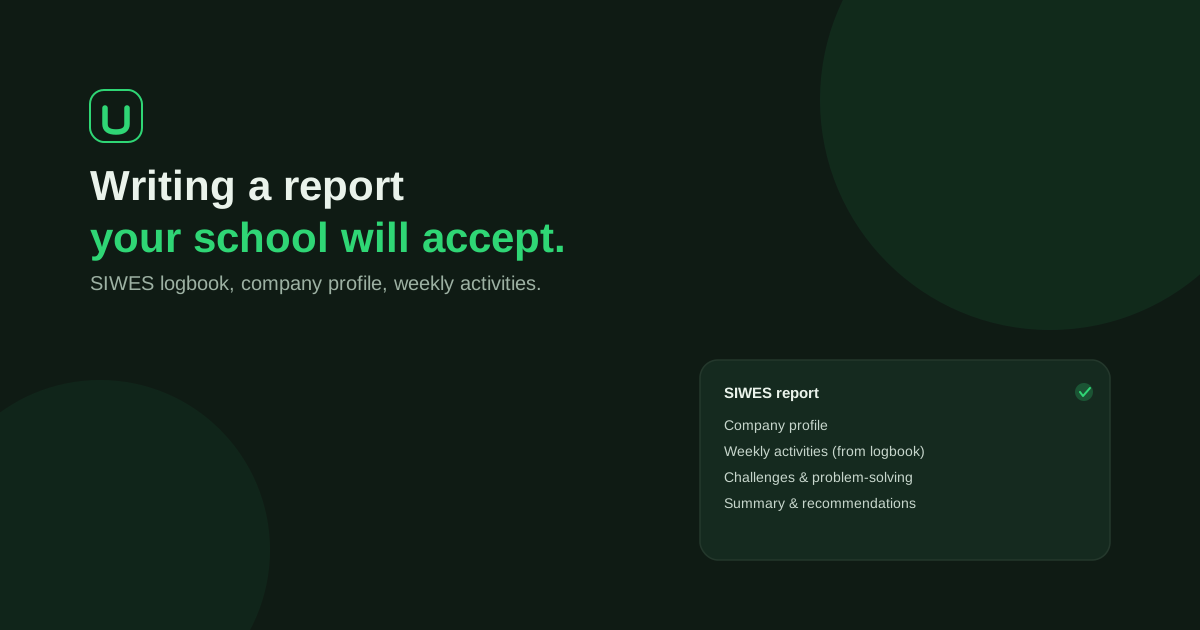
Your genuine daily entries are the starting material for the report you submit later. UniDraft helps organise the placement facts and guidelines you confirm into an editable SIWES report. Start your SIWES document with UniDraft, then compare it with your real records. Official logbooks, signatures and authorised training remain separate responsibilities.
Start with the actual record
Use your institution's layout and required record/signing schedule. NOUN's general instructions explicitly require daily completion and weekly industry-supervisor signing for its students. That is a named institutional example, not proof of every school's schedule.
Write from contemporaneous notes. If an entry is missing, preserve genuine supporting notes and ask about the authorised correction process. Do not manufacture a past date, task, measurement or signature. A quiet day can be recorded honestly.
An entry worksheet for any engineering placement
| Field | What to record |
|---|---|
| Date and unit | The actual day and permitted location or work unit |
| Task | What was being examined, documented or done |
| Role | Your accurate contribution: observed, assisted or performed, with supervision where applicable |
| Method or record | The actual authorised process or document, without guessing missing steps |
| Outcome | What you observed or copied from an identified genuine record |
| Learning or question | A bounded lesson, uncertainty or follow-up supported by the experience |
Choose the accurate verb, not the lowest-sounding one. Do not claim to operate equipment when you observed it, or describe genuine authorised work as observation merely to follow a template. Report unresolved faults as unresolved.
The examples below are fictional writing patterns, not student records, technical procedures or permission to perform work. Every bracket requires your own permitted facts. Actual authorisation, competence, risk assessment, supervision and relevant procedures govern engineering work.
Civil engineering examples
Fictional site-record entry:
Observed [authorised team] document [actual work stage]. I helped label [permitted record or sample identifier] under [role]'s supervision. The engineer's record showed [actual result and unit, if permitted]. My notes distinguish the observation from work I did not perform.
Fictional drawing-office entry:
Compared [permitted drawing revision] with [authorised markup] and listed [actual changes] for the engineer's review. I did not approve or alter the design. I learned why the revision identifier matters when describing the work.
A drawing or test sheet must be permitted for use; your own sketch may still expose restricted site information. The civil SIWES guide helps turn actual records into report sections.
Electrical engineering examples
A logbook explanation is not a safe-isolation or testing instruction. Do not reproduce abbreviated procedures as if they authorise electrical work. If you do not know a safety arrangement or equipment state, seek clarification rather than invent it.
Fictional observation entry:
Observed [authorised technician] during [permitted inspection]. I recorded the job identifier and the technician's stated purpose. The authorised person controlled the equipment and checks. My record identifies [actual procedure reference, where shareable] and my role; it does not claim I independently verified the equipment safe.
Fictional test-record entry:
Assisted with documentation of [test actually carried out by authorised personnel]. With permission, copied [reported value and unit] from [identified genuine test sheet] and noted who made the measurement. I did not choose test settings or interpret compliance independently. [Unresolved result or interpretation] was referred to [role].
Fictional documentation entry:
Updated [permitted equipment register] from the engineer's authorised markups and returned it for review. I recorded the source revision and unresolved labels. No equipment operation is being claimed.
See the electrical/electronic report guide for documentation context, not permission to perform a procedure.
Mechanical engineering examples
Separate inspection, maintenance, machining and approval. A generic service sequence cannot substitute for the actual manufacturer's instructions and authorised workplace process.
Fictional maintenance-record entry:
Observed [technician] review [machine]'s scheduled maintenance record. I entered [actual authorised fields] from the completed job sheet. The job remained [actual status]. I learned how the recorded equipment identifier connects the work to its maintenance history.
Fictional machining-record entry:
Under [actual supervision], assisted with documenting [operation]. Recorded the authorised drawing revision and [genuine measured dimension and unit] from [identified source]. The instructor reviewed the measurement against the specified criterion. I did not infer that all parts or later operations met tolerance.
Fictional assembly-record entry:
Observed the technician use the applicable procedure for [assembly]. My task was [actual permitted contribution]. I noted the procedure reference and outcome the technician recorded, without supplying a universal tightening sequence or value.
The mechanical SIWES report guide covers organising the actual experience.
Chemical and process engineering examples
Record the actual sample, method, authorised role and source of a result. Do not infer a plant setting or treatment dose from the appearance of one sample.
Fictional laboratory-record entry:
Observed [analyst] document [permitted sample identifier] using [actual method reference]. I assisted with [actual authorised documentation task]. The reported result was [genuine value and unit] in [record]. Questions about suitability or interpretation were referred to [role].
Fictional comparison entry:
Helped organise the technician's recorded observations from [actual comparison]. I preserved the sample labels and reported conditions. The authorised team interpreted the results under its procedure; I did not decide an operating dose from visual appearance alone.
Fictional control-room entry:
Observed [operator] review [permitted process display]. With permission, copied [actual recorded values with units] into [authorised record]. I did not change set points or claim that a copied value was my own measurement.
For notation, see chemical formulas and units.
Repeated tasks, quiet days and missing information
If the same task repeats, record it honestly and identify a real change where one exists: item, stage, outcome or supervision. Do not invent variety. If you read a permitted manual, attended a briefing or waited for an assigned task, describe that truthfully.
If the placement is not meeting training requirements, discuss it with the institution supervisor or coordinator. Do not solve the gap with fictional entries. The general logbook guide and computing examples use the same evidence principle across different placements.
Permissions apply to notes, drawings and uploads
Check employer restrictions, personal information, intellectual property and operational security before reproducing or uploading material. Redrawing a diagram or removing a name may not remove the restriction. Use an approved general description where appropriate; do not assume a supervisor's casual assent settles every disclosure issue.
From entries to the report and defence
Group genuine entries into the account of work in your SIWES report. Keep dates, role and outcomes consistent with the records and forms, including the SCAF. A summary supplements rather than replaces required daily entries.
Before submission check:
- Each claimed task is traceable to genuine notes or records.
- Your contribution and the authorised team's contribution are distinct.
- Measurements have units and an identified source.
- Missing or uncertain information is disclosed rather than invented.
- Required endorsements are genuine and obtained through the actual process.
- Confidential material is removed or appropriately cleared.
- You can explain the record accurately, without a prescribed one-minute performance test.
Use the submission checklist and formatting checker as aids, not guarantees of approval.
UniDraft supports the written document using your confirmed material and guidelines. It does not fill or sign the official logbook, verify a measurement or find a placement. Check current pricing and included correction rounds in the document workflow, and review every factual claim and final file yourself.
Sources and scope
- NOUN SIWES general instructions — its daily record and weekly signing requirements.
- Industrial Training Fund SIWES scheme document — student record and supervision responsibilities; local instructions still govern the required layout.
All examples and worksheets above are original fictional teaching aids. They prescribe no engineering operation, assessment weight or institution-wide approval outcome.