
A good Estate Management project topic is one property question about a defined area or property type, answerable with records or respondents you can actually reach. "Property investment in Nigeria" is a theme. A workable topic says which properties, where, over what period, and whose data you will use.
UniDraft's free topic generator can give you a starting shortlist. Treat every suggestion as a draft to test against data access, your department's brief and your supervisor's view, not as an approved title.
Once your question, design and data access are agreed, UniDraft organises your confirmed work, checked sources and supervisor instructions into an editable Word project document. Start your project document with what you have verified, and review every figure and claim yourself.
This guide is about the problem that sinks most Estate Management projects: property data. Rents, sale prices and valuations are held privately, recorded inconsistently and often unwilling to be shared. It does not list ready-made titles, because titles go stale and your supervisor will ask why you chose yours. If you are a student on a building-related placement instead, the built environment SIWES report guide covers a different task. And if your friend in Business Administration is asking the same "can I reach the firm?" question, the Business Administration topics guide covers the general firm-access checks; here we focus on what is particular to property.
What does an Estate Management project actually study?
Estate Management programmes cover several areas. The University of Ibadan's programme page, for example, lists property appraisal and valuation, property investment analysis, feasibility and viability assessment, property and facility management, sales, leasing and brokerage, land records and administration, and development project oversight. Other departments describe their programmes differently, so read your own department's handbook.
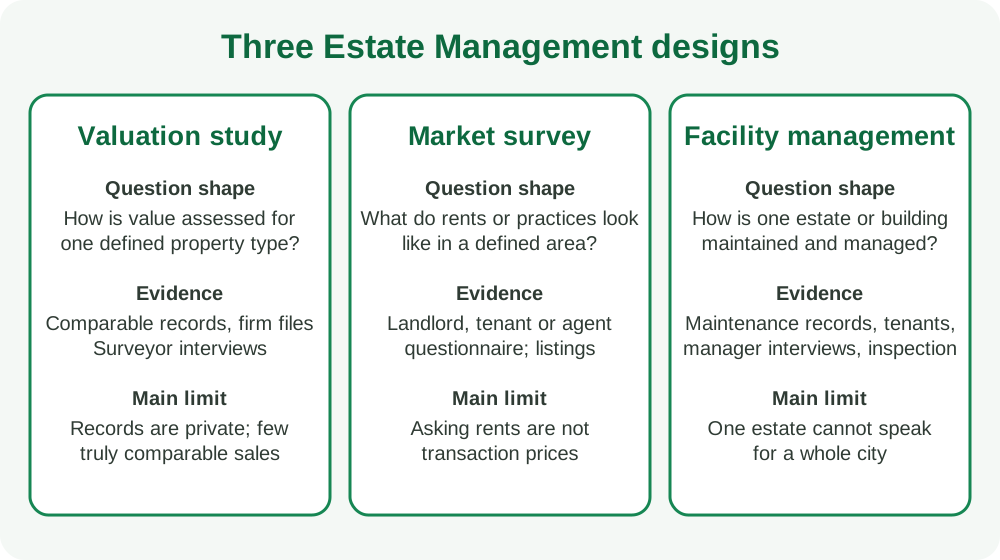
For a project, those areas turn into three common designs. Departments differ on what they accept and what they call each design, so treat this as a planning aid, not a rule.
| Design | Typical question shape (provisional) | Evidence | Main limit |
|---|---|---|---|
| Valuation study | How do practitioners assess value for one defined property type? | Interviews, firm files (with permission), comparable records | Records are private and few are truly comparable |
| Market survey | What do rents or practices look like among a defined group in one area? | Questionnaire to landlords, tenants or agents; dated listings | Asking figures are not transaction figures |
| Facility management study | How is one estate or building group maintained and managed? | Maintenance records, tenant views, manager interviews, inspection | One estate cannot speak for a whole city |
Who holds property data, and how do I get at it?
Do not assume a clean dataset exists. In Nigeria, property information sits with different holders, each with different reasons to share or refuse. Work through this list before you fix a title.
- Estate surveying and valuation firms. They hold valuation files, rent reviews and letting records for clients. These are confidential, so expect to get interviews or heavily anonymised extracts, not whole files.
- Landlords, tenants and agents. They know actual rents and terms in an area. They are reachable by questionnaire if you define who they are, but people often round, forget or understate figures.
- Property companies and estate managers. They hold service charge, maintenance and occupancy records for estates they run. Access depends on one manager saying yes.
- Government land and records offices. They hold land administration records, but access rules, fees and completeness vary, and you should ask your supervisor how students normally approach them.
- Published reports and listings. Professional bodies, agencies, researchers and property websites publish market commentary or listings. These are secondary data: check who produced them, when, and what each figure measures.
The honest rule is: name the holder of every figure your objectives need. If an objective depends on data nobody will give you, rewrite the objective, not the data. The primary and secondary data guide helps you decide which kind of evidence each objective actually calls for.
Valuation, market survey or facility management: which should I choose?
Valuation study
Valuation is a professional judgement, not a number you can compute from a textbook. In Nigeria, registered estate surveyors and valuers are regulated: the Estate Surveyors and Valuers (Registration, etc.) Act provides for a Board that keeps the register and regulates the profession, and it makes it an offence for an unregistered person to practise for reward or hold themselves out as an estate surveyor and valuer. For a student, the practical consequence is simple. Your project may study how valuation is done, but you are not a valuer, and a figure in your report is not a valuation opinion. Present any worked number as an illustration of a method, as your supervisor directs.
Good valuation-type projects therefore tend to ask about practice (what methods firms use for a given property type, what problems they report, what data they find hard to get) and answer through interviews or a short questionnaire to practitioners. Projects that try to value real properties on your own usually collapse on comparability, which we come back to below.
Market survey
A market survey describes what a defined group says or does: landlords' stated rents, tenants' reported payment terms, agents' views on demand. It suits students who can reach respondents but not firm files. Its weakness is that stated figures are not verified figures. Say so, and see the survey research design guide for how to frame a survey question properly.
Facility management study
This design is closest to a case study: one estate, one building group, one managed property. You trade breadth for depth and you depend on the manager's permission. The case study research guide explains how to set the case boundaries, and why a single estate cannot support claims about "estates in Nigeria".
If you are unsure which design matches your question, the guide to choosing a research design walks through the link between objectives and design.
Can I use estate surveyors and firms as respondents?
Yes, and it is often the most realistic route. Practitioners can describe methods, challenges and local market conditions without handing over client files. A few points make this work:
- Define the population. "Estate surveyors in the city" is vague. "Registered firms with an office in a named city" is better, if you can obtain a list. Ask your supervisor and department how to build or obtain a list; do not assume a public one exists.
- Ask about practice, not secrets. A question like "Which valuation method do you most often use for residential properties, and why?" is answerable. "Send me your last ten valuations" is not.
- Expect small numbers. A defined population of practitioners may be small. That affects sampling and analysis, so read the sampling techniques guide and talk to your supervisor before you decide the method.
- Keep identification optional. Respondents are more candid when firms are not named. Agree this in your consent wording.
- Record who answered. Keep the dates, the form of each response and who took part, so your methodology chapter matches what actually happened.
The professional landscape is worth stating correctly in your background. ESVARBON, the Estate Surveyors and Valuers Registration Board of Nigeria, is the statutory regulator that registers practitioners and sets standards. The Nigerian Institution of Estate Surveyors and Valuers (NIESV) is the professional body, founded in 1969, and it works with ESVARBON on matters such as programme accreditation. Do not swap the two names: one regulates, the other is the institution members belong to.
How do I handle data confidentiality?
Property data identify real people and real money. Treat confidentiality as part of the design, not an afterthought.
- Get permission in writing from any firm or manager whose records or time you use, and ask what may be named.
- Remove identifiers from anything you show: client names, exact addresses, plot numbers and contact details. Describe a property by type and broad area instead.
- Tell respondents what you will do with their answers and who will read them. The research ethics and consent guide covers consent wording in student projects.
- Store the raw material carefully and delete what your supervisor says you need not keep.
- Never copy a client's valuation report into an appendix unless the firm and your supervisor have both agreed.
If a firm says no, accept it and move to your fallback design. Do not paraphrase records you were not given.
How do I sample properties?
Sampling properties is different from sampling people, because you have to decide what the "unit" is: a building, a unit within it, a letting, or a transaction. Pick one and keep it.
The principles are the same as in any study. Define the population (for example, residential lettings in a named neighbourhood in a named period), find a list or a way to reach the units, and be honest about how you chose them. A pile of listings you happened to see online is a convenience set, not a random sample, and your report should describe it as one. Selection effects are real in property: listings over-represent what is currently on the market, and respondents over-represent people who like to talk.
Avoid copying sample-size numbers from another project. How many units or respondents you need depends on your population, your design and what your supervisor expects; the sample size guide explains the logic so you can work through your own numbers.
What are the comparability pitfalls?
Comparability is where property projects usually go wrong. Two records may look alike but measure different things.
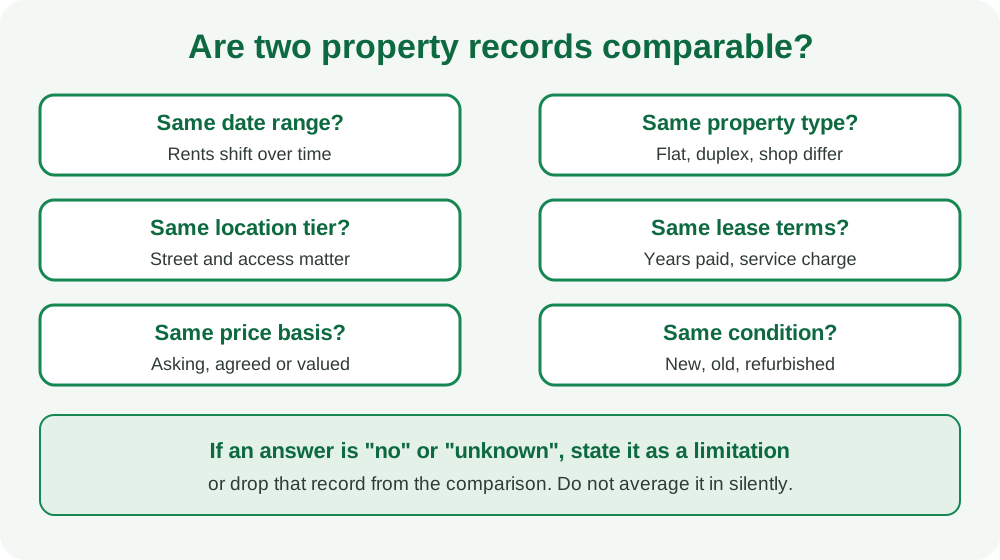
Ask these questions of every pair of records you plan to compare:
- Date. Rents and prices move over time. Records from different periods are not directly comparable unless you handle the gap explicitly.
- Type and size. A flat, a duplex and a shop do not share a rent scale. Compare like with like.
- Location. Within one city, small differences in access, neighbourhood and infrastructure can matter. Do not lump areas together because they share a name.
- Terms. Lease length, advance payment and who pays service charges change what a "rent" figure means.
- Price basis. An asking price, an agreed price and a valued figure are three different things. Never mix them in one column.
- Condition and age. New, old and refurbished properties are different products.
If you cannot answer one of these for a record, say so. Either drop the record or list it as a limitation. Silently averaging unlike records is the single most common way to produce an impressive-looking and meaningless table.
What are the limits of my claims?
Your conclusions should match your evidence and no more. Some honest limit statements:
- Interviews with practitioners describe what those practitioners said, not what every firm does.
- A questionnaire on rents measures reported rents, not verified ones.
- A single estate study explains that estate in that period.
- A small sample of lettings cannot support a statement about "the market".
- Correlation between a property feature and a rent does not show the feature caused the rent.
Write these in your scope and limitations. The limitations guide shows how to state them without sounding apologetic. Supervisors and external examiners respect a student who can say exactly what the data can and cannot show.
A fictional feasibility worksheet
This is an invented example to show the checking process. It is not a recommended or approved title.
Provisional question (fictional): How do estate surveyors and valuers in one named city describe the problems of getting comparable evidence when valuing residential property?
| Check | Fictional answer | Verdict |
|---|---|---|
| Who is the population? | Registered firms with an office in the city | Need a list; ask supervisor |
| Can I reach them? | I know two firms; need more | Uncertain |
| What evidence? | Short interview or questionnaire, no client files | Realistic |
| Confidentiality | Firms not named; no property identities | Agreed in consent wording |
| What can I claim? | What respondents report, in one city, one period | Limit stated |
| Fallback if few respond? | Widen to a second city or a defined group of agents | Prepared |
Notice what this worksheet does not do: it does not promise a market value, a national conclusion or a number nobody can verify. The question is narrower than the first idea, and that is why it is feasible.
Common mistakes in Estate Management topics
- Choosing a title that needs transaction data nobody will release.
- Treating asking rents as market rents.
- Comparing records from different years, types or lease terms without adjustment.
- Presenting a student calculation as a valuation opinion.
- Naming a firm or client without permission.
- Generalising from one estate or one city to "Nigeria".
- Inventing respondents or records when access fails. This is fabrication, and the consequences are serious.
Questions to prepare for your defence
- Why did you choose this design and not the other two?
- Who holds your data, and how did you get it?
- How did you decide which properties or respondents to include?
- Are your records comparable? How do you know?
- What did you do about confidentiality?
- What can you not conclude from your findings?
Practise answering each in two or three sentences. If one answer is "I'm not sure", fix the method or the claim before the defence, not during it. The guide to choosing a final-year project topic also has general questions worth rehearsing, and the data collection methods guide helps you describe your approach precisely.
Where UniDraft fits in
UniDraft helps organise your confirmed work, checked sources and supervisor instructions into an editable Word project document. You do the fieldwork, collect or obtain the property data, run the analysis and make any professional judgement. Review every figure before submission. Start your project document when your question, design and data access are settled, or try the free topic generator first.
Sources
- Estate Surveyors and Valuers (Registration, etc.) Act (PLAC): registration, offences and the functions of the Board.
- IVSC: ESVARBON joins as a new member organisation: ESVARBON's regulatory role and the Nigeria Valuation Standards.
- University of Ibadan: Estate Management programme: example of the areas an Estate Management programme covers.
- Wikipedia: Nigerian Institution of Estate Surveyors and Valuers: background on NIESV (general reference; verify with the institution's own materials).