An executive summary of a report is a short, stand-alone overview placed at the front, written after everything else. It gives the key findings, the main points of each section and any recommendations, so a busy reader can understand the whole report without opening it. It is usually longer than an abstract.
If your department wants one for your industrial training report, build it from what actually happened. UniDraft organises your confirmed placement work, checked sources and supervisor instructions into an editable Word document, so the finished chapters your summary depends on are in order. Start your SIWES report, then write the summary last, from the finished chapters and your logbook.
What is an executive summary, in plain terms?
Think of it as the whole report in miniature, written for someone who may never read the rest. University writing guides describe it in very similar words. Boston University's School of Public Health says it should work as a "stand alone" document, and that its main job is to let readers grasp the results quickly and persuade them to read the full report. The Naval Postgraduate School's Graduate Writing Center calls it a self-contained, condensed version of the work. York St John University compares it to an "elevator pitch" that helps the reader decide whether the full report is worth reading.
Two points matter for students. First, it is not an introduction, a preface or a list of highlights; the University of Southern California's writing guide says so directly. Second, it summarises the report you wrote, so it cannot contain anything your report does not. No new activity, figure or opinion appears in the summary first.
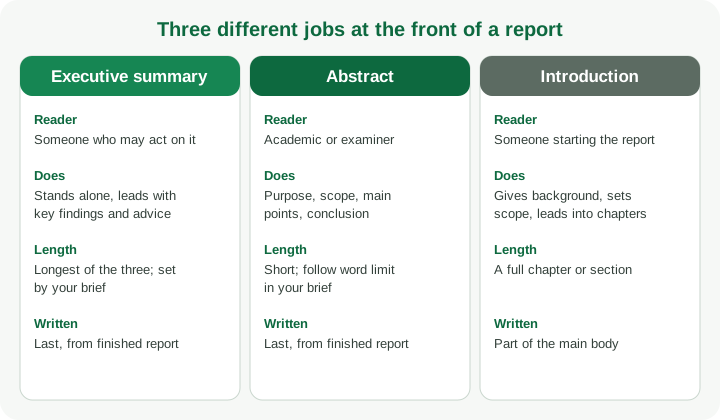
How is it different from an abstract and an introduction?
The three sit at the front of many reports, so students mix them up. The difference is mostly about the reader and the job.
| Executive summary | Abstract | Introduction | |
|---|---|---|---|
| Typical reader | Someone who may act on the report: supervisor, manager, committee | Academic reader or examiner deciding if the work is relevant | Anyone starting the report |
| Main job | Stand alone and lead with findings and advice | Compress purpose, scope, main points and conclusion | Give background, narrow the focus, set up the chapters |
| Relative length | Longest of the two summaries | Short | A full section or chapter |
| Recommendations | Often prominent | Usually implied or brief | Not the place for them |
| Referencing | May include references in some guides | Usually none | Normally cites sources |
These contrasts come from the guides opened for this article, and they are conventions, not law. The USC guide says an abstract is written for academic readers and rarely states recommendations, while an executive summary is written for outside audiences and usually makes recommendations explicit with their justification. Federation University Australia's helpsheet adds that an executive summary can start with the key findings and then expand on them, often with dot points, while an abstract follows a more compact purpose-to-conclusion line. The same helpsheet separates an abstract from an introduction: the introduction gives background and thesis, the abstract reports purpose, scope, main points and conclusions.
Some universities also use the two names almost interchangeably, depending on the assessment. That is why your first job is to find out what your department means by the word, not to assume the definition from a website.
For the abstract itself, UniDraft already has separate guides. Use the SIWES report abstract guide for industrial training and the final year project abstract guide for projects.
Seminar reports have their own seminar abstract guide. This post covers only the executive summary and where it differs.
When does a department or employer want an executive summary?
There is no single Nigerian rule. The honest position is that requirements vary by institution, faculty, department and supervisor. What can be said from the sources opened for this article is limited:
- The Naval Postgraduate School says all its theses require an abstract, while executive summaries are required only in some cases and must be confirmed with the advisor or department. That is a US example, but it shows how normal it is for the answer to differ.
Situations where an executive summary may be requested (these are judgement calls, not rules):
- A SIWES or industrial training report written like a workplace report. A department may model the report on a professional report, with front pages that include an executive summary.
- A report that goes to someone outside academia, such as an employer, a host organisation or a sponsor, who will not read the whole thing.
- Consultancy-style or case-based assignments, where the reader wants findings and advice, not the whole method.
- Long reports, where a one-page overview helps a busy supervisor.
If your handbook does not mention it, ask your coordinator one plain question: "Do you want an abstract, an executive summary, or both, and how long should it be?" Write the answer down. If the brief is silent, do not add pages the department did not request.
What should go into it?
The sources agree on a core set. Pick the ones your report actually contains.
- The purpose or headline. What the report is about and the most important thing it shows. Boston University advises introducing the problem and purpose but skipping extended background, since readers know it or can find it later.
- A brief overview of each main section. York St John describes the content as brief overviews of each section, such as aims, methodology, results, discussion, recommendations and conclusions, depending on the report.
- Key findings. What you learned or established, stated plainly.
- Recommendations, if the report makes them. Federation University notes that recommendations in an executive summary can be worded very close to those in the report. Make sure they match.
- Nothing the reader does not need. Boston University says to leave out anything the reader does not need to know.
For a SIWES report, that translates into these questions:
| Question the reader has | Take the answer from |
|---|---|
| Where and when did the training take place? | Your placement details and logbook dates |
| What kind of work did you do? | Your activities chapter, grouped by area of work |
| What was your actual role? | Your records: observed, assisted or performed |
| What did the placement teach you? | Your learning and challenges sections |
| What would you suggest? | Your recommendations section, if you wrote one |
Keep your role precise. "Assisted with" and "performed" are different claims, and you may be asked about them at your SIWES defence.
How long should an executive summary be?
Use the number in your brief. When there is none, the guides offer ranges that disagree with each other, which is the point: none of them is a universal rule.
| Source | Guidance it gives |
|---|---|
| York St John University | Recommended to keep it within a single page, varying with the report and assessment guidelines |
| Boston University School of Public Health | Most are no more than one page; some instructors want about 5 to 10 percent of the report's length |
| Federation University Australia | Can be quite long, up to 15 percent of the report's word length |
| Naval Postgraduate School | Typically 2 to 5 pages for a thesis, with abstracts around 200 words |
| USC Libraries | Rule of thumb of no more than 10 percent, with an upper limit of around ten pages |
Do not take a number from this table into your report. These come from different institutions with different kinds of reports, mostly not Nigerian SIWES reports. For a typical student report, the safe reading is: shorter than a chapter, longer than an abstract, never so long that it repeats the report. Confirm the allowed length with your supervisor.
A fictional SIWES executive summary example
This is a fictional teaching example. The organisation, dates and activities are invented. It is not anyone's real placement and is not a template to copy; replace every fact with your own records.
Executive Summary
This report covers a four-month industrial training placement in the customer-support and IT unit of a mid-sized logistics company, from March to June. The placement aimed to show how routine technical support is organised and how faults are recorded and resolved.
Under supervision, the student assisted with setting up workstations, helped document common troubleshooting steps, and observed how network faults were diagnosed and escalated. The student did not have administrative access to the company's live systems, so tasks involving network configuration were limited to observation.
The main learning points were the importance of accurate fault records, the value of checking basic equipment before escalating, and the difference between how networking was taught in class and how it is handled in a working environment with access limits. The main challenge was learning the company's ticketing process quickly enough to contribute to it.
The report recommends that the placement unit give future trainees a short written orientation on its ticketing process in the first week, and that the department schedule an early check-in with trainees about their tasks.
Why it works, sentence by sentence:
- Paragraph one gives the where, when and purpose, then stops. No history of SIWES.
- Paragraph two states the real role and the real limit. "Assisted" and "observed" are specific, and the limit prevents an inflated impression.
- Paragraph three gives the learning and the challenge, and connects classroom to practice without a generic claim.
- Paragraph four gives recommendations, each one traceable to the report. If your report has none, leave this out rather than invent some.
What it does not contain: no made-up percentages, no claim of having redesigned anything, no employer approval you were not given, and nothing that is not in the report. That is what makes it defensible.
Step by step: write it after the report
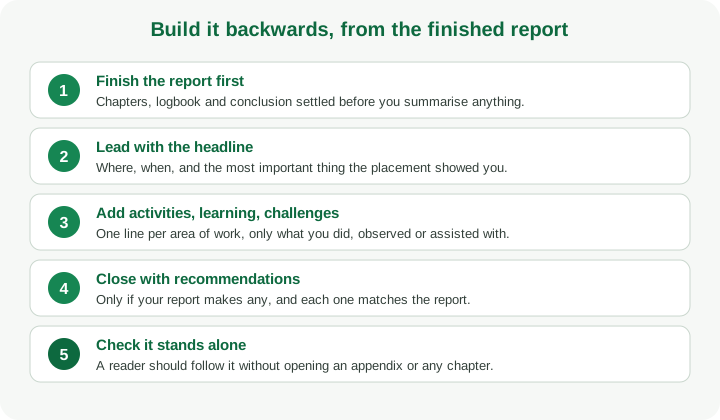
- Finish the report. Chapters, conclusion and any recommendations should be settled. York St John's guide says to write the summary after the main report is done; the same logic applies after supervisor corrections, because a changed chapter means a changed summary.
- Read your own report once, taking notes. Note the key facts, findings and any recommended actions, as the USC guide suggests.
- Draft the headline. One or two sentences: where, when, what the report is about, and the single most important result.
- Add one line per section. Activities, learning, challenges, conclusion. Group related tasks rather than listing every week.
- Add recommendations only if the report has them. Check wording against the report.
- Write new sentences. Boston University advises against copying sections of the report, which makes the reader's task repetitive.
- Cut. Remove background, definitions of SIWES, thanks and any sentence that announces what a chapter will do.
- Test it alone. The USC guide stresses that the summary must make sense on its own: if someone must open an appendix or another chapter to understand a sentence, rewrite the sentence.
- Compare it with the finished report line by line, then compare it with your report conclusion, since the two should agree.
Common mistakes
| Mistake | Fix |
|---|---|
| Treating it as an introduction | Move background and objectives to the introduction; the summary reports what the whole report found |
| Writing it first | Write it last, from the finished chapters |
| Including something the report does not say | Delete it, or add and support it in the report first |
| Pasting the conclusion and the first lines of each chapter together | Rewrite as new, joined sentences |
| Vague learning: "I gained many skills" | Name the skill and the work through which you developed it |
| Inflated role: "I managed the network" | State what you actually did, observed or assisted with |
| Confidential details | Leave out client names, passwords, patient records and sensitive figures; use the description your employer and coordinator allow |
| Adding an executive summary when the department wants an abstract | Check the handbook; do not add pages that were not requested |
Checklist before you submit
- Has your department or coordinator told you an executive summary is wanted, and how long it may be?
- Is every activity, figure and recommendation in the summary also in the report?
- Does it show your real role and any limits on your access?
- Can a reader understand it without opening another page?
- Is it written in your own words, not pasted from chapters?
- Does it fit the position your format puts it in (often after the title page and before the main body, but follow your brief)?
- Did you update it after your last round of corrections?
If you are unsure how your department wants the front pages laid out, UniDraft's free format guides are a good place to look. Because the summary sits in the preliminary pages, remember page numbering and your contents list when you add it. The table of contents guide explains how to keep a contents page accurate in Word, and the complete SIWES report guide shows where the front pages belong.
What supervisors and examiners may ask
A summary near the front invites questions about the rest. Be ready for:
- "You say you assisted with workstation setup; what exactly did you do?"
- "Which of these learning points came from your own work and which from observing?"
- "Where in the report is this recommendation supported?"
- "Why does the summary say this, when chapter three says something slightly different?"
If you can answer each by pointing to your logbook or a chapter, the summary is doing its job. See the defence preparation guide for more on this, and the guide to strong SIWES samples to see how a finished report fits together.
Is it worth it for project and seminar reports?
Executive summaries are more common in SIWES-style and professional reports than in a research project, where the abstract usually does this job. A final-year project or seminar report may ask for an abstract instead, or for both. The principle is the same either way: summarise only what the finished work contains, in the format your department names. Your supervisor corrections can change what the summary needs to say, so update it last.
Where UniDraft fits
UniDraft organises your confirmed placement work, checked sources and supervisor instructions into an editable Word document, whether that is a SIWES report, a seminar report or a final-year project. You supply the facts and review the result; the summary should always be checked against your own records and logbook before submission. Start your SIWES report.
Sources
These pages were opened while preparing this article. They are general academic writing guidance from other countries; your department's brief overrides them.
- Boston University School of Public Health: Executive Summaries
- York St John University: Guide to writing an executive summary
- Federation University Australia: Abstracts and executive summaries helpsheet
- Naval Postgraduate School Graduate Writing Center: Executive Summaries and Abstracts
- USC Libraries: Writing an executive summary