A strong SIWES report sample shows five things: a clear chapter structure, a verified profile of the host organisation, specific work-done entries (task, tools, your role, outcome), real skills and problems, and a conclusion that follows from the evidence. This post shows each with a fictional placement, so you can copy the pattern and not the content.
UniDraft helps you organise your confirmed placement details, logbook activities and your department's instructions into an editable Word SIWES report, so you are not starting from a blank page or someone else's file. Start your SIWES report, then check every paragraph against your own record. UniDraft does not fill ITF forms such as Form 8 or the SCAF, and it cannot decide what your supervisor will approve.
The short answer
- A sample is useful for shape: the order of sections, how much detail a task gets, how a conclusion links back to problems.
- A sample is dangerous for content: its company, dates, activities and wording belong to someone else.
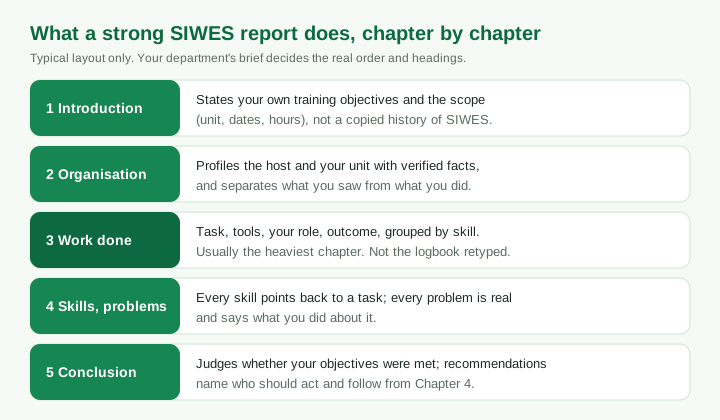
- The chapter layout below is typical, not official. Your department's SIWES brief overrides it.
- Whatever the layout, a strong report agrees with your signed logbook and says what you did, not what the unit did.
Why layouts differ, and why that matters when you read a sample
There is no single national SIWES report template. The Industrial Training Fund (ITF) coordinates the scheme, but each institution sets its own report format. Two published examples we opened show how far they can differ.
One university's guidelines (Abubakar Tafawa Balewa University, Bauchi, effective from the 2025/2026 session) list a cover page, declaration and table of contents, then four chapters: introduction (brief history of the ITF and of the placement), a literature review related to the knowledge gained, experience gained, and challenges, conclusion and recommendations. It also states page limits for the first two chapters and a type size. Its assessment splits marks across a supervisory visit, the oral presentation, the report and logbook entries, with the report carrying a modest share of the total.
A "proposed" SIWES technical report template hosted on a Nigerian university faculty website (the fci.buk.edu.ng site; a proposal, not a national rule) uses a different order: preliminary pages, then introduction with an overview and objectives of SIWES, organisation profile with mission, vision and organogram, experience acquired, and a final chapter combining summary, conclusion, limitation and recommendation.
So a sample from one school can be wrong for another even if it is a good report. That is the main reason to ask your coordinator which format applies before you look at any sample. If you want to see how marks are usually split before deciding where to spend effort, read how SIWES is graded; allocations vary by institution.
The fictional placement used below
Everything from here is an invented teaching example. Nothing here is a real company, a real student or a real logbook, and none of it should be reused.
- Student: a fictional trainee, "the trainee".
- Host: "Company X", a fictional mid-sized business with an IT support unit.
- Unit: IT support and networking.
- Placement: a fictional six-month attachment. (Your own duration depends on your programme and institution.)
- Supervisor: a fictional industry-based supervisor, "the unit lead".
The excerpts use plain wording on purpose. Notice what they do, then do the same with your own facts.
Chapter 1: Introduction in a strong sample
A strong introduction is short and personal. It says what SIWES is in a couple of sentences, then spends most of its space on your objectives and scope. A weak one reproduces a long history of SIWES that any student could paste.
Weak (generic):
SIWES was established by the Industrial Training Fund in 1973 to expose students to industry. This report is about my SIWES.
Strong (specific, fictional):
This report covers the trainee's industrial training at the IT support unit of Company X (fictional) between the dates recorded in the logbook. The trainee set three objectives: to learn how a small office network is installed and maintained, to practise diagnosing user hardware and software faults, and to understand how support requests are tracked and closed.
Annotation: the strong version names the unit, points to the logbook for dates, and states objectives that Chapter 5 can later judge. Check any historical statement about SIWES against ITF or your institution's guidance before you include it with the ITF materials your SIWES unit provides. Our full report guide covers what else belongs here.
Chapter 2: Organisation profile in a strong sample
The test for this chapter is whether every fact has a source. A strong profile separates company-wide facts (what the company does, where it operates) from what you personally saw in your unit.
Weak: "Company X is a leading company with excellent services and a bright future."
Strong (fictional):
Company X is a fictional business that sells and services office equipment. The trainee was attached to its IT support unit, which, according to the unit lead's briefing in week one, handles hardware faults, user accounts and the office network for the head office. The trainee reported to the unit lead for all assigned tasks. The company-wide reporting structure was not shared with the trainee and is therefore not described.
Annotation: "leading company" is unverifiable praise. The strong paragraph cites where the information came from (a briefing), says whom the trainee reported to, and is honest about what the trainee could not confirm. If your department asks for an organogram, draw only reporting lines you have confirmed; do not infer a company-wide hierarchy from a list of departments. A chart of who reports to whom is different from a flowchart of task steps.
Follow the host's rules on what you may disclose. Internal diagrams, client names and system details may not be yours to publish, so ask your industry supervisor first.
Chapter 3: Work done, the chapter that carries a sample
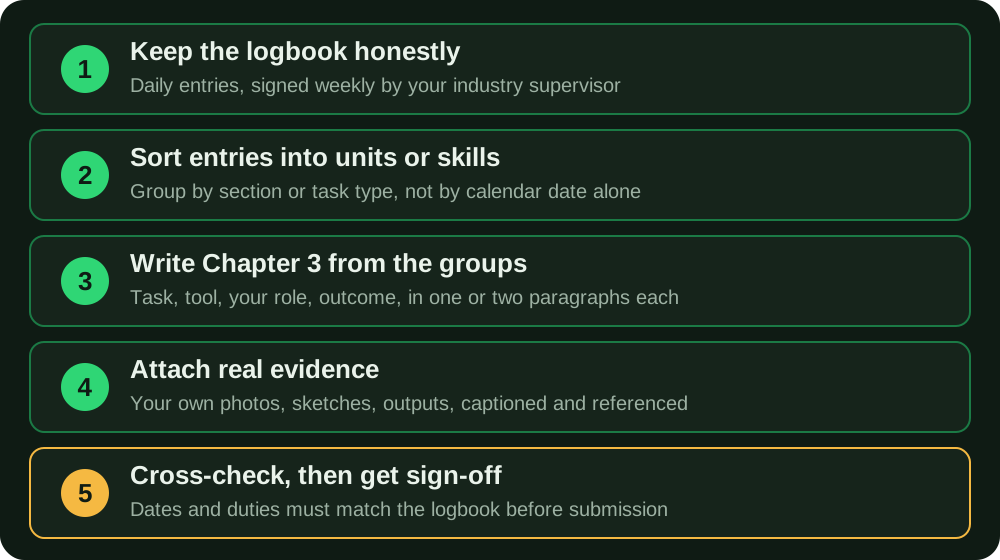
If you only study one chapter of a sample, study this one. A strong version uses the same four-part pattern for each task: what the task was, what tools or methods were used, what you personally did, and what came of it. It groups related work by skill instead of marching through weeks.
Weak (a retyped logbook line):
Week 4: Learned about networking. Week 5: Continued networking.
Strong (fictional):
Network setup and troubleshooting. In weeks 4 and 5 the trainee assisted the unit lead in preparing a managed switch for a new office extension. Under supervision the trainee labelled cables, assigned ports to the three user groups agreed with the unit lead, and tested connectivity from two workstations using ping. One workstation could not reach the file server. The trainee checked the port assignment, found that the port had been left on the default configuration, and reported it; the unit lead corrected it, and the workstation then connected.
Annotation:
- The heading names a skill area, not a date range.
- "Assisted", "under supervision" and "reported" are honest role verbs. If you only observed, say observed.
- The problem and its resolution are specific enough to check against the signed logbook.
- There is no claim about results the trainee could not know, such as company-wide performance gains.
For more detail on writing the underlying entries, see how to fill the SIWES logbook, and for discipline-specific entry styles there are computer science logbook examples. Your report and logbook should tell the same story.
Evidence in this chapter should be real: captioned photographs, screenshots or sketches from your own placement, shown only if the host and your department allow. A figure with no caption and no mention in the text proves nothing.
Chapter 4: Skills, challenges and how they were handled
Weak samples list adjectives ("I gained confidence, teamwork and communication"). Strong ones tie every skill to a task from Chapter 3.
Weak: "I acquired many skills and faced some challenges which I overcame."
Strong (fictional):
Skill: diagnosing connectivity faults, practised in weeks 4 to 6 on the extension network (see Chapter 3). Challenge: during week 8, the unit's only diagnostic cable tester was unavailable for several days. The trainee used port-by-port checks and ping tests instead, with the unit lead's approval, which took longer and covered fewer cables per day. Limit: the trainee could not verify cable quality, only whether a link worked.
Annotation: the challenge is small, plausible and specific. It names a consequence and a limit instead of a triumph. That honesty usually reads as more credible than a dramatic invented crisis. Never invent an accident, a breakdown or a conflict to fill a heading; if your placement had few problems, a short true section beats a long fake one.
Where your department uses headings such as general, technical and social challenges, keep each one tied to something that actually happened.
Chapter 5: Conclusion and recommendations
Here the sample earns or loses its marks. A strong conclusion judges the placement against the objectives set in Chapter 1, and recommendations address someone by name or role.
Weak: "In conclusion, SIWES is very important and I enjoyed it. I recommend that SIWES should continue."
Strong (fictional):
The first two objectives were largely met: the trainee took part in installing and testing a small network and in diagnosing user faults. The third was met only in part, because the ticketing system was used by the unit lead and the trainee only observed it. Recommendation to the company: give new trainees a short written orientation covering tools and who to ask in the first week. Recommendation to the department: share expectations for the report earlier, ideally before the placement begins.
Annotation: objectives are revisited and graded honestly, including a partial result. Each recommendation names an addressee and follows from a problem or gap in the body. The full method, with more weak and strong pairs, is in our guide to SIWES report conclusion and recommendations.
The pages around the chapters
A sample also shows the front and back matter, which are where formatting marks are easiest to lose.
- Cover page and certification or declaration. Wording and signatories come from your department; one published guideline we opened includes a declaration that the work is the student's own and has not been presented before. Do not sign for anyone (the free formatting checker tests layout only, not approvals), and do not fill in an approval you have not received.
- Acknowledgement. Thank real people. See what to write in a SIWES acknowledgement.
- Abstract, if required. Write it last; our abstract guide shows the shape.
- References and appendices. List only sources you cited, in your required style, and put permitted logbook pages or photographs in appendices.
What examiners commonly look for (typical, not official)
No two coordinators mark identically, and this list is not an official marking scheme. These are patterns that most guidelines and marking conversations point towards:
| What a reader checks | What a strong report shows | What a weak one shows |
|---|---|---|
| Format | Follows the department's current brief and order | Follows a sample from another school |
| Specificity | Task, tools, your role, outcome | "Learned about X" |
| Agreement with the logbook | Dates, units and tasks match the signed entries | Activities the logbook never mentions |
| Skills | Each skill points to a task | A list of adjectives |
| Honesty | Real problems, stated limits | No problems, or invented ones |
| Conclusion | Judges the objectives, addresses recommendations | Praises SIWES in general |
| Language and presentation | Formal, consistent, captions on every figure | Mixed styles, loose screenshots |
In some schools the report is also presented orally to a panel, so you need to be able to explain every paragraph. How to defend your SIWES report covers likely questions.
The traps of copying a sample
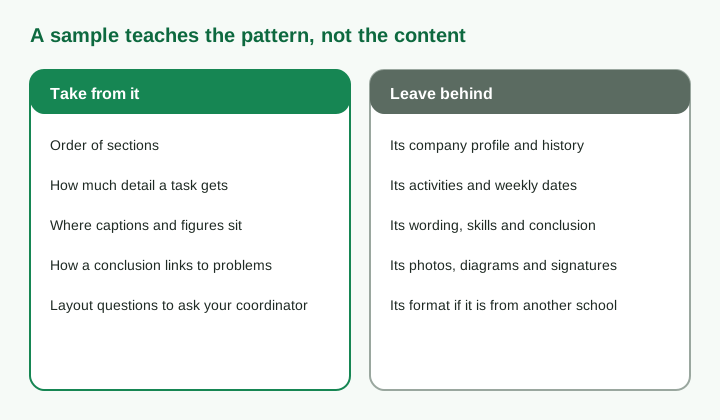
- Wrong format. A sample from another institution may use different chapters, margins, page limits or referencing. Your coordinator's current brief wins, and our university format guides list formatting rules for many institutions.
- Contradicting your logbook. Copied activities that your signed logbook does not support are a quick way to lose credibility.
- A company profile that is not yours. Changing the name leaves the wrong history, wrong structure and wrong services.
- Similarity. Copied or lightly reworded text can be flagged by similarity checks and noticed by coordinators who have read many reports.
- You cannot defend it. If you are asked to explain a paragraph about a task you never did, you will not be able to.
- Unknown quality. A polished file is not a marked file. Many samples online are undated, unattributed or auto-generated pages with little real content. We deliberately do not link sites that sell or host "ready-made" reports because their origin cannot be checked.
- Fabricated approval. Never reproduce a sample's signatures, stamps or "approved by" lines. Required endorsements must come from the people your department names.
A safe way to use a sample
- Get a sample from your own department if you can: your coordinator, a recent graduate with permission, or the department library.
- Read only the contents page first and note the chapter order and page counts.
- Read one work-done section and mark where it states task, tools, role and outcome.
- Close the sample. Build your own outline from your logbook, grouped by skill.
- Reopen the sample only to check layout details, such as heading levels and caption style.
If you would like to compare how a strong sample works for a different document type, see our seminar report sample guide, which uses the same take-the-pattern-not-the-words approach.
Pre-submission checklist
- I have my department's current SIWES brief and my report follows its chapter order.
- Every activity matches an entry in my signed logbook.
- Every company fact has a source I can name, and confidential material is left out.
- Chapter 3 uses task, tools, my role and outcome, grouped by skill.
- Each skill claimed points back to a task.
- Problems are real and each says what I did and what limit remained.
- The conclusion judges my Chapter 1 objectives, and recommendations name an addressee.
- Photos, diagrams and screenshots are mine, permitted, captioned and referred to in the text.
- No signatures, stamps or approvals are filled in by me.
- I can explain every paragraph out loud.
Where UniDraft fits in
A sample can show you what good looks like, but your report has to be built from your own record. UniDraft works from the placement details, activities and instructions you confirm and organises them into an editable Word SIWES report, which you then review and edit. It does not fill ITF forms, does not guarantee approval or a grade, and does not replace your supervisor's judgement. Questions about the official SIWES forms go to your coordinator and industry supervisor; our explainer on Form 8 shows who handles it.
Sources
- SIWES Guidelines 2026, Abubakar Tafawa Balewa University, Bauchi - one university's published report structure, language rules and assessment split.
- Proposed Template for SIWES Technical Report (fci.buk.edu.ng) - a proposed template showing a different chapter order.
- SIWES orientation report, University of Nigeria Nsukka - on completing the logbook correctly and submitting it with Form 8.