A pharmacy SIWES report should describe the pharmacy work you actually went through: the setting, the unit or section, the products and processes you saw, the checks that were made, the records that were kept, your honest role in each task and what you learnt. Pharmacy students often submit the same report: a long copy of a textbook chapter on dosage forms, a list of drugs nobody can place in a week and a closing chapter that praises the "wonderful exposure". A report that names the setting, the dates, the type of task and your real part in it is already stronger than that pile.
Your faculty's handbook and your supervisors set the chapter order, layout and evidence rules. This article gives you the pharmacy-specific parts: what to record, how to protect patients, how to describe community, hospital and industry work, and how to prepare for questions. For the mechanics that apply to every course, start from the general SIWES report guide.
The short answer
- Keep a dated record from the first day: date, unit, task, product class (never a patient), your role and the check that was made.
- Label every task observed, assisted or performed under supervision, and keep that label identical in your logbook, report and defence.
- No patient identity, prescription copy or real record appears in the report or its appendices.
- Describe the setting you were in: community pharmacy, hospital pharmacy, industry or regulatory. Each stresses different content.
- Your faculty's template and your supervisor's instructions beat any outline you read online, including this one.
Writing it up with UniDraft. After the placement, UniDraft builds your written SIWES report as an editable Word document from the details you confirm, your supervisor's instructions and your school's format, applied in that order of priority. You provide the real activities from your logbook and it handles the structure and formatting. Start your SIWES report with UniDraft
What the published material on pharmacy placements says
The picture varies by school, so treat any single description as an example, not a rule. Two sources we opened are useful for context.
A February 2026 news report describes the Clinical Department of one Nigerian faculty of pharmacy running a formal SIWES defence for its 400 and 500 level students. Students presented on their industrial postings, reflected on their development and described how they applied pharmaceutical care in clinical settings, with lecturers and external examiners guiding the process. The report names no grading scheme, so it tells you what a defence can look like, not how you will be scored.
A published study of fifth-year pharmacy students at a Nigerian university, based on two focus groups in March 2017, found that students noticed differences between classroom theory and actual practice, which they attributed to constraints in the practice environment and gaps in what they had learnt. That is useful to you as a writer: an honest account of where practice differed from what you were taught, and why, is a legitimate and interesting part of Chapter 4.
We did not find a published national rule on duration or structure that we could verify, so we are not giving you one. Duration, timing and whether your attachment is called SIWES, an externship or experiential learning depend on your institution. Ask your faculty for the written guide, and use what SIWES is for the general scheme.
Pharmacy placements are not all the same
Community pharmacy, hospital pharmacy, a manufacturing plant and a regulatory or distribution setting run very different days. The report skeleton is the same, but the evidence in the activity chapters is not.
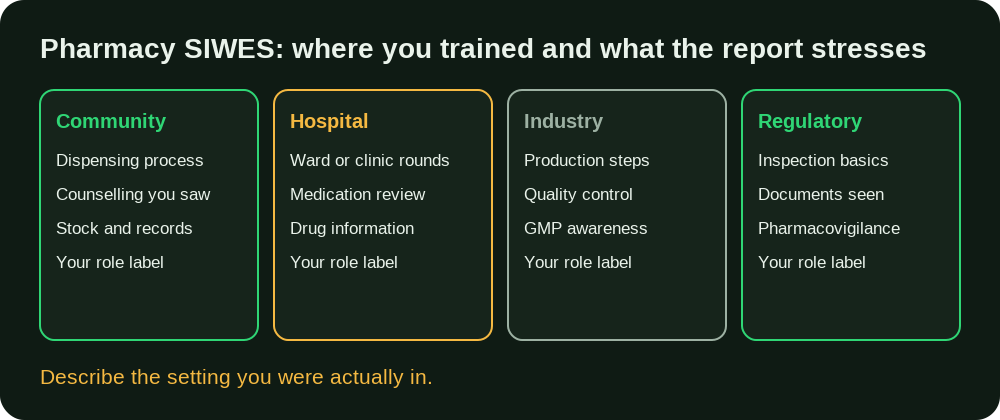
Choose the pattern nearest to your placement and write in that language.
- Community pharmacy. Your evidence is how prescriptions and over-the-counter requests were handled, how products were stored and displayed, the counselling you heard, stock control and records.
- Hospital pharmacy. Your evidence is the supply of medicines to wards or clinics, how orders and prescriptions were verified, medication-related queries, and how the pharmacy worked with nurses and doctors.
- Industry. Your evidence is production steps, in-process and finished-product checks, documentation, cleanliness and the awareness of manufacturing standards that your host explained to you.
- Regulatory, distribution or warehouse settings. Your evidence is documents, storage conditions, handling of returned or expired stock and inspection routines you were shown.
If you rotated through several settings, give each its own dated block and say how many days you spent there. Do not claim expertise in a unit you passed through for two days.
What a good pharmacy logbook entry contains
Pharmacy work is procedural and full of checks, which makes it easy to record well and easy to fake badly. The fix is the same in every discipline: write what happened when it happened, and keep your role honest.
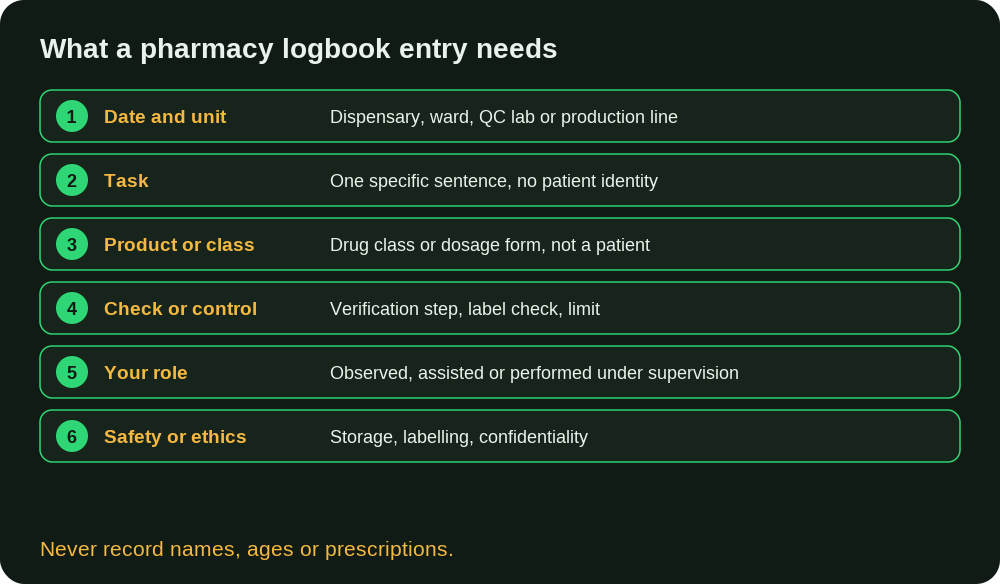
- Date and unit. The day and the section, such as dispensary, ward pharmacy, quality control or production line.
- Task. One specific sentence about what you did or saw.
- Product or class. The dosage form or therapeutic class, never a patient. "An oral suspension for a child" is enough.
- Check or control. The verification step: label check, expiry date check, dose check, in-process test, storage temperature record.
- Your role. Observed, assisted or performed under supervision.
- Safety or ethics. Storage, labelling, handling of controlled or hazardous products, confidentiality.
The logbook guide explains weekly sign-off and why entries written in one sitting are easy to spot.
A sample entry table
This is a layout example with placeholders, not content to copy. Your own dates, units and tasks replace everything in it.
| Day | Unit | What was done | Role |
|---|---|---|---|
| Mon | Dispensary | Learnt the layout of stock shelves, the labelling format and the expiry-date check before any item is dispensed | Observed |
| Tue | Dispensary | Helped pick and label items against a prescription, then handed the work to the pharmacist for the final check | Assisted |
| Wed | Stores | Took part in receiving a delivery and comparing the delivery note against the order | Assisted |
| Thu | Counselling area | Listened to the pharmacist explain how to take a medicine, noted the points that were stressed | Observed |
| Fri | Weekly review | Reviewed the week with the supervisor and had the logbook signed | Performed |
The table shows the unit, the task and the student's part. It says nothing about a patient and nothing about a prescription's content.
Protect the patient: what never goes in the report
Pharmacy handles information about people's health. A good report protects it.
- No names, ages, addresses, folder numbers or phone numbers, in the text, figures or photographs.
- No copied prescriptions or medication records, including in appendices. Describe the type of request instead.
- No photographs of screens, registers, labels or patients.
- No internal documents. Standard operating procedures, formularies marked internal and batch records are usually controlled. Summarise the idea in your own words.
- Ask first. If you are unsure whether your host allows you to describe something, ask your industry-based supervisor and note that you did.
This is both an ethical point and a practical one. A panel trusts a student who handled information carefully more than one who put a real prescription in an appendix.
Writing about community and hospital work
The temptation in these settings is to write about the drugs. Write about the process.
Pick three or four tasks you saw repeatedly and describe each with this pattern:
- Purpose. What the task is for, in one sentence.
- What you saw done. The steps in order, at the level of a careful summary.
- The check. What was verified, by whom, and what would happen if something was wrong, for example a label that did not match.
- Your role. Observed, assisted or performed under supervision.
- Something specific. A query that needed the pharmacist, a stock-out and how it was handled, a labelling error caught at the check.
Three or four tasks described like this, with concrete details, are worth more than twenty drugs listed in a sentence each. If your placement included counselling, write about the points the pharmacist stressed and why, in your own words. Do not write that you counselled unless you did so under supervision.
Writing about industry placements
Manufacturing and quality settings reward precision and punish vagueness. Describe the area you were in, the product type in general terms, the steps you saw, the checks that were performed and the records that followed. Where numbers are involved, such as a limit, a count or a temperature, include them only if you saw them on the day and your host allows you to publish them. Otherwise describe the type of check and its purpose.
Awareness of manufacturing standards is a good topic for a student who did not run the process. You can write about what your supervisor explained about cleanliness, gowning, line clearance, labelling control and documentation, as things you were taught and saw practised. Do not claim the company is certified or inspected unless it is public and you were told so. If your placement was a laboratory unit, the laboratory science report guide covers bench records, quality control and biosafety writing in more detail, and you can borrow its structure for the quality-control chapters.
Figures, tables and calculations
Good figures in a pharmacy report are modest and yours:
- A table of the units you rotated through, with dates and what you did in each.
- A flow diagram of how a request moved from reception to dispensing, or how a batch moved through a production stage, drawn from what you were shown.
- A labelled sketch of the layout of the dispensary or stores, if your host allows it.
- A worked calculation such as a dose or dilution, but only one you did or witnessed, with your own illustrative numbers clearly labelled as an example, never a real patient's.
Number each one, caption it, refer to it in the text and say what it shows. If you write chemical or drug formulas, the guide to formatting chemical formulas in academic reports shows how to typeset subscripts and symbols correctly in Word.
A working chapter outline
Use this only where your approved template leaves the activity chapters open. Your faculty's layout comes first.
Preliminary pages. Title page, certification, acknowledgement, abstract if required, table of contents and lists of tables and figures. Do not add a signature or stamp you have not received.
Chapter 1: Introduction. Brief and accurate background to SIWES, the aim of your training and the scope of your report.
Chapter 2: The host organisation. Name, location, type, services, structure and the units you were attached to, written from what you saw and what your host allows.
Chapter 3: Training activities. Organised by unit and period. Each block follows the pattern above: purpose, what you saw, the check, your role and something specific.
Chapter 4: Experience gained, challenges and lessons. Skills built, tied to specific weeks, and real challenges, including any gap you noticed between what you were taught and what you saw in practice, with how it was handled.
Chapter 5: Conclusion and recommendations. A short summary, your judgement of the training and recommendations addressed to a named party. The conclusion guide shows how to write them without sounding like a complaint.
References and appendices. Textbooks and guidance you cited, and any appendix your host allows.
Common mistakes supervisors flag
- A textbook in disguise. Chapters on "dosage forms" or "routes of administration" with no mention of what happened in your pharmacy.
- Role inflation. "I dispensed" when the record shows you picked and labelled under supervision.
- Real patient data. Names, folder numbers or prescriptions in the text or an appendix.
- No checks. Tasks described as if nothing is ever verified.
- A list of drugs. Brand and generic names strung together without a task around them.
- Copied host description. A company or hospital history pasted from a website.
- A logbook and report that disagree. A unit in the report that the logbook does not show.
- Wrong formatting. Font, spacing and heading levels that differ from your institution's rules. The free formatting checker reads a .docx and flags mismatches, and the format directory lists university rules where they are on record.
Defence questions to prepare for
Whether or not your faculty holds a formal defence, expect questions on role and reasoning. Prepare honest answers to these:
- Walk me through one task from receiving a request to completing it.
- What checks were made before a product left the dispensary or the line?
- What would you do if a label did not match the request?
- How were controlled or hazardous products stored and recorded?
- Which part of the report did you only observe?
- What differed from what you were taught in class?
- How did the pharmacist or supervisor communicate with other professionals?
- What would you recommend the host change?
The guide to defending your SIWES report covers how to structure answers and what to bring.
A realistic writing timeline
- Week one: rebuild the record. Lay your logbook out by week and unit, mark gaps honestly and ask your supervisor to confirm any detail you are unsure about.
- Week two: draft the activity chapter from the record, setting by setting, with role labels and checks.
- Week three: the rest. Host organisation, experience gained, challenges, conclusion and recommendations.
- Week four: figures, formatting and consistency. Number and caption figures, apply the required formatting and compare every claim with the logbook.
If your supervisor sends corrections, managing IT report supervisor corrections shows how to track them.
Pre-submission checklist
- Every activity matches a dated logbook entry and carries an observed, assisted or performed label.
- No patient identity, prescription copy or real record appears anywhere, including appendices and photographs.
- Tasks are described in your own words, with the check that applied.
- Figures and tables are numbered, captioned and discussed in the text.
- Chapter order, headings and length match your faculty's guide.
- No signature or approval appears that you have not actually received.
Where UniDraft fits in
UniDraft builds your written SIWES report as an editable Word (.docx) document from the placement facts you confirm, your supervisor's instructions, your department's format and your university's format, applied in that order of priority. If your supervisor sends corrections, you give them to UniDraft and a new version is created while earlier versions are kept. Bring the real details of your dispensary, ward or plant days, because those are what you will be asked about.
Start your SIWES report with UniDraft
Sources
- News report: faculty of pharmacy conducts SIWES defence for clinical students (February 2026): example of a formal SIWES defence in pharmacy.
- Pharmacy Education: study of fifth-year pharmacy students' experiential learning: abstract describing focus groups on differences between classroom theory and practice.