Publishing from a final year project means rewriting one focused part of it as a short journal article, not trimming the report. The article needs one clear question, tighter literature, the journal's own structure, honest authorship, evidence of ethics approval where relevant, and a journal you have checked. Discuss feasibility with your supervisor first.
Your project report is still the foundation. UniDraft organises your confirmed work, checked sources and supervisor instructions into an editable Word document, so the version that gets you a pass is complete and traceable before you adapt anything. Start your project document now, and treat the article as a second, separate piece of writing. If you are still in the early stages, the free topic generator helps you think about a question you could later defend and publish.
Is your project even a candidate for publication?
Most final year projects will never be published, and that is normal. A project is assessed for whether you can carry out a research process. A journal asks a different question: does this add something its readers do not already know? Before you invest weeks, run an honest check with your supervisor.
| Question | Why it matters |
|---|---|
| Is there one clear question the work answers? | An article makes one contribution; a report can carry several objectives. |
| Is the method sound and fully described? | Reviewers examine methods closely. Gaps you could hide behind a pass mark will be noticed. |
| Is the evidence real and kept? | You need the data, instruments and approvals on file, not memories of them. |
| Does it say something new or useful to a specific readership? | A competent repeat of a well-known study may still be a good project and a weak article. |
| How was the project assessed, and what did examiners flag? | Unresolved weaknesses in design or evidence will not disappear by rewriting. |
A published guide from Aberdeen's library advises agreeing with your supervisor on the thesis's most compelling contribution and the best article format, such as a research article, position paper or review. That conversation is the real first step. Do not skip it and do not treat it as a favour request; the supervisor knows what the department considers sound.
What changes between a project report and a journal article?
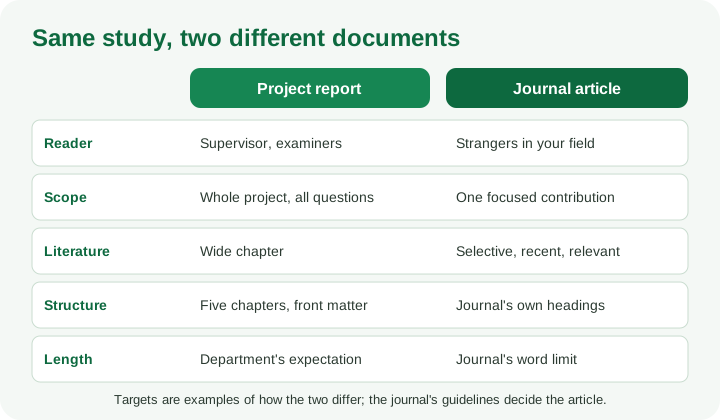
The main change is that the article is a new document for a different reader. Elsevier's researcher-focused advice on turning a thesis into an article describes journal articles as much shorter than theses and says to treat the paper as a new, tighter piece of work. Aberdeen's guidance makes the same point about structure: most journal articles follow an Introduction, Methods, Results and Discussion pattern, so a thesis has to be reorganised around the key findings and what they mean.
Length and scope
Your report may carry three or four objectives and many tables. An article usually carries one question. If your project asked about, say, three related things, choose the one with the strongest evidence and leave the rest for another paper or drop it. Elsevier's advice for multi-question theses is to combine or focus them rather than cram everything in.
Check the target journal's word limit before you write, not after. The limit is the journal's, and it varies, so this post gives no number.
Framing and the introduction
A project introduction often explains the background, the problem, the objectives, significance and scope across several sections. In an article that shrinks to a short opening that places the question in existing research and states what you did. Elsevier's tips suggest keeping the introduction brief and to the point, and using the thesis's introduction material to shape the abstract.
The framing also changes. A report can say, in effect, "I did this to satisfy a requirement and learn the process." An article cannot. It has to say what is missing in the literature and how your study responds. The research gap guide helps you state that without overclaiming.
Literature review
The report's literature chapter shows your department that you read widely. The article's literature section is selective: the most relevant and recent sources that position your question. Journals often limit references, so be ruthless. Do not carry over the entire chapter and do not cite a paper you have not read.
If you need to rebuild or refresh the source list, finding research papers covers legitimate full-text routes, and reading a research paper covers what to record so you can describe other studies accurately.
A reference manager helps keep the list consistent; see the Zotero and Mendeley guide.
Methods, results and discussion
Methods stay essential, but they are written to be succinct and repeatable. Results should present the findings that answer your single question; extra tables from the report usually do not belong. The discussion should interpret what you found, tie it to existing literature, admit limitations and suggest what should follow. Elsevier specifically advises interpreting rather than repeating the results. The limitations guide shows how to state weaknesses honestly, which reviewers value more than hidden ones.
Abstract
The article abstract is a standalone summary, usually written last, from the finished text. Many project abstracts mirror your department's format. Do not paste yours in unchanged; the journal's instructions govern length and structure. The abstract guide covers what an abstract must contain, which carries over, even though word limits do not.
Front matter and back matter
Dedication, certification, acknowledgement, declaration and lists of tables are report requirements. They do not become sections of the article. Follow the journal's template instead, and keep the department's formatting for the report, which is exactly what UniDraft's format guides and formatter are for.
Authorship: who goes on the paper, and where does your supervisor fit?
Authorship in a student-supervisor paper is where avoidable conflict starts. Settle it in writing before drafting, and base it on a recognised standard rather than seniority.
The International Committee of Medical Journal Editors (ICMJE) recommends authorship based on four criteria, all of which should be met:
- A substantial contribution to the conception or design of the work, or to the acquisition, analysis or interpretation of data.
- Drafting the work or revising it critically for important intellectual content.
- Final approval of the version to be published.
- Agreement to be accountable for all aspects of the work, including resolving questions about accuracy or integrity.
The same ICMJE page says people who do not meet all four should not be listed as authors but should be acknowledged, with their specific contributions stated. It also says activities such as securing funding, general supervision, administrative support, or writing assistance, language editing and proofreading alone do not justify authorship. Because acknowledgement can imply endorsement, the page recommends obtaining written permission from each person acknowledged.
ICMJE is a medical-journal standard, and your field or journal may follow a different convention. It is a useful, openly published benchmark, and the journal's author guidelines remain the final word.
What this means in practice:
- A supervisor who shaped the design, helped interpret results, revised the draft and will stand behind the paper can reasonably be an author.
- A supervisor who only approved the topic and signed forms may be better acknowledged, if they agree.
- A friend who typed up the questionnaire data, or who proofread, is a contributor to acknowledge, not an author.
- Nobody should be listed without their knowledge and agreement.
- The ICMJE page also states that AI tools cannot be listed as authors, and that AI use should be disclosed. Humans stay accountable for everything submitted.
A short, calm conversation works: "I would like to write a paper from the project. What do you think my role and yours should be, and who else contributed?" The supervisor corrections guide covers working through feedback, which you will meet again from reviewers.
How do you choose a journal and avoid predatory ones?
Start with fit. Elsevier's advice is to check the target journal's aims and scope before writing, and to read at least three recent papers from it as models of the expected form. Ask your supervisor which journals people in the department read and cite.
Then check the journal's trustworthiness. Think. Check. Submit. is a campaign led by organisations in scholarly publishing that offers a checklist of questions. It does not publish a list of approved or banned journals; you apply the questions yourself. Its journal checklist asks, in substance:
| Question | What to look for |
|---|---|
| Do you or your colleagues know the journal? | Have you read articles from it, is the name distinct, can the ISSN be verified? |
| Can you identify and contact the publisher? | Clear publisher name and real contact routes (email, phone, postal address). |
| Is the peer review process clear? | A stated process, independent reviewers, and no guarantee of acceptance or very short review times. |
| Are articles indexed or archived? | Discoverable in a recognised database, with long-term preservation and persistent identifiers. |
| Are fees clear? | What the fees cover, when they are charged, the amounts and any waivers. |
| Are author guidelines provided? | Licence and copyright terms, repository rules, conflict-of-interest policy, formats. |
| Is the publisher part of recognised initiatives? | For example COPE membership, DOAJ listing for open access journals, or hosting by services such as African Journals Online. |
The checklist says that if you can answer yes to most or all of these questions, you can proceed with submission. Treat a cluster of "no" answers, or any promise of guaranteed acceptance, as a reason to stop. Unsolicited emails inviting you to submit are a prompt to run the checklist, not a recommendation.
Some further cautions that are common sense rather than rules:
- Do not pay a fee until the fee policy is written, clear and something your supervisor has seen.
- Do not submit the same manuscript to two journals at once.
- Search the journal's name on its own site rather than trusting a link in an email, and confirm the website matches the publisher the email names.
- If a journal's name closely resembles a famous one, slow down and check it is the same organisation.
What ethics evidence will you need?
A journal reviewing human-participant work wants proof that people were treated properly. What exactly it requires depends on the journal and your field, so read its author guidelines and ask your supervisor. Gather the evidence now, because it is hard to recreate later:
- Any ethics or departmental approval for the study, with date and reference where one exists.
- The consent form or consent script you used, and a record of how consent was obtained.
- A description of how you protected privacy, such as anonymising responses and storing files securely.
- The instruments you used (questionnaire, interview guide) in their final versions.
- Permission from any organisation that allowed access to staff, records or sites.
If your project was a software build, a desk study or a secondary-data analysis, ethics requirements are different, and the journal may ask you to state why none applied. Do not invent an approval you never had. If you did not obtain a required approval, tell your supervisor now; that may limit which journals can accept the work. The research ethics and consent guide and the data management plan guide explain what to keep and why.
Will your own project text cause an overlap problem?
A passed project report usually sits in your department, sometimes in a repository. Journals care about this under their prior-publication policy. Aberdeen's guidance tells authors to ensure the thesis does not violate the journal's policy on prior publication and to review the licence terms to see which rights they keep. It does not specify how much overlap is acceptable, and neither can this post; read the target journal's policy and ask the editor if it is unclear.
The safe habits are straightforward:
- Rewrite in new sentences for the new structure instead of copying chapters.
- Say in your cover letter, if the journal asks, that the work derives from a degree project.
- Keep your references and data traceable.
- Check your text with the same care you gave the project. The similarity report guide explains what such reports can and cannot tell you, and paraphrasing without plagiarising covers rewriting properly.
A plain timeline from project to submission
The pace depends on your supervisor, the journal and your other commitments. This is a sequence, not a promise of dates.
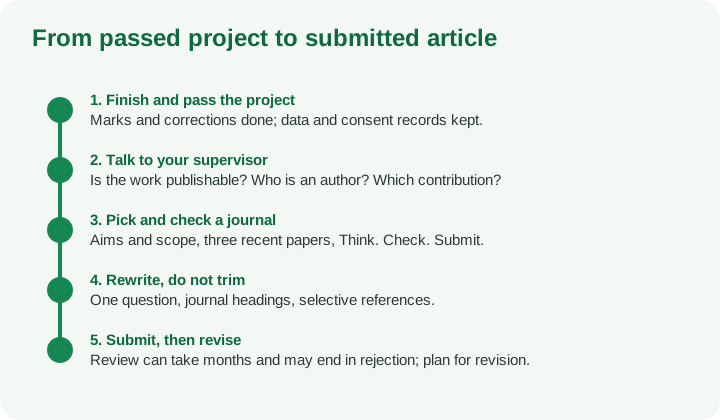
- Finish and pass the project. Complete corrections, keep a clean copy of the final report, and store the data, instruments and approvals together.
- Talk to your supervisor. Ask whether the work is publishable, which contribution to build on, and who should be an author. Write the agreement down.
- Choose and check a journal. Read the aims and scope, read three recent papers, run the Think. Check. Submit. questions, and read the author guidelines.
- Rewrite. Draft the new introduction, selective literature, concise methods, focused results and discussion. Prepare the abstract last.
- Share, polish, submit. Get your supervisor's feedback and a peer's read, check every reference, then submit following the journal's process, including any ethics and conflict-of-interest statements.
- Respond to reviewers. Editors often ask for revisions, and rejection is common in any field. Answer each comment politely, change the manuscript where the point is fair, and explain clearly where you disagree. Review time is outside your control.
Common mistakes
- Cutting chapters down instead of writing a new, focused paper.
- Keeping every objective in the article.
- Assuming the supervisor is automatically an author, or leaving out someone who contributed substantially.
- Citing papers you have not opened.
- Submitting to the first journal that replies enthusiastically.
- Paying fees before the policy is understood.
- Claiming ethics approval you cannot document.
- Submitting to two journals at the same time.
Questions your supervisor may ask
- What exactly is new in this study, and for whom?
- Which one question will the article answer?
- What evidence of ethics approval and consent do you hold?
- Who contributed what, and who agreed to be an author?
- Why this journal, and how have you checked it?
- Will you disclose that the work began as a degree project?
If you can answer these in a paragraph each, you are ready to start drafting. If you cannot, that is useful information too.
Where UniDraft fits
The report comes first. Bring your confirmed results, checked sources and your supervisor's instructions, and start your project document with UniDraft to organise them into an editable Word file. Writing the journal article, choosing the journal, and deciding authorship remain your decisions with your supervisor. The free citation tool can help you locate sources; always check them against the original paper.