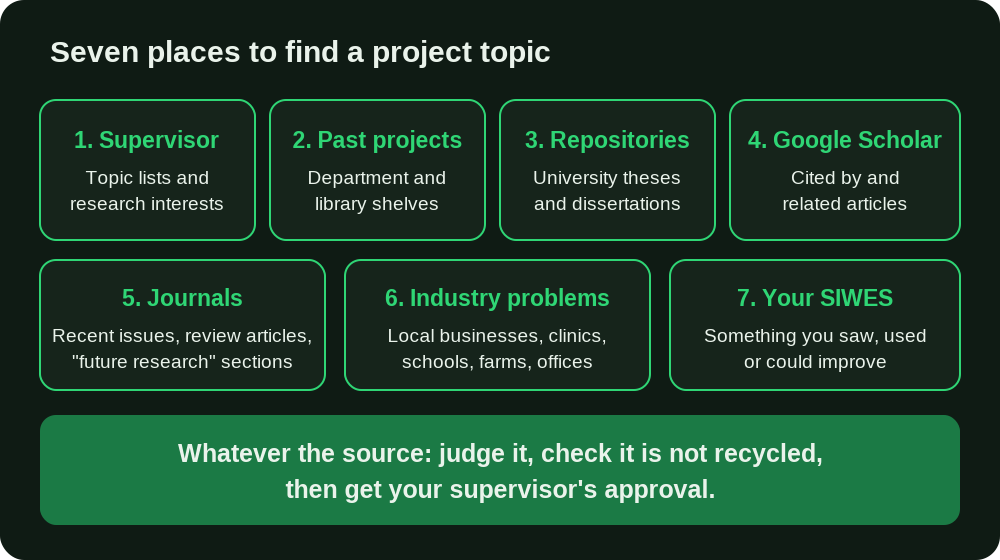
You can find final year project topics in seven places: your supervisor and department, your department's past projects, a university thesis repository, Google Scholar, recent journal and review articles, real problems in organisations around you, and your own SIWES experience. The first one matters most, because a topic only counts once your supervisor approves it.
Where you look is a different question from how to decide. If you already have a list of candidates and need to pick, read how to choose a final year project topic. This guide is about the earlier step: where good candidates come from, which sources to trust, and how to avoid ending up with the same topic as ten other students.
The short version
- Start with people, not websites. Your supervisor and project coordinator know what your department will approve.
- Use past projects to see what has been done and to avoid it, not to copy.
- Use Google Scholar and journals to find questions that are still open.
- Use the world around you, including your SIWES placement, to find a real problem and a place to get data.
- Treat any list you did not get from your department as an idea source only.
- Before you commit, run the source check and the recycled-topic check later in this guide, then take two or three options to your supervisor.
Once your topic is approved, UniDraft helps with the next job: writing the project up. It builds your final year project document as an editable Word file from your confirmed work, your supervisor's instructions and your school's format. Start your final year project document with UniDraft.
1. Your supervisor and departmental topic lists
What it is. Many departments either publish a list of suggested topics or expect each supervisor to offer areas they want to supervise. Some assign supervisors first and let the topic grow from a conversation. Practice varies between universities, faculties and even departments, so there is no single national rule to quote. Ask.
Why it is the best source. The person who will guide you and mark the work already knows the area. They can tell you whether the data is reachable, whether the equipment exists, and whether a topic is too big for the months you have. A topic that comes from your supervisor's interests usually gets faster, more useful corrections, which matters when you reach the stage covered in managing final year project supervisor corrections.
How to use it.
- Ask your project coordinator or HOD's office whether there is a topic list or a rule on how topics are assigned.
- Ask your supervisor which areas they are working in this session.
- Bring a short list, not an empty hand. Two or three working titles, each with one line about the angle and a couple of papers you have found, shows you have done groundwork.
- Write down what the supervisor says about each. Their reasons teach you what your department values.
How to judge it. A supervisor's list is the most trustworthy source you will find, but it is still a starting point. Supervisors suggest areas more than finished titles, and some lists are reused year after year, so students in your own class may be given the same suggestion. Ask whether other students are working on it.
2. Your department's past projects
What it is. The projects of earlier graduating sets, which may sit on library shelves, in the department's archive, or occasionally in a digital folder. Access rules differ: some departments allow browsing, some allow viewing only under supervision, and some do not release them at all.
Why it helps. Past projects show you three things that no website can: what your department accepts as a project, what depth and length are normal, and which topics have already been used. If you want to see what a finished one looks like, what to look for in a final year project sample explains how to read one critically.
How to use it.
- Read the titles first. Group them by theme. The themes that keep recurring are the ones most likely to be recycled.
- Read the "recommendations for further study" part of two or three recent ones. Authors often name what they could not cover, and that is a legitimate seed for a new topic.
- Note the methods used. If every project in your department uses a questionnaire, a topic needing a lab or software build may need extra supervisor support.
How to judge it. Past work tells you what has been done, not what is good. Some past projects are excellent and some barely passed. Use them to learn the format and to avoid duplication. Do not reuse the text, tables or data. Apart from the academic dishonesty problem, examiners who know the department will notice, and the plagiarism and similarity report can be checked against more material than you expect.
3. University repositories and theses
What it is. Many universities keep an institutional repository, a searchable collection of theses, dissertations and sometimes undergraduate projects. Nigerian universities differ widely in whether they have one, what they put in it, and whether it is public. Search your own university's library website and ask the librarian. Do not assume yours has one.
Why it helps. Postgraduate theses are long, carefully referenced and supervised. Their literature chapters are often the best map of a subject you will find, and their "gaps" sections give you topic ideas at a higher level that you can scale down to undergraduate size.
How to use it.
- Search by keyword and by department to see how others have framed similar studies.
- Scale down: a PhD question about a whole region becomes a final year question about one local government area, one institution or one firm.
- Read the reference list, because it shows you where to search next.
How to judge it. Check who supervised it, the year, and whether the full text is available to you. A thesis with no date or no named institution is of limited use. As with any source, use it to get ideas and references, and write your own study.
4. Google Scholar
What it is. A free search engine for scholarly literature. Google's own description is that it lets you explore related works, citations, authors and publications, and that it can link you to full documents through your library or elsewhere on the web (see Sources).
A simple topic-finding routine.
- Search a broad area from your course, for example a subject you scored well in or liked.
- Add "Nigeria" or the name of a state or a sector to see local studies.
- Open one recent paper that interests you. Read the abstract and the last section.
- Click Cited by to see newer papers that built on it, and Related articles to see neighbouring work.
- Write down three questions the papers leave open. One of them is probably your topic.
Using the date filter on the left to show recent years keeps you from building a topic on a situation that has since changed. The same search habits feed your literature review later; how to write a literature review shows how to turn the papers you collect into a chapter.
How to judge it. Scholar returns everything from strong journals to weak ones. A result being listed is not evidence that it is good. Look at the journal, the authors' institution and whether the paper is peer reviewed, using the journal checks in the next section.
5. Journals and review articles
What it is. Peer-reviewed articles in your field. A review article summarises a whole area and usually ends with gaps and future directions. A research article reports one study and often ends with limitations and suggestions.
Where to browse. Open-access collections let you read without paying. African Journals Online (AJOL) indexes journals published in Africa across many subjects, and the Directory of Open Access Journals (DOAJ) describes itself as an index of open access journals from around the world that are quality-assured and peer-reviewed. Browse the latest issues of two or three journals in your area and write down recurring themes.
How to use it.
- Read the title list of the latest two issues. Repeated themes are live topics.
- Read the introduction of one article. The problem paragraph usually names what is still debated.
- Read the "limitations" and "suggestions for further research" lines. Each is a ready-made question with a reference attached.
How to judge a journal. The Think. Check. Submit. checklist, supported by publishers and library bodies, asks questions that work for readers as well as authors. In plain terms:
- Can you identify the publisher and contact them?
- Does the site explain how peer review works, and avoid promising very fast acceptance?
- Is the journal indexed somewhere searchable, such as DOAJ or a regional platform like AJOL?
- Are fees, if any, stated clearly?
- Have you or people in your field read articles from it before?
If a journal fails most of these, do not build your literature around it. A weak source can drag a good topic down, and it affects how you cite later; how to write references covers the mechanics.
6. Real problems around you
What it is. A topic that starts as an observation, not a title. A small business that loses sales during power cuts. A school where record-keeping is still on paper. A clinic with long waiting times. A farm cooperative that cannot track inputs. A department office that still handles results by hand.
Why it works. Real problems come with a setting, a group of people and a reason the study matters. That is most of what a statement of problem needs, and it makes the work specific, which supervisors like. If you take this route, how to write the statement of problem shows how to turn an observation into the opening of Chapter One.
How to use it.
- Pick a setting you can access: a business, school, hospital, office or community you can actually visit or contact.
- Describe the problem in one sentence with who, where and what goes wrong.
- Ask whether there is existing literature on that kind of problem elsewhere, even if not in your exact setting.
- Ask whether you can get permission and data. If you cannot, the topic is not workable, however interesting.
How to judge it. The test for a local problem is access and ethics. Can you reach enough respondents or records? Will the organisation allow it? If people are involved, will you need consent and to keep their details private? Your department may have its own rules on this, so ask before you collect anything.
7. Your SIWES experience
What it is. The industrial training period, covered in what SIWES is, puts you inside a workplace for months. That makes it one of the most underrated sources of project ideas.
What to look for.
- A process that was slow, manual or error-prone.
- A tool or system your organisation used that you could evaluate.
- A recurring complaint from customers or staff.
- A skill gap you noticed among colleagues.
- A measurement the organisation never made but would have found useful.
Cautions.
- Permission. Do not use the organisation's data, names or figures without permission. If you were told something in confidence, leave it out.
- Separation. Your SIWES report describes what you did during training. Your project is a separate study. Do not recycle sections of one into the other.
- Fit. Check with your supervisor that a workplace-based topic suits your department. Some expect a more theoretical or lab-based study.
How to judge it. If the idea came from a real workplace, ask whether it could be done by someone who did not work there. If not, you may be too dependent on your placement staying cooperative for the entire project.
How to judge any source
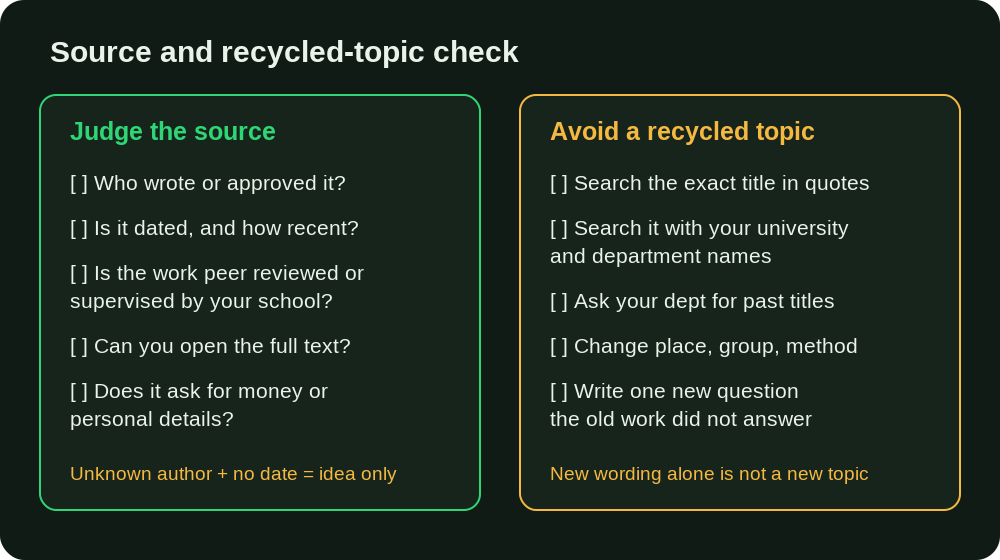
Topic sources vary hugely in quality. Run each one through the same questions. Figure 2 puts them on one page.
| Question | A good sign | A warning sign |
|---|---|---|
| Who produced it? | Named supervisor, department, publisher or researcher | No author, no institution |
| When? | Dated and recent for a fast-moving field | Undated, or years old on a field that has changed |
| Was it reviewed? | Supervised by a school or peer reviewed | Nobody checked it |
| Can you read the full thing? | Yes, openly or through your library | Only a title, or a paywall for the title |
| What does it want from you? | Nothing | Money or personal details for a list |
| Does it fit you? | Right level, country and discipline | Written for another level or setting |
Project topic websites and downloaded lists
Search for a topic and you will find many Nigerian websites that list thousands of titles by department, along with downloadable "project materials". Their quality and terms differ, and some are mainly commercial. We do not recommend any of them as a source of an approved topic, and we do not link to them.
If you look at one anyway, use it only to notice a subject area, then discard the title and rebuild it from sources you can verify. A listed title is shared with whoever else found the same page, has no link to your department's approvals, and may be years old. The same warning applies to forwarded PDFs, explained in more detail in why a downloaded topics list is riskier than it looks, which is written about seminars but applies to project lists in the same way.
If you want a shortlist tailored to your course, the free topic generator takes your department and a favourite course and gives you candidates to bring to your supervisor.
How to avoid a recycled topic
A recycled topic is one that has been done, often more than once, in your department or school. It is the most common reason a topic gets turned down late. Here is a fast method.
- Search the exact title in quotation marks on Google and Google Scholar. If it appears, someone has used it.
- Search the key words with your university and department name. For example, add the school name after the main terms. Look for repositories, library pages and journals that mention it.
- Ask for the past-titles list. Your project coordinator or library can say whether the topic or a close version has been done.
- Count how often the theme appears. If many titles in your department begin with the same phrase, the area is crowded.
- Change the substance, not the wording. A different location, population, time period, technology, variable or method creates a new study. Renaming does not.
- Write one question the earlier work did not answer. If you cannot, the topic probably adds nothing.
Example of turning a recycled topic into a fresh one
The following is an illustrative template, not a topic you must use.
- Recycled version: "The impact of social media on students' academic performance."
- Narrowed by place and group: "Social media use and study habits among final year students of [Department] at [University]."
- Narrowed by question: "Whether time spent on [named platform] during exam periods is associated with [named outcome], as reported by students of [Department] at [University]."
- What you add: a specific setting, a clear variable and a question the broader title avoids.
Whether a topic like this is acceptable in your department is for your supervisor to say. Once you have a narrowed topic, how to write research questions and objectives shows you how to break it into questions you can answer.
Common mistakes when looking for a topic
- Starting on a website instead of with your supervisor. You may fall for a title your department would reject.
- Picking a topic with no accessible data. Great idea, no respondents, no project.
- Choosing something too broad. "Cloud computing" or "malnutrition in Nigeria" is a subject, not a topic.
- Choosing something too new to have literature. You need real papers to build a review.
- Copying a past project's title and structure. Reusing the structure invites the same questions from examiners.
- Waiting too long. Topic hunting that runs for weeks leaves little time for the proposal. When you are ready, how to write a final year project proposal takes you through the next step.
- Skipping approval. A topic is not yours until your supervisor says so.
A two-week plan for finding a topic
If you have no topic yet, this plan gets you to a supervisor-ready shortlist without wasting time.
| Days | What to do |
|---|---|
| 1 to 2 | Ask your coordinator about topic lists, assignment rules and deadlines. Write down every course or area you enjoyed. |
| 3 to 4 | Browse your department's past titles. Note recurring themes and what to avoid. |
| 5 to 7 | Use Google Scholar and two journals. Collect five recent papers in your favourite area and note the open questions in each. |
| 8 to 9 | Note any real problem you saw at SIWES or in a local organisation. Check you can get permission and data. |
| 10 to 11 | Draft three working titles. Run each through the source check and the recycled-topic check. |
| 12 to 13 | Narrow each by place, group and question. Find at least a handful of real papers for each. |
| 14 | Meet your supervisor with the shortlist and ask which to proceed with. |
Your department's calendar may be shorter or longer than this. Adjust the days, but keep the order.
What to bring to your supervisor
For each candidate topic, one page is enough:
- Working title in one line.
- The problem in two sentences: who, where, what goes wrong.
- Why it matters in one sentence.
- Sources found: three to five papers with author, year and journal.
- Method idea: how you would get the data and from whom.
- Access check: whether you have permission or a way to get it.
- Recycling check: what you searched and what you found.
A supervisor who sees this can respond in minutes instead of asking you to come back.
When you have chosen
Once your topic is approved, the work shifts from finding to building. What a final year project is gives the overall picture, and how to write a final year project step by step lays out the order of the chapters.
Where UniDraft fits in
When you reach the writing stage, UniDraft builds your project as a formatted, editable Word document from your own information and your school's formatting rules, so you can spend your time on the research. Start your final year project document with UniDraft.
Sources
- Google Scholar: About, the description of related works, citations and library links.
- Directory of Open Access Journals: About, the description of DOAJ as an index of quality-assured, peer-reviewed open access journals.
- Think. Check. Submit.: Journals checklist, the checklist questions for judging a journal, which also lists AJOL and DOAJ as indexing signals.