To narrow down a research topic, start with the broad area and then fix four boundaries: the aspect you will study, who or what it involves, where it happens, and when. Combine them into one question that a single method can answer, then check that evidence exists and your supervisor agrees.
If you are still choosing between areas, UniDraft's free topic generator suggests candidate directions from your department. Treat them as starting points to narrow, not approved titles. Once your question is confirmed, UniDraft helps organise your confirmed work, checked sources and supervisor instructions into an editable Word document. Start your project document when you have a question your supervisor has accepted.
Why a broad topic stalls a project
A broad topic does not fail loudly. It fails slowly. Every article seems relevant, the literature never ends, and you cannot say what your own contribution would be. By the time the deadline is near, you are still reading, and the chapters you need to write have no shared spine.
A narrowed topic does the opposite. It tells you what to search for, what to leave out, which method fits and what a finished answer would look like. University library guides make the same point: the Columbus State Community College guide describes a good topic as one somewhere in the middle, and the University of Michigan guide warns that a topic that is too broad or too narrow becomes hard to research.
This article is about the shrinking step only. Choosing between whole directions, checking access and weighing your supervisor's input is covered in how to choose a final-year project topic with evidence. Judging whether a narrowed question has been answered in the literature is a different job, covered in how to identify a research gap. Here we take a topic you already like and make it small enough to finish.
What does narrowing a topic actually mean?
Narrowing means adding boundaries until a reader could tell exactly what you are studying and what you are not. It does not mean making the work less serious. A well-bounded question is usually easier to defend because every claim stays inside the boundary you drew.
The library guides we opened agree on the same handful of boundaries:
- Who or what: a population, group, material or object.
- What aspect: one part of the subject, such as a process, cause, effect or practice.
- Where: a location, institution or setting.
- When: a period, event or cycle.
- Why (angle): the lens, such as causes, outcomes, costs or perceptions.
Saint Louis University's library guide phrases these as the "5 W" questions, and the University of Michigan guide uses a similar who, what, where, when and why set. Columbus State Community College's library guide adds that you can narrow by a smaller piece of the topic, such as an event, aspect or discipline. These are sensible planning aids from library and writing-support pages; they are not a Nigerian university requirement, and your department may expect a different structure.
The funnel: five steps from area to question
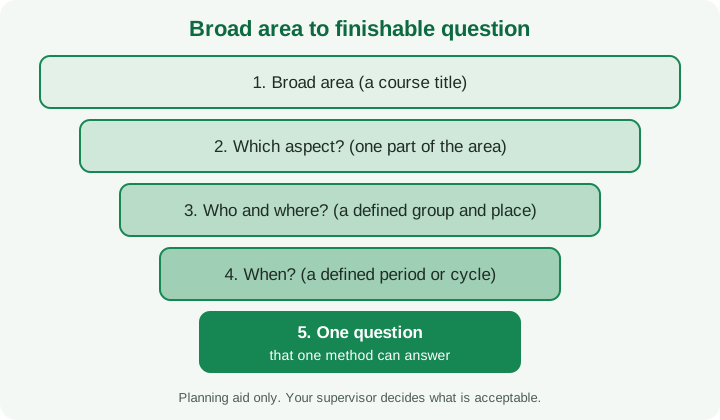
Work down the funnel one step at a time and write the result after each step. Do not skip to the final sentence; the intermediate lines show you where your thinking is still vague.
Step 1: Name the broad area
Write the area in a few words, often the course or field name. This is the line you must leave behind, so do not treat it as a title. If you cannot even name the area, do your background reading first; the Michigan guide suggests learning about a topic before deciding how to limit it.
Step 2: Choose the aspect
Ask which part of the area you care about. An area usually contains many aspects: causes, practices, costs, design choices, attitudes, outcomes. Pick one. If two aspects both appeal to you, write both down and decide later which gets its own project; trying to cover both is the most common way to stay broad.
Step 3: Fix who and where
Name the people, material or system involved and the setting. "Students" is a population but not a boundary; "students in one department of one institution" is. If you plan to collect data from people, remember that access, permissions and ethics review sit behind this step. Confirm with your supervisor what applies in your setting. Do not assume that a group is reachable just because it is easy to name.
Step 4: Fix when
A period, a cycle or an event makes a question finishable. It can be a past period for documents and records, or a defined window of observation for a study. Tying the question to a time also makes your later claims honest: you describe what you examined, not what is always true.
Step 5: Write one question
Combine your answers into a single question. Turning the narrowed topic into a question forces you to say precisely what you are trying to find out. A good test: the question should be answerable by one method. If it needs a survey and an experiment and a document analysis, you have two or three questions, not one.
Worked example 1: a nursing area
Fictional planning example. No study has been done, no site has been approached and nothing here is a finding or an approved title.
A final-year nursing student likes the area "maternal health". Here is how the funnel might run.
| Step | Line written | Still unclear? |
|---|---|---|
| Area | Maternal health | Everything |
| Aspect | Antenatal care attendance | Attendance of whom, measured how? |
| Who and where | Women who registered at one primary health centre | Is a register or a participant group available? |
| When | One defined registration cycle | Which cycle can be accessed? |
| Question | What reasons do women registered at one primary health centre give for missing scheduled antenatal visits? | Is permission available? Which method? |
Notice what the funnel exposed. The question needs women to speak, so it points to interviews or a short questionnaire, and that triggers consent, ethics and permission questions the student must raise with the supervisor and the relevant review office. If access to the centre cannot be confirmed, the student can change the setting or consider a document-based question instead. The funnel did not make the project easy; it showed exactly which decisions are still open.
For direction on evidence routes and what to check first in this discipline, see the nursing project-topic guide.
Worked example 2: an accounting area
Fictional planning example. No records have been located and no result is implied.
An accounting student starts with "taxation".
| Step | Line written | Still unclear? |
|---|---|---|
| Area | Taxation | Everything |
| Aspect | Record-keeping by small traders for tax purposes | Which practices, judged against what? |
| Who and where | Traders in one market | Can traders be reached, and will they talk? |
| When | One trading season | Is the season already past? |
| Question | How do traders in one market describe the way they keep sales records, and what do they say prompts them to keep or skip them? | Method and permission? |
Here the aspect shifted early. "Tax compliance" would have required data on payments and assessments that the student probably cannot reach. "Record-keeping as the traders describe it" is something the student can ask about directly. Narrowing is partly a search for the question your evidence can actually carry.
The accounting project-topic guide walks through evidence routes and a feasibility worksheet for this discipline.
Compare the two funnels. In each, the topic got smaller at every step, and at each step a new practical question appeared. That is a good sign: you are meeting the real project earlier.
How do I know the topic is still too broad?
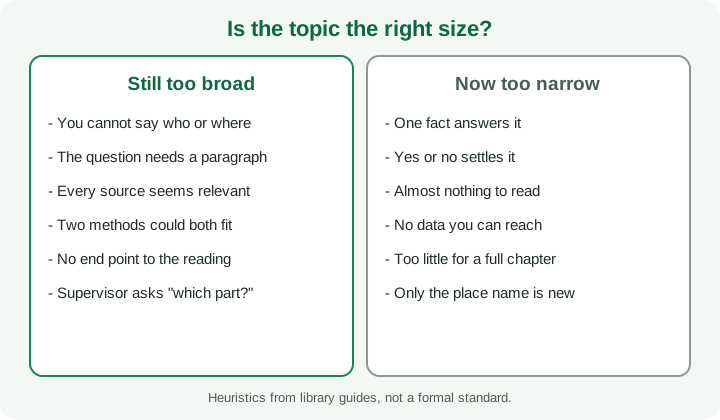
No single test settles it. Library guides offer rough checks, and they work best together.
- The one-sentence test. Can you state the question in one sentence without "and"? If you need a paragraph, the topic is not yet a question. The Michigan guide's own example is a topic stated as a clear, bounded phrase.
- The "who, where, when" test. If you cannot say who, where and when, you have not set a boundary. Say them aloud to a coursemate.
- The search-result test. Library guides treat finding far too much information as a hint of breadth and finding too little as a hint of narrowness. Treat result counts as a prompt to look again, not as a pass mark. Counts vary with the database and your search words. The guide to finding research papers explains how to search so the count means something.
- The "which part?" test. If your supervisor, or you, keep asking "which part of it?", keep narrowing.
- The method test. If two very different methods could both answer your question, it probably hides two questions.
- The page test. The right scope depends on the length and purpose of the piece of writing. A final-year project has room for a bounded question, not a survey of a field. Ask what chapter structure your department expects before deciding how much to cover.
How do I know I narrowed too far?
Narrowing has a lower limit. The Columbus State library guide says a topic is too narrow if you are not finding enough information. A question that a single fact settles is another sign. Signs you went too far:
- A yes or no answer settles the question.
- You can find almost nothing to read, even after trying other search words.
- You cannot reach any data, document or participant.
- The only thing that is new is the place name.
The Columbus State and Michigan guides explain the fix: widen the period, the group or the area, explore related issues, or compare with another case. Narrowing and broadening use the same dials; you are turning them until the topic fits. A related warning appears in the research-gap guide: changing a location does not by itself create a defensible contribution, so be ready to explain why the place or group matters to the question.
Common mistakes when narrowing
- Narrowing by title only. Adding "in Nigeria" or the name of a state to a broad title makes it longer, not clearer. Check that the question itself is bounded.
- Narrowing to what you cannot access. A neat question about records or participants you cannot reach is a dead end. Check access early.
- Keeping two aspects. "Causes and effects and solutions" is three projects.
- Choosing the method first. Picking a statistical test before the question fits the method to nothing. Let the question point to the method; see how to choose a research design.
- Narrowing before reading. Without background reading you may bound a question that does not make sense in the field.
- Never stopping. At some point the topic is narrow enough. Write the question, take it to your supervisor and start the real work.
From narrowed topic to project documents
Once your supervisor accepts the question, it feeds the rest of the project. The same bounded sentence supports your problem statement and your research questions and objectives.
The limits you set (who, where, when) are also what you later describe as boundaries of the work, and the limitations of the study guide shows how to write about them honestly.
If a defence panel asks why you studied this group in this place in this period, your funnel notes are the answer. Keep them. The project defence questions guide covers the questions that tend to follow.
What to bring to your supervisor
Bring a short note, not a finished chapter:
- The broad area you started with.
- Your funnel lines (aspect, who and where, when).
- The one-sentence question.
- The evidence you checked: sources you opened, and the access you have confirmed or still need.
- The method you think fits, and the one decision you most need help with.
Ask what must change and write down the answer. Your department's rules on proposals, topic approval and the number of options override anything on a general website. If you are working on a seminar instead of a project, seminar topic selection applies the same idea at a smaller scale.
Narrowing by department
The funnel applies in every discipline, but what counts as the "who" or "what" differs. In a laboratory subject the "who" may be a sample or material; in engineering it may be a device and a use; in history it is a set of documents and a period; in education it is a school-level group. Use the guide for your department to see typical evidence routes, for example computer science or economics.
Others include education and psychology. Every department is listed in the main topic guide.
A short checklist before you commit
- I can state the question in one sentence.
- I can say who or what, where and when.
- One method could answer it.
- I opened relevant sources and know the area has enough to read.
- I know what access, permission or ethics steps apply, or I have asked.
- My supervisor has seen the question and told me what to change.
If every line is true, stop narrowing. UniDraft's free topic generator is there if you want fresh directions to run through the funnel, and the citation finder helps you locate sources to check. When the question is confirmed, start your project document and bring your supervisor's instructions, your confirmed work and the sources you have checked. For university-specific layout questions, use the format guides and follow your own department.
Sources
- Saint Louis University Libraries: English 1500 guide — the "5 W" questions for narrowing a topic.
- University of Michigan Library: The Library Research Process — limiting a topic by who, what, where, when and why, and the Goldilocker tool.
- Columbus State Community College Library: Refine a Topic — signs a topic is too broad or too narrow and how to adjust it.