
A good human resource management project topic is one HR practice or outcome, studied in a defined organisation or group, with a measure you can defend and permission to collect it. The hard parts are rarely the title. They are getting into the organisation, keeping staff answers honest, and measuring things like motivation without overclaiming.
UniDraft's free topic generator can give you a starting shortlist. Treat every suggestion as a draft to test against access, your department's brief and your supervisor's view, not as an approved title.
Once your HRM question, design and access are agreed, UniDraft organises your confirmed work, checked sources and supervisor instructions into an editable Word document. Start your project document with what you have verified, and review every figure and claim yourself.
This guide is deliberately narrower than the general advice in the Business Administration topics guide, which compares survey, case study and secondary-data designs across the discipline, and the Marketing topics guide, which deals with consumers rather than employees. Here the people you study are staff, and the organisation that employs them is also the gate you must pass through. That changes how you get access, how you protect respondents, how you measure and how far you can claim. It does not list ready-made titles. Departments differ, so your supervisor and department brief always decide what is acceptable.
What do HRM projects usually study?
Published Nigerian HRM research gives a feel for the usual territory without telling you what to choose. One survey-based study of Nigerian construction firms, for example, looked at practices in recruitment and selection, training and development, and motivation and labour relations, and reported challenges such as labour turnover and compensation. Its authors suggested future work on how such practices relate to productivity and project performance. The abstract I opened did not report limitations or a response rate, which is a reminder that you cannot judge how much to trust a study from its summary alone.
Common HRM project areas include recruitment and selection, training and development, performance appraisal, compensation and benefits, motivation, employee retention and turnover, labour relations, and welfare. Each can be asked at several levels. A useful way to turn an area into a topic is to complete this sentence: Among [defined staff group] at [named organisation or type], how do [respondents] describe or rate [one practice or outcome] in [period]? If you are still deciding between areas, the general guide to choosing a project topic covers the first narrowing steps.
Whether a topic is "new" matters less than whether it is feasible. A fairly ordinary question about one practice in one organisation, with sound measures and honest limits, is easier to defend than an ambitious one nobody can evidence.
How do I get access to an organisation as a student researcher?
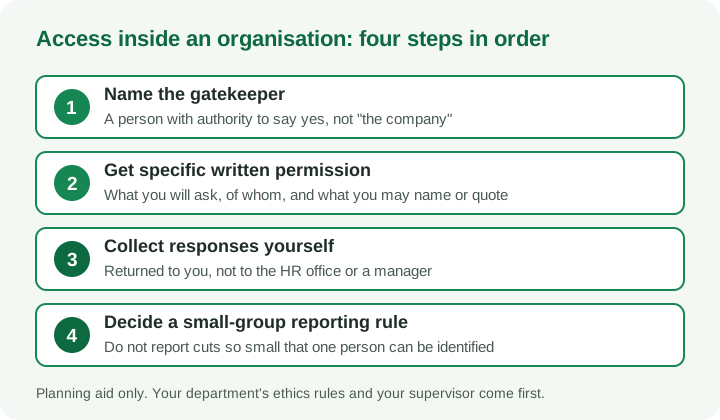
Access is the first thing that breaks an HRM project, because your subject matter (pay, promotion, discipline, morale) is exactly what organisations are cautious about. Plan the approach before you fix the title.
- Name the gatekeeper. This is the person with authority to say yes: an owner, an HR manager, a head of department. "The company" cannot give permission.
- Ask for something specific. "May I give a ten-minute questionnaire to permanent staff in two departments, and interview two supervisors?" is easier to approve than "I want to study HR in your firm". Say what you will not ask for, such as individual pay records.
- Get permission in a form you can show. A short letter or email from the organisation, plus any letter your department issues. What is required varies by institution; ask your supervisor what yours expects.
- Agree what may be named. Will the organisation be identified or described generically? May you quote managers? Can you see documents, or only ask questions?
- Plan a fallback. If the organisation says no in week six, you need a second organisation, a wider group of respondents, or a design that does not need entry. Your supervisor approves any change.
- Think about your own position. If you work there, did SIWES there, or are related to the owner, say so to your supervisor. Staff may answer differently when the researcher is a colleague or the owner's relative.
For consent wording and how to protect personal data, read the research ethics and consent guide. Never invent respondents, interviews or documents to rescue a topic whose access fell through.
What happens to anonymity when the employer is the sampling frame?
This is the issue most HRM students underestimate. Your list of staff usually comes from the employer, the employer may know who was asked, and staff know it. If respondents believe a manager will see their answers, they tend to tell you what they think management wants to hear. Practitioner guidance on employee surveys makes a similar point, suggesting that independence from the employer helps staff answer honestly.
Two terms are often mixed up. In the practitioner guidance I read, an anonymous survey collects no identifying information, while a confidential survey may link answers to a person but reports only in aggregate. Be clear which one you are offering, because a promise of anonymity you cannot keep is worse than a modest, honest promise of confidentiality.
Practical steps for a student researcher:
- Collect responses yourself. Return forms to you, not to the HR office. If you use an online form, do not send the link through a manager's account if you can avoid it.
- Ask for less. Every extra detail (department, grade, tenure, age, sex) narrows who a respondent could be. In a team of eight, a combination of "female, supervisor, over ten years" may point to one person even with no name on the form. Use broad bands and ask only what your objectives need.
- Set a small-group rule before analysis. Practitioner guidance commonly suppresses results for very small groups, with five respondents often cited as a threshold in survey platforms. That is a practice from commercial surveys, not a university rule. Choose your own rule, tell your supervisor, and apply it to cross-tabulations and quoted comments alike.
- Handle comments carefully. Open-ended answers can reveal the writer through wording or detail. Quote sparingly, and remove identifying specifics.
- Say what you did. Your methodology should state who held the responses, who could see them and how they were stored. Do not claim more protection than you provided.
If the organisation insists on seeing raw forms, that is a conflict between access and respondent protection. Bring it to your supervisor before you collect anything.
How do I measure motivation, retention or performance?
The words in HRM titles are constructs, meaning ideas that cannot be seen directly. "Employee motivation" is not a number you can read off a form. You must decide what you mean, then choose a way to capture it.
Should I use a validated scale or write my own?
| Option | What it gives you | What you must still do |
|---|---|---|
| Published, validated scale | A definition, tested items and prior reliability evidence you can cite | Check the licence, whether it fits your setting and population, and report reliability in your own data |
| Adapted published scale | A starting point you can cite | Say exactly what you changed; adapting weakens the claim that it is "validated" |
| Self-made questions | Wording fitted to your setting | Define the construct, justify each item, pilot it, and describe it as your own instrument |
Be careful with the word validated. A scale is validated for particular purposes and groups; that does not transfer automatically to Nigerian public-sector staff or a small private firm. Cite where it was developed, and report how it behaved in your data.
Licensing is a real issue. The Minnesota Satisfaction Questionnaire short form (20 items on aspects of job satisfaction such as pay, supervision and working conditions) is a well-known example. A university course page I opened states that it is copyrighted and that use beyond that course's assignment requires purchase. So "it is online" does not mean you may use it in a project. Ask your supervisor, and check the publisher's terms. Note too that job satisfaction and motivation are different constructs; matching the instrument to your question matters more than its fame. Some motivation scales, such as those built on self-determination theory, exist in the literature, but check their source, licence and fit before relying on any of them.
If you write your own items, treat it as a measurement task, not a formality. The questionnaire design guide covers wording and structure, the validity and reliability guide explains what you may honestly claim about your instrument. A small trial run on a few people outside your sample shows which items confuse staff.
What about retention and performance?
These are harder than they look because the obvious number may not be the one you can reach.
- Retention and turnover. Turnover is a record-based figure (who left, over what period, out of how many). A questionnaire cannot measure it, but it can measure intention to stay, which is a different thing. Do not mix them in one claim. Records may also be confidential, so ask whether the organisation will release summary counts.
- Performance. You have three routes: staff rate themselves, supervisors rate staff, or records show output. Self-ratings are easy but tend to flatter; supervisor ratings may be unavailable or sensitive; records are rarely shared. Say which you used, and phrase conclusions as "reported performance" if that is what you have.
- One measure per construct is thin. A single question labelled "motivation" is weak evidence of a broad idea. Several items, each on one idea, usually describe a construct better.
For analysing rating-scale answers, see the Likert scale analysis guide, and let your supervisor decide which summaries and tests suit your design.
How do I sample when the staff population is small?
A single organisation may have 25, 60 or 150 staff. That changes the sampling question. With a small, defined staff list, the honest approach is often to invite everyone, a census, rather than draw a sample and pretend it is representative. The reason is simple: sampling methods are built for populations too large to ask in full.
What matters more in a small population is who actually answers. If 30 of 150 staff respond and most are from one department, the sample is lopsided whatever the arithmetic said. Record your population, how many you invited, how many replied and from which broad groups, then discuss what that means for your conclusions.
Do not borrow a sample-size formula or threshold from a classmate or a blog without checking it against what your supervisor expects. The sample size guide explains the common methods and their assumptions, and the sampling techniques guide covers when each approach fits. If you interview rather than survey, sample size is usually justified differently, so ask your supervisor.
What can an HR study claim, and what can't it?
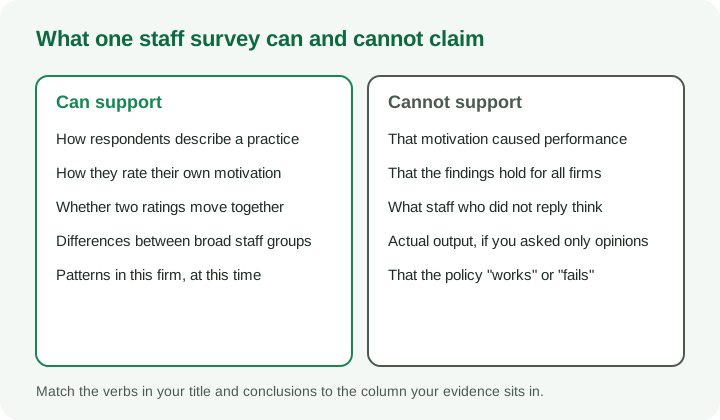
A one-time staff survey describes how respondents say they see things at one moment. That is useful, and it is also all it is. The most common error in HRM projects is a title and conclusion that promise more than the evidence supports.
- Association is not cause. If staff who rate pay as fair also rate themselves as motivated, you have found that two answers go together. You have not shown that pay caused motivation, since both could reflect mood, tenure or something you did not ask. Words like "effect of" and "impact of" in a title promise causation. "Relationship between" or "how staff describe" often matches survey evidence better, but ask your supervisor, since departments differ on wording.
- One organisation is one organisation. Findings from a single firm do not tell you about Nigerian firms generally.
- Non-respondents are unknown. The people who did not answer may differ from those who did.
- Opinions are not outcomes. If you asked what staff think about training, you have not measured whether training improved anything.
- Recommendations should follow the evidence. Recommending a policy change from a thin, single-firm survey needs careful, modest wording.
Your limitations section is where you say all this plainly. The limitations guide shows how to do it without sounding apologetic, and the survey design guide explains what a survey can reasonably support.
A fictional feasibility worksheet
This is an invented example for planning practice. The organisation, numbers and outcomes are made up, and no data have been collected.
A student starts with: "Effect of motivation on employee performance in Nigerian companies." Here is how the checks above reshape it.
| Check | Draft answer | Problem to resolve |
|---|---|---|
| Which organisation? | "Nigerian companies" | Choose one defined unit |
| Who gave access? | Nobody yet | Find a gatekeeper and ask specifically |
| Who is the staff list from? | HR office | Plan to collect forms yourself |
| What is "motivation"? | Not defined | Choose a defined construct and instrument |
| What is "performance"? | Not defined | Self-report, supervisor rating or records? |
| What does "effect" claim? | Cause | A one-time survey shows association at most |
| Population size? | Unknown | Get a headcount before planning the sampling |
After a week, the student reaches a provisional question: how do permanent staff of one named distribution company rate the recognition practices they experience, and how do they rate their own work engagement? The HR manager agrees in writing to a questionnaire for about 60 permanent staff, with the company described generically. The student will collect forms personally, ask only for broad department and tenure bands, and report no group smaller than a rule agreed with the supervisor. This is a candidate, not an approved topic: the supervisor must still agree the question, the instrument and the wording of the title.
Common mistakes in HRM projects
- Treating "the company" as access. Without a named person and written agreement, you have a wish.
- Letting HR run the survey. Staff answer differently when management distributes and collects the forms.
- Collecting identifying details you do not need. Each one makes anonymity harder to keep.
- Using a copyrighted scale without permission. Check the licence and tell your supervisor which instrument you intend to use.
- Calling one question a measure of a construct. Define it and use several items.
- Causal titles on survey evidence. Match the verb to the design.
- Quietly inflating thin returns. Report the actual response, not the number you planned.
Questions your supervisor or panel may ask
- Who gave you permission, and what exactly did they agree to?
- How did you protect respondents, given the employer supplied the staff list?
- Where does your measure of motivation (or retention, or performance) come from, and why is it suitable here?
- How many staff were in the population, how many did you invite and how many replied?
- What does your design allow you to say, and what does it not?
- What would you do differently with more access or time?
Prepare short, honest answers. The project defense guide lists the kinds of questions panels commonly raise.
From topic to document
When your HRM question, design, access and measures are settled, the remaining work is collecting your data and writing it up consistently. UniDraft organises your confirmed question, your own analysis, checked sources and supervisor instructions into an editable Word document. Start your project document with what you have verified.
UniDraft does not obtain organisational permission, recruit respondents or run your analysis, and it cannot guarantee approval. Those remain your work and your supervisor's decision. You can also use citations to keep references consistent and the formatter to check layout once you have a draft.