A good accounting, business administration or banking and finance SIWES report explains what you actually did and observed in an office, bank or firm, in a way that links to your dated logbook, without exposing anyone's confidential records. The challenge is different from, say, an engineering report. Your work is built on documents (invoices, vouchers, statements, ledgers, customer forms) that belong to someone else. Explain the procedure and your role while respecting confidentiality.
Your department's SIWES guide and your supervisor set the chapter order, page layout and what evidence is allowed. Start with the general SIWES report guide and the format directory for your institution, then use this page for the finance-specific detail.
Your placement records contain the detail; the report needs to explain it without exposing client information. UniDraft helps organise the non-confidential activities and guidelines you confirm into an editable SIWES report. Start your SIWES document with UniDraft, using only material you are permitted to share, then review every activity and reference before submission.
The short answer
- Build the report from a weekly record of tasks, document types, procedures and your role, not from a sample report you found online.
- Label each task observed, assisted or performed under supervision, and keep that label the same in the logbook, the report and your defence answers.
- Describe procedures and controls (how a reconciliation works, why a voucher needs approval). Do not paste real customer names, account numbers, balances or scanned statements.
- Use a clearly fictional practice example when figures are needed for teaching. A label such as "Client A" does not make a real record safe to disclose.
- Never claim you prepared financial statements, signed off an audit, approved a loan or authorised a payment unless that is exactly what happened and your supervisor can confirm it.
- The department's approved template wins over any outline, including the one below.
Why finance placements need extra care
Finance placements can involve access to confidential material. A bank clerk shows you a customer's statement so you can learn how to read it. An audit senior hands you a client's bank statements to tick against the cash book. A small business owner lets you see the cash received that week. Access and observation still need to stay within the permissions of your role. The problem starts when the same material ends up in a report that is printed, bound, handed to lecturers and sometimes kept in a departmental library.
Permission to view workplace information is not permission to publish it in a report or upload it to an online tool. Check your host's confidentiality rules and the relevant institutional and privacy requirements before sharing any material. The Nigeria Data Protection Commission is an official starting point for data-protection resources. This guide does not determine whether a particular disclosure is lawful. Removing a name alone may leave someone identifiable through dates, roles, balances or unusual transactions; prefer describing the process without their records.
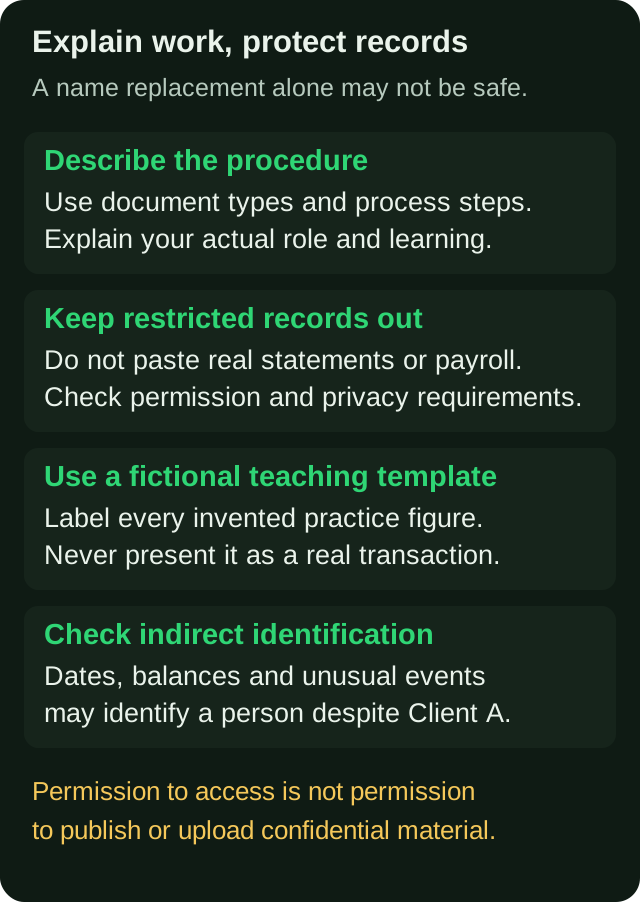
Two quick tests help. First, could a stranger identify a person or company from this sentence? If yes, rewrite it. Second, would my supervisor be comfortable seeing this paragraph in a public library? If you are unsure, ask the supervisor before submission, and treat a "no" as final.
Where finance students are actually placed
Placements vary a great deal, so do not copy someone else's headings. The following settings illustrate possible work; use only tasks and units that match your actual approved placement.
Commercial and microfinance banks. A placement may include customer service, cash or teller operations, account opening, operations or back office, credit or loan administration, and sometimes clearing, remittances or compliance. Many banks restrict what interns may touch. If you were mostly watching the teller line or helping customers fill forms, say that. Customer service and process observation are real material.
Audit and accounting firms. Typical tasks include vouching, ticking and casting, bank reconciliation checks, stock-count attendance, preparing working papers, drafting parts of a management letter, and filing documents. Do not imply that assisting with working papers gave you authority to approve an audit conclusion. Describe what you did on the working paper, who reviewed it and what you learnt about audit evidence.
Corporate finance, accounts and payroll departments. Tasks include posting to ledgers, preparing payment vouchers, petty cash records, supplier statement reconciliations, payroll data entry, stock records and tax filing support. Describe the workflow from document to ledger to report, using generic figures only.
Business offices, SMEs and administrative units. Business administration students may sit in HR, procurement, marketing, sales or general administration. The report then centres on organisation structure, how decisions flow, records kept, customer handling and how the unit meets targets. See the placement route in how to find a SIWES placement if you are still choosing between settings, and what SIWES is if you want the scheme's purpose in one page.
What to log every week
The logbook is the evidence that holds your report together. A label such as "assisted in the accounts department" does not explain the task. Record the details while they are fresh, follow your required daily or weekly schedule, and use a regular review slot to check omissions.
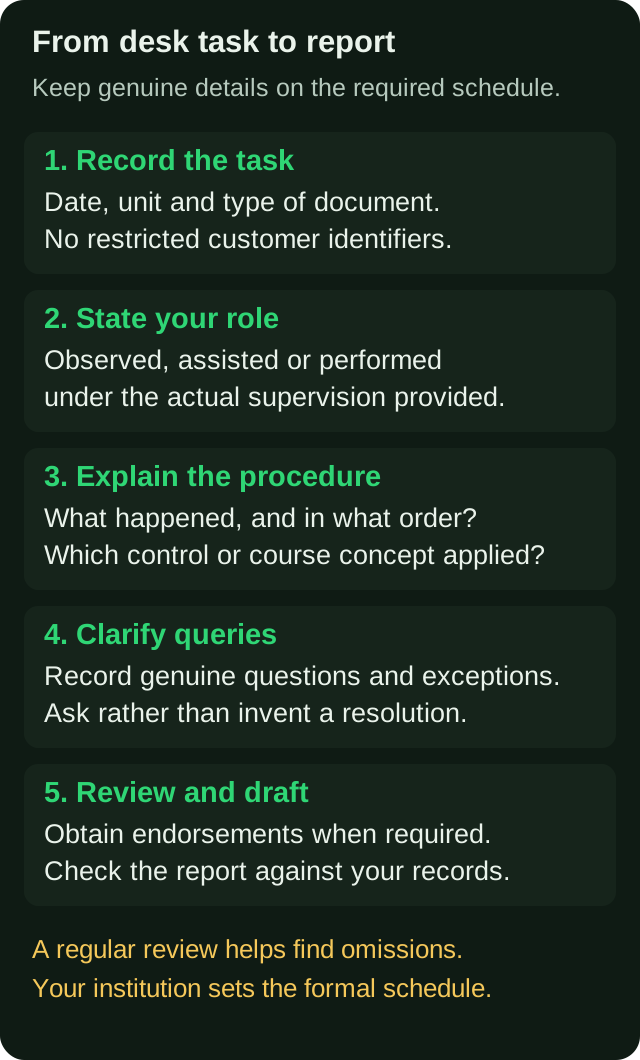
- The task and the document type. "Matched supplier invoices to goods received notes", not "did accounts".
- Your role. Observed, assisted or performed under supervision.
- The procedure or control behind it. Why does the invoice need a goods received note? Why must a voucher be approved by someone other than the preparer?
- Exceptions and queries. A missing receipt, a posting to the wrong account, a customer complaint, a difference on a reconciliation, and what was done about it.
- The course link. Cash book, trial balance, control accounts, audit evidence, internal control, credit analysis, customer relationship, whatever your syllabus calls it.
For the weekly routine itself, how to fill your SIWES logbook is the place to start. The computer science logbook examples are from another field, but they show how specific an entry can be.
A sample logbook table (illustrative only)
The rows below are made up to show the level of detail. They describe no real organisation, client or person. Replace them with your own activities.
| Week | Task and document | Role | Procedure and course link | Query or note |
|---|---|---|---|---|
| 1 | Orientation, introduced to the accounts unit, read the chart of accounts | Observed | Account classification, chart of accounts | Asked how new accounts are approved |
| 2 | Sorted and filed payment vouchers with supporting invoices | Assisted | Documentation and audit trail | Two vouchers lacked an approval signature; supervisor followed up |
| 3 | Posted receipts into the cash book from the cashier's summary | Performed under supervision | Cash book, double entry | Posting corrected after supervisor spotted a wrong date |
| 4 | Compared bank statement lines with cash book entries for a sample client | Assisted | Bank reconciliation; timing differences | Unpresented cheque identified by the senior |
| 5 | Helped a customer complete an account opening form at the desk | Assisted | KYC, customer due diligence, customer service | Learnt why identification documents are checked |
| 6 | Watched a stock count at a client warehouse | Observed | Inventory existence, audit evidence | Count sheets signed by two people |
Notice that none of these rows contains a customer name, an amount tied to a real account or a signature. Someone reading it learns how the work was done and what you took from it.
A working chapter outline
Departments differ on chapter count. The sequence below is an illustrative working outline, not a rule.
Preliminary pages. Title page, certification, declaration, acknowledgements, abstract if required, contents and lists of tables and figures, in the style your department asks for. Do not include a supervisor approval you have not received. If you need Roman then Arabic numbering, this Word walkthrough shows the steps.
Chapter one: introduction. The SIWES period, host organisation, your assigned unit, the objectives of the training and the scope of the report. Briefly say what SIWES is meant to achieve. Keep it short; it is not the main body.
Chapter two: the organisation. History and ownership in a paragraph or two, mission and vision if they are public, organisational structure as you saw it, and the unit or departments where you worked. Draw the structure from observation, not from the internet, and name roles rather than individuals if your host prefers that.
Chapter three: training experience. Give the actual activities enough space to explain your role. For each major task area (for example, cash handling, reconciliation, vouching, customer service, payroll or procurement), describe the purpose, the steps in order, the documents involved by type, the control or check, and your role. Include one illustrative table or form only if it is blank or invented. A good test is whether each section could be traced back to logbook weeks.
Chapter four: skills, challenges and relevance to your course. What you gained technically (record keeping, spreadsheets, accounting software you actually used, customer handling), what you struggled with (speed, unfamiliar documents, restricted access) and how it connects to your degree. Be honest about restrictions; "I was not permitted to handle cash" is a legitimate observation about internal control.
Chapter five: summary, conclusion and recommendations. Summarise, conclude and recommend. Direct recommendations at the right audience: the department about preparing students, the host about intern supervision, or the SIWES unit about placement. Keep them tied to what you saw.
References and appendices. List only sources you cited, such as an accounting standard, a textbook, or a regulator's guidance. The free citation finder helps you find real sources for APA or Harvard instead of guessing details. Appendices can carry blank templates or the placement letter.
Writing a finance activity so it reads like accounting
Use a repeatable pattern so your supervisor can scan the report: purpose, sequence, documents, control, role and what you learnt. Here is an invented paragraph on bank reconciliation, showing the voice.
Illustrative only. In the third week, I observed how the unit prepared a monthly bank reconciliation for one of its accounts. The purpose is to explain differences between the balance in the organisation's cash book and the balance on the bank statement. The officer first compared deposits and withdrawals on the statement with entries in the cash book and ticked the matched items. Items in the cash book but not yet on the statement, such as cheques issued but not yet presented, were listed as timing differences, and items on the statement not yet in the cash book, such as bank charges, were noted for posting. The reconciled figures were then agreed and the statement was reviewed by the senior accountant. I assisted by ticking matched lines under supervision and did not prepare or approve the final statement. I learnt that a reconciliation is a control: it helps detect errors, omissions and unauthorised items early.
The paragraph avoids a bank name, a balance or a company. It states the role plainly and links to theory. Check the paragraph against the assessment criteria your institution supplies.
Activity prompts by setting
Use only those that match your logbook.
- Banking. Account opening and know-your-customer checks as you saw them described, cash deposits and withdrawals, cheque handling, customer complaints, transfers and electronic channels, loan application intake, daily balancing of the till. Describe controls such as dual authorisation without disclosing specific thresholds or system details your host would regard as sensitive.
- Audit and accounting. Vouching a sample of payments, agreeing a ledger balance to a supporting schedule, attending a stock count, circularising debtors, preparing a lead schedule, filing and indexing working papers.
- Corporate accounts. Ledger posting, trial balance extraction, supplier statement reconciliation, petty cash imprest, payroll input, fixed asset register updates, support for tax filings.
- Business administration. Office procedures, correspondence and records management, procurement steps from requisition to payment, sales order processing, stock records, HR onboarding, meeting minutes, customer follow-up.
Be honest about involvement and software
Many offices use accounting packages, spreadsheets or bank systems. Name the software you actually used, and say what you did in it: entered vouchers, ran a report, exported a list. If you only watched someone else use it, write that. Do not describe a module you never opened. It is also fine to say your access was limited because of confidentiality; that is itself an observation about control.
Defence questions to prepare for
Use the following process questions to practise explaining the work you actually did. How to defend your SIWES report covers answering without bluffing. Prepare short, honest answers to these:
- Walk us through how a bank reconciliation is done. What are the usual reasons for differences?
- What is the difference between a payment voucher and a receipt, and why must each be supported?
- Why should the person who prepares a payment not be the person who approves it?
- What did you personally do in the unit, and what did you only observe?
- What was the most difficult query or error you encountered, and how was it resolved?
- How did your placement connect to a course you took, for example auditing, taxation or management accounting?
- How did the organisation protect customer or client information in the work you saw?
- If you were advising the department, what would you change about SIWES preparation?
Practise saying each answer aloud using your own tasks. If you cannot answer a question about an item in your report, that item probably needs to be rewritten, shortened or removed.
Common mistakes
| Mistake | Why it fails | Fix |
|---|---|---|
| Pasting real statements, ledgers or customer forms | Breaches confidentiality and often host rules | Describe the procedure or use a blank fictional template; check indirect identification |
| "I prepared the audit report" without actually doing so | Misstates your role | State your actual role: vouched a sample, ticked schedules, filed |
| Copying a sample report's activities | The panel asks you to explain them | Use only tasks that appear in your logbook |
| Long company history and mission statements | Not your training experience | Follow the required length and keep the focus on your training |
| Generic "I learnt teamwork and punctuality" | Reads as filler | Tie skills to specific tasks and examples |
| Numbers with no source | Cannot be defended | Use only figures you can trace, or describe without numbers |
| Logbook and report disagree on dates or roles | Looks fabricated | Reconcile them before submission |
Use the logbook to check dates and roles. If a genuine task is missing or a record conflicts, clarify it with the relevant supervisor rather than inventing an entry or silently changing history. How the marks are shared between logbook, supervisor and report depends on your institution, so check how SIWES is graded before deciding where to spend your effort. If your school issues forms, remember the report is separate paperwork; what SIWES Form 8 is explains one that students confuse with it.
Planning the writing
Do not wait for the last week. During the placement, record tasks on the required schedule and ask your supervisor what you may describe. Clarify dates, unit names and software while the people involved can check them. Obtain endorsements when required, rather than postponing them until the end. Plan drafting around your actual submission date. Then write the rest, add figures, tables and references, and check the layout. If your supervisor sends comments, managing report corrections explains how to apply them without losing earlier versions, and the submission checklist helps with the final pass.
Pre-submission checklist
- Every activity in the report appears in the logbook with a matching role label.
- No identifying or confidential customer, client or staff information is included without resolving the applicable organisational, privacy, consent and institutional requirements.
- Tables and figures are numbered, captioned and explained in the text; blank or invented templates are labelled as such.
- Chapter order, headings and length follow your department's approved guide.
- Fonts, spacing and margins match your rules; the free formatting checker reads a .docx and flags mismatches against your university's rules.
- Front matter contains no signature or approval you have not received.
- References are real and consistently formatted.
When the body is done, how to write the SIWES report conclusion and recommendations shows how to close it without generic wording.
Where UniDraft fits in
UniDraft builds the written IT/SIWES report as an editable Word (.docx) document from the placement facts you confirm. Supervisor instructions and student-confirmed guidelines take priority over general departmental and university patterns. It produces the written report only. It does not generate presentation slides, fill your logbook or Form 8, find you a placement, or guarantee any outcome with an AI detector. You supply and confirm what you actually did, review every generated claim and reference, and keep restricted client information out.
The SIWES report costs ₦10,000 once, including three free supervisor-correction rounds. If you want to see how your institution lays things out first, browse the free format guides.
Sources
- Nigeria Data Protection Commission (NDPC): official starting point for data-protection resources; check the applicable requirements before disclosing information.