"Compliance engine" sounds like enterprise software jargon, but the concept it describes is genuinely useful for academic writing: a system that applies formatting and structural rules consistently, automatically, instead of relying on you to remember and reapply them by hand every time the document changes.
The problem it solves
Formatting drift is one of the most common reasons a report gets sent back -- not because a student doesn't know the rules, but because a document edited across many sessions, with content pasted in from other files, quietly accumulates inconsistencies. Chapter 1 might be Times New Roman 12pt double-spaced; Chapter 4, pasted in from a different draft weeks later, might not be.
A compliance engine's job is to make that drift structurally impossible -- rules are applied to the whole document every time it's generated, not set once at the start and left to erode.
Why precedence order matters
Formatting rules for a Nigerian university document typically come from three levels, and they don't always agree:
- Direct supervisor instructions -- highest priority. If your supervisor tells you something specific, that wins.
- Department guideline -- the default for your specific programme.
- University baseline -- the institution-wide fallback when nothing more specific applies.
A compliance engine that doesn't respect this order can silently apply the wrong rule wherever these three disagree -- for example, defaulting to a department's standard margin even after a supervisor explicitly asked for something different.
What a good one actually checks
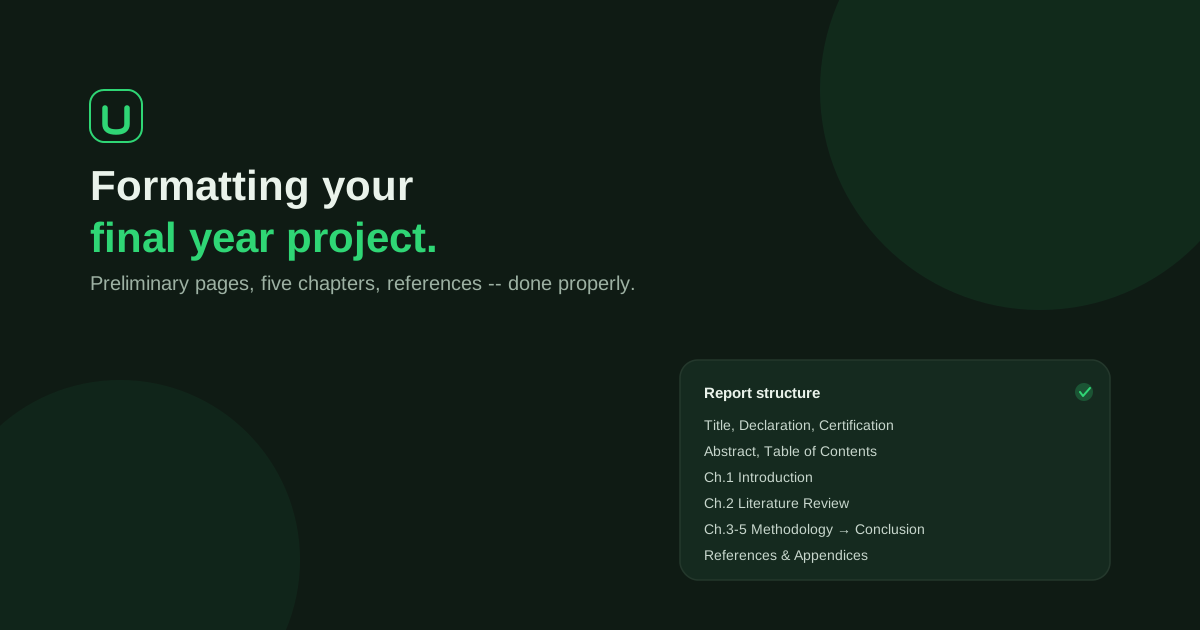
Beyond margins and fonts: chapter/section structure matching your department's expected breakdown, page numbering conventions (Roman numerals for preliminary pages, Arabic from Chapter 1), and -- in more complete implementations -- citation-to-reference-list consistency.
Where UniDraft fits in
This is exactly what UniDraft's compliance engine does: supervisor instructions, department guideline, and university baseline are applied in that precedence order automatically, to the whole document, every time -- so page 1 and page 90 follow identical rules.