A Mass Communication SIWES report should explain what you genuinely did and observed at a newspaper, radio or television station, PR firm, advertising agency, or digital media outlet: the desk or unit, your assignments, the tools and workflows, the ethics you met, and what you learnt. It should match your signed logbook. Media placements are unusually easy to "decorate" with bylines and campaign claims that were really somebody else's work, and an examiner who knows the industry will notice.
Your university or polytechnic, your department and your supervisor set the chapter order, layout and evidence rules. Start with the general SIWES report guide and check your school in the format directory. This article adds what is specific to media work: how to use bylines, scripts and campaign material as evidence, how a report differs from a portfolio, and how to handle sources and clients responsibly.
Your bylines, scripts and editor feedback can explain your training when your role and permissions are clear. UniDraft helps organise the placement facts and guidelines you confirm into an editable SIWES report. Start your Mass Communication SIWES document, using only material you may share and reviewing each claim about your contribution.
The short answer
- Build the report from a weekly record of tasks, not from a sample report off the internet.
- Treat bylines, scripts, rundowns, social posts, briefs and edit notes as evidence that you can describe, not as filler to paste in.
- Label each task observed, assisted or done under supervision, and keep those labels the same in the logbook, report and defence.
- Keep the full portfolio separate. The report explains training; the portfolio shows finished output.
- Do not publish the names of confidential sources, unpublished stories, client budgets, or campaign plans you were not cleared to share.
- Your department's approved template always wins over any outline, including ours.
What SIWES expects, in one paragraph
The SIWES portal run by the Industrial Training Fund describes the scheme as meant to bridge the gap between employers' expectations and graduates' actual performance. Its stated aims include giving students industrial skills, exposing them to work methods and equipment they may not have at school, and letting them apply what they learnt in a real work setting. That is useful framing for a media report: the examiner wants to see that you moved from theory (news values, scriptwriting, media law, public relations theory) to practice, and can say honestly how far. If you need the basics first, read what SIWES is.
Where Mass Communication students are placed, and what each is good for
Placements differ widely, and your institution decides whether a placement meets its requirements. Your report should describe the one you had.
| Placement type | Typical units | What you might genuinely record |
|---|---|---|
| Newspaper or online news | News desk, features, sub-editing, photo desk | Assignments covered, stories filed, edits received, editorial meetings |
| Radio | Newsroom, programmes, continuity, studio operations | Bulletin preparation, scripts, interviews recorded, programme logs |
| Television | Newsroom, production, graphics, studio floor | Rundowns, voice-overs, camera or floor tasks, editing suite work |
| PR firm or corporate affairs | Media relations, events, publications | Press releases drafted, media lists, event support, clippings reports |
| Advertising agency | Creative, account service, media planning | Briefs, copy drafts, storyboards, campaign support tasks |
| Digital or social media | Content, community management, analytics | Content calendars, posts, platform reports, audience replies |
A student placed in a radio newsroom, for example, has nothing to apologise for if they never touched TV production. Describe the real thing in detail rather than gesturing at everything.
Build an evidence list before you write
Media students have an advantage: the work leaves traces. The problem is that the traces belong to the organisation, and you only have the right to use some of them. Make a private list as you go.
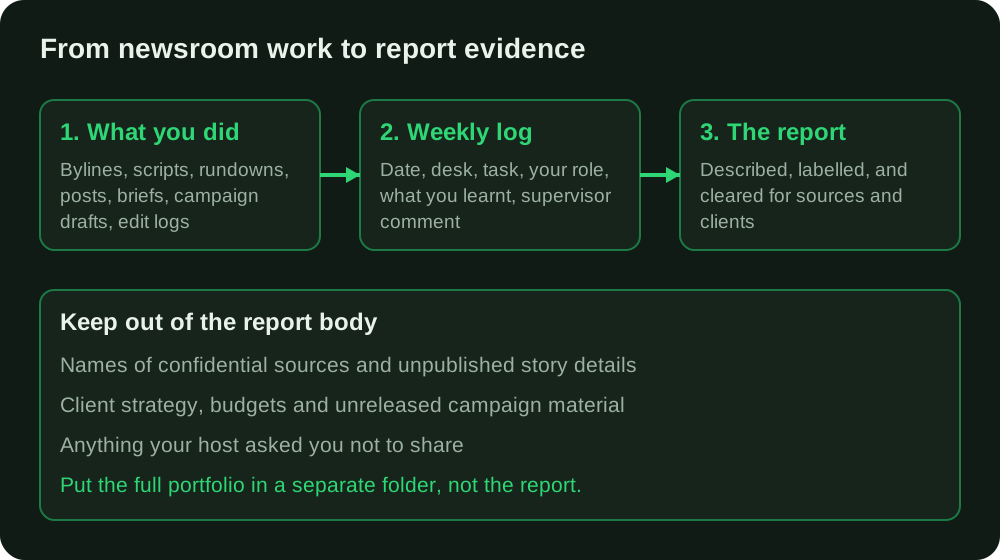
| Evidence | How to use it honestly |
|---|---|
| Published byline or credit | Cite the title, date, outlet and what you did: reported, wrote a first draft, edited, or contributed research. A shared byline does not mean you wrote everything |
| Script, bulletin or voice-over | Describe the format, length and your role. Quote a short extract only if permitted |
| Rundown or programme log | Explain what it controls and which part you handled |
| Press release or media list | Say what you drafted or compiled and what the supervisor changed |
| Campaign brief or copy draft | Describe your contribution; leave out budgets, client strategy and unreleased creative |
| Content calendar or analytics screenshot | Redact client names or figures if you were not cleared to share |
| Editor's or supervisor's feedback | Summarise what you were corrected on and what you changed afterwards |
If you cannot show a document, you can still describe the task in words. The point is that every claim in the report should be something you could talk through at a defence.
Bylines, scripts and campaign work: how to claim them fairly
Newsrooms use bylines loosely. A story may carry your name because you attended the event and filed notes, while a senior reporter wrote the final copy. A script may be yours in structure but rewritten by the editor. An agency campaign is usually a team product.
Write what actually happened, plainly. Compare:
- "I wrote the front-page story on the council budget." (inflated if you only supplied quotes)
- "I attended the budget briefing, recorded the quotes, and wrote the first draft of the story, which the news editor rewrote before it ran with a shared credit." (accurate, and shows learning)
The second version is more useful to a panel. It tells them what you did and what an editor changed, which is exactly what training looks like. The same logic applies to broadcast. If you "read the news", say whether that was a live bulletin, a rehearsal, or a recording the producer later edited.
For PR and advertising, separate ideas you contributed, tasks you executed and decisions others made. If you suggested a hashtag that was not used, you can still write that you proposed it. If your copy was one of several drafts, say so.
Report versus portfolio
Many students confuse the two, and the confusion costs marks. A portfolio is a selection of your best finished work, built to impress an editor or recruiter. A SIWES report is a training document, written for an examiner. It describes the work and what you learnt, not only the output.
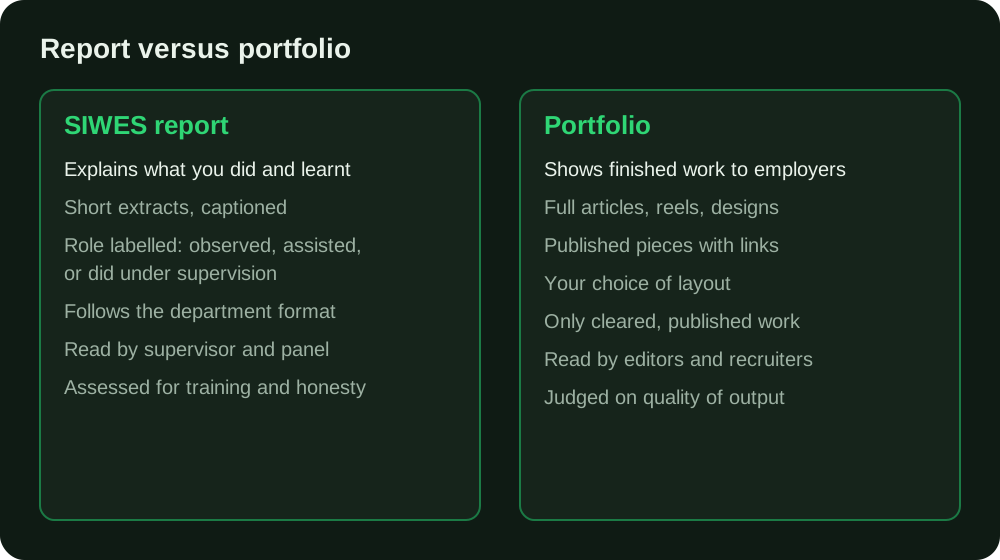
A sensible approach is to keep a clean folder of cleared, published work as your portfolio, and use short, captioned extracts in the report appendix only where your department allows it. Ask your supervisor early whether the department expects clippings, scripts or screenshots as an appendix, because practice varies. If the department wants a presentation of your portfolio as well, that is separate work from the written report.
Confidentiality: sources, clients and unpublished material
This is the part most generic guides skip, and it matters more in media than in almost any other field.
Confidential sources. The International Federation of Journalists' Global Charter of Ethics for Journalists says journalists must observe professional secrecy about the source of information obtained in confidence. Your host editor will treat that as non-negotiable, and so should you. Do not write names, phone numbers or identifying details of sources in your logbook or report if they spoke on condition of anonymity. A descriptive label can still identify a source indirectly. Remove identifying combinations and obtain the appropriate editorial guidance before disclosure. If you are unsure whether a source was confidential, ask the editor before it goes into a document that your supervisors and panel will read.
Unpublished stories. If a story was killed, held back or embargoed, it may not be yours to describe. You can say you worked on "an investigative assignment" and describe the skills you used, such as document checking and interview preparation, without revealing the subject.
Clients and campaigns. Agencies and PR firms usually have confidentiality obligations to clients. Budgets, product launch dates, strategy decks and unreleased creative are normally off-limits. Ask your industry supervisor what you may disclose and get it in writing, or at least in a message you can keep.
Staff and colleagues. Do not write gossip, newsroom politics or criticisms that could identify individuals. Recommendations in the last chapter should be about processes, not people.
Defamation and accuracy. The same Charter says respect for facts and the public's right to truth is a journalist's first duty and that essential information should not be suppressed or documents falsified. Apply that to your own report. Do not alter a quotation, clipping or date to look better.
Know the regulators you may meet
You do not need a chapter on regulation, but a sentence or two shows you understand the environment. Advertising in Nigeria is regulated by the Advertising Regulatory Council of Nigeria (ARCON), which the council's website says was formerly the Advertising Practitioners Council of Nigeria (APCON) and was renamed under the 2022 Act. For current obligations, consult the applicable official rules and your organisation's authorised compliance lead; this writing guide does not establish a blanket approval rule for every online communication. If your agency vetted a campaign, you can describe the step you saw, rather than guessing at rules. For broadcast and press, the relevant regulators and codes depend on your host; ask your supervisor which code your newsroom works by, instead of quoting one from memory.
A chapter-by-chapter working outline
Some departments use four chapters, others five. The common structure below is a working outline, not a rule.
Preliminary pages. Use the exact title page, certification, declaration, acknowledgement, contents and lists required. Do not add a signature or approval you have not received. If you need Roman then Arabic numbering, this Word walkthrough shows how.
Chapter 1: Introduction. The SIWES scheme, its objectives, the approved period, your host organisation and the scope of the report. Keep it short and specific.
Chapter 2: The host organisation. Name, location, ownership and mandate, the units or desks, and where you sat in the structure. Draw the organisation chart as it was where you worked. Use the amount of organisational context your brief requires; copying the company's "About Us" page is not a placement experience.
Chapter 3: Activities and experience. Allocate space according to the brief and actual experience. Group your work by desk or process, for example news gathering, scripting and editing, studio operations, press release writing, content scheduling. For each, describe:
- The task and why it mattered
- The steps in the order they happened
- The tools and software (recorders, editing suites, CMS, scheduling tools)
- Your role: observed, assisted or done under supervision
- Feedback you received and what you learnt
Chapter 4: Problems, skills and relevance to your course. Be honest about problems: lack of equipment, irregular schedules, limited supervision, security risks while reporting, long hours. Explain which course content helped (for instance writing for the media, media law and ethics, public relations) and where theory fell short.
Chapter 5: Summary, conclusion and recommendations. Recommendations should come from what you observed and be addressed to the right party: the school, the SIWES unit or the host organisation.
References and appendices. Cite any code, book or article you quoted. The free citation finder helps you check real sources instead of guessing. Put permitted clippings, blank templates or redacted samples in appendices.
What to record every week
The report is easy if the weekly record is good. At the end of each week, write these down while you remember them:
- Dates and the desk or unit
- Each assignment, with the output (story, script, release, post, design brief)
- Your role in it and who supervised you
- Tools used and anything new you learnt
- A correction or feedback note from an editor or supervisor
- Anything that is confidential, so you remember to leave it out
How to fill your SIWES logbook covers the routine, and these computer science logbook examples show the level of detail that works. The fields are the same for media: be specific.
Sample logbook entries (illustrative)
The rows below are invented to show the pattern. They describe no real student, station or organisation.
| Day | Unit | Activity | Role | Learning |
|---|---|---|---|---|
| Mon | News desk | Attended a press briefing with a reporter, took notes, listed three quotable lines | Observed and assisted | Selecting quotes and checking name spellings before filing |
| Tue | News desk | Wrote a 250-word first draft from the notes; editor cut it to 150 words | Done under supervision | Leading with the news, cutting background |
| Wed | Radio studio | Watched bulletin preparation; timed items on a stopwatch | Observed | How running order and timing work |
| Thu | Features | Drafted interview questions for a profile; accompanied reporter | Assisted | Preparing open questions and not asking leading ones |
| Fri | Newsroom | Fact-checked figures in a story against a published report | Done under supervision | Verifying numbers before publication |
An agency or digital placement would use different units, but the same columns. Keep "Role" honest every day.
Writing an activity so it reads well
Use one pattern for each activity. Here is an invented example showing the style. It describes no real person or outlet.
Illustrative only. In the third week I was attached to the radio newsroom. I observed how the news editor prepared the noon bulletin from agency copy and reporters' voice-reports. I was given two short items to rewrite for broadcast: I shortened sentences, replaced written numbers with spoken ones and marked pronunciation of place names. The editor changed the order of the items and cut one line for time. I did not read the bulletin on air. What I learnt was that radio copy is written for the ear, so one idea per sentence matters.
Notice what it does: it names the role, shows a clear task, admits that the editor made changes, and says plainly what it did not involve.
Common mistakes supervisors flag
| Mistake | Why it fails | Fix |
|---|---|---|
| Listing every story under your name | Shared credit or rewritten copy is not "wrote" | Say what part you did and what the editor changed |
| Pasting full articles or scripts | Pads the report and may breach host rules | Short captioned extract, rest in portfolio |
| Naming confidential sources or clients | Ethical and contractual breach | Check indirect identification and disclosure permission first |
| A report that is all theory about mass media | Examiner wants your placement | Use the space required by the brief; explain actual tasks |
| Claiming on-air or lead-creative roles you did not hold | Easy to catch at a defence | Use observed, assisted or supervised |
| Copying another student's report | Different host, different facts | Build from your own log |
| Generic problems such as "lack of equipment" | Shows no observation | Name the actual problem and what you did about it |
If your supervisor returns the draft with comments, keep older versions and record what changed. Managing IT and SIWES report corrections explains how.
Defence questions to prepare for
Use these original rehearsal prompts to check your account and its ethical boundaries; they are not measured predictions of panel questions:
- Which desk or unit were you in, and who supervised you?
- Walk us through one story, script or campaign from brief to output. What did you do?
- What did your editor or supervisor change in your work, and why?
- How did your organisation verify facts before publishing or broadcasting?
- Did you face an ethical problem, such as a source asking not to be named, or a request to soften a story? What happened?
- What did you see that your classroom theory did not prepare you for?
- What would you recommend the department change in how Mass Communication students are prepared for placements?
Answer from what happened, and say "I observed that" when it applies. How to defend your SIWES report covers how to answer without bluffing. If you are unsure how the mark is shared between logbook, industry supervisor and report, read how SIWES is graded; it varies by school.
Pre-submission checklist
- Every activity in the report appears in the logbook, with the same role label.
- No confidential source, client budget, embargoed story or private contact detail appears.
- Any clipping, script extract or screenshot is permitted, captioned and referred to in the text.
- Bylines and credits are described accurately, including shared work.
- The chapter order and headings follow your department's approved guide.
- Fonts, spacing and margins match your school's rules; the free formatting checker reads a .docx and flags mismatches against your university's rules.
- Nothing carries a signature or approval you have not received.
- You have run through the submission checklist for IT reports.
When the body is done, how to write the SIWES report conclusion and recommendations shows how to close it without generic wording.
Where UniDraft fits in
UniDraft builds the written IT/SIWES report as an editable Word (.docx) document from the placement facts you confirm, project/supervisor instructions, student-confirmed guidelines, department patterns, university baselines and platform defaults, applied in that priority order. It does not invent activities, bylines, results or approvals. It does not generate slides, fill your logbook or Form 8, or find you a placement, and it does not promise to get a document past an AI detector. If your supervisor sends corrections, you provide them, confirm the changes and a new version is produced while earlier versions are kept.
Check current pricing and included correction rounds before checkout. You still supply and confirm what you did, because that is what you will be asked about at your defence. If you have not yet secured a placement, how to find a SIWES placement is a good place to start.
Sources
- SIWES portal, Industrial Training Fund: the scheme's stated purpose and objectives.
- IFJ Global Charter of Ethics for Journalists: professional secrecy regarding confidential sources, respect for facts, and verification before publication.
- Advertising Regulatory Council of Nigeria (ARCON): the advertising regulator, formerly APCON.