If you are choosing where to do SIWES, the practical answer is this: pick the city where organisations in your own field are most likely to exist, make sure your department accepts the host, and count the full cost of living there before you accept. Lagos offers the widest variety of private-sector hosts, Abuja is built around government agencies and construction, and Ibadan has research institutes, a large teaching hospital and state offices at a lower cost of living. This guide is about the city question. For the general search method, read how to find a SIWES placement first and come back here to narrow it down.
The short answer by city
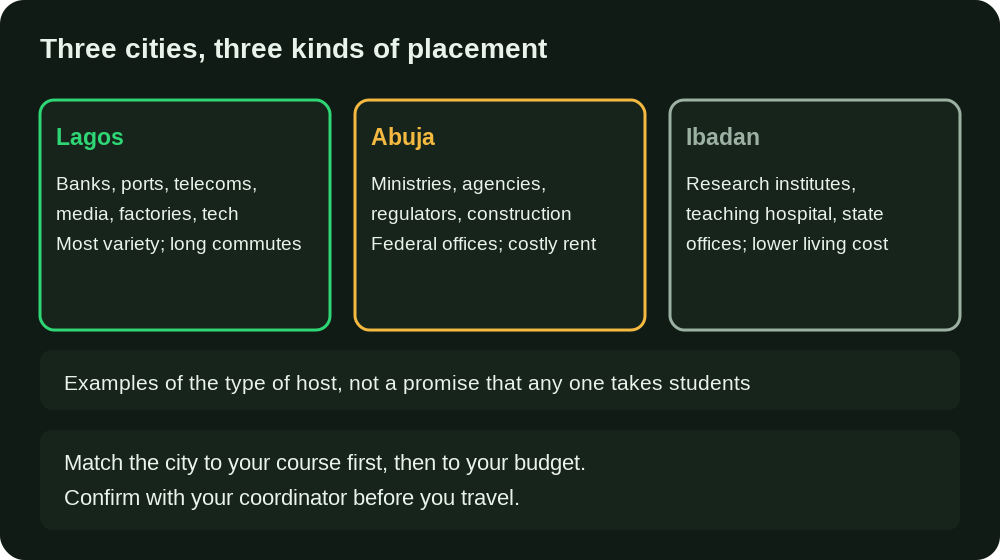
- Lagos: the widest range of banks, telecoms, ports and logistics, media, manufacturing and technology firms. Expect strong competition and long commutes.
- Abuja: federal ministries, departments and agencies, regulators, embassies and a large construction and real estate sector. Rent is often high, and government offices have their own access rules.
- Ibadan: research institutes, a major teaching hospital, universities, state government offices and agro-industry. Living costs are often lower than in the other two cities, and there are fewer private firms.
- In all three: a relevant host with a named supervisor beats a famous name with nothing for you to do.
- Before you relocate: get your coordinator's approval, accommodation sorted and the nearest ITF area office identified.
Where UniDraft fits, right at the start
Whichever city you land in, the placement ends with a written report that must follow your school's rules. UniDraft builds that report as an editable Word document from your confirmed work, your supervisor's instructions and your school's format, so the paperwork side stays manageable while you focus on the placement itself. Start your SIWES report with UniDraft once you are placed and your logbook is filling up.
What this guide covers, and what it does not
This is a pointer guide. Nobody can honestly publish a list of "companies that take SIWES students in Lagos" that stays accurate, because intake changes every year and many hosts decide on the day. So instead of a directory, you get three things: the kinds of organisation each city is known for, how to approach them, and a list of questions to settle before you accept. The examples named below are categories or well-known institutions in each city. Naming one is not a statement that it takes SIWES students, so verify before you build a plan around it.
One boundary matters: the rules differ by institution. We opened published guidelines from the University of Ibadan's industrial training centre, the University on the Niger and the Federal University of Agriculture, Abeokuta, and they agree on the broad shape but differ in detail. Your school's SIWES handbook always wins over a blog post, this one included.
Lagos: the widest choice, the hardest logistics
Lagos is Nigeria's commercial centre, and for placement purposes that means variety. A student of almost any discipline can find a relevant host type somewhere in the state. The difficulty is not availability of organisations but access, transport and competition.
Kinds of host you can look for
- Banks and financial services: relevant for accounting, banking and finance, economics and computer science students. Many banks route student requests through a head office or a human resources contact, so a walk-in to a branch rarely works on its own.
- Telecoms and internet providers: useful for electrical and electronic engineering, computer science and related programmes.
- Ports, shipping and logistics: the Apapa and Tin Can port areas are the obvious clusters for logistics, supply chain, marine, mechanical and civil students.
- Manufacturing and industrial estates: Ikeja, Agege and other industrial areas host factories where mechanical, electrical, chemical, food science and production students can find relevant work.
- Technology companies and start-ups: the Yaba area is widely known as a technology cluster. Computer science, software and data students often look there. Small teams may offer more hands-on exposure than a large firm, but check that someone will supervise you.
- Media houses: broadcast, print and digital media are concentrated in Lagos, which matters for mass communication students. See the mass communication SIWES report guide for what that report looks like.
- State government offices and agencies: the Lagos State Secretariat at Alausa, Ikeja, houses many ministries. Relevant for urban planning, works, environment and public administration students.
- Hospitals and laboratories: teaching and general hospitals, diagnostic laboratories and pharmaceutical firms for health and laboratory science students.
- Construction and consulting firms: for civil engineering, architecture, estate management, quantity surveying and building students. The built environment SIWES guide explains how that record usually looks.
What makes Lagos tricky
Distance and traffic. A placement that looks close on a map can cost hours a day in transport, and that affects whether you arrive on time and in a fit state to learn. Lagos is also where the most students are searching at once, so a generic request is likely to be one of dozens. Make yours specific, and see how to write a SIWES application letter that gets read for how.
A practical rule: choose a host within a commute you can sustain for the full period, even if it means a smaller organisation. A five-month placement you attend reliably is worth more than a prestigious one you dread.
Abuja: government, regulators and construction
Abuja is the federal capital, and the character of its host organisations follows from that. If your discipline connects to public administration, regulation, infrastructure or policy, Abuja may suit you.
Kinds of host you can look for
- Federal ministries, departments and agencies: the Federal Capital Territory hosts the headquarters of many federal bodies. Relevant for public administration, political science, economics, statistics, law-adjacent programmes and, for some agencies, engineering and computer science.
- Regulators and technology agencies: national regulators in telecoms, information technology and other sectors are based in Abuja, which is useful for computer science, electrical engineering and communications students.
- Oil, gas and energy bodies: the national oil company's headquarters and several energy-sector bodies are in the capital. These tend to be very competitive and process requests through formal channels.
- Construction and real estate: Abuja's building activity supports civil engineering, architecture, building, estate management, surveying and quantity surveying placements with contractors and consultants.
- Hospitals and tertiary health facilities: federal teaching hospitals and specialist centres for medical, nursing and laboratory students. The University of Abuja Teaching Hospital in Gwagwalada is one example of a teaching hospital in the territory.
- Banks, insurers, consulting and media: the corporate side is smaller than Lagos but real, particularly in the Central Business District and Wuse areas.
What makes Abuja tricky
Government offices can be slow and formal. An application may need to be addressed to a named officer, delivered in hard copy with your institution's introduction letter, and followed up in person. Be patient, polite and organised, and keep a copy of everything you submit.
Cost is the other issue. Housing near the city centre is expensive, and many students end up in satellite towns with a daily commute. Work out accommodation before accepting, not after. If you have family or a contact in Abuja, that can decide the whole question.
Ibadan: research, health and state government
Ibadan is a different proposition. It is the capital of Oyo State and a long-established educational centre, so its character is institutional rather than corporate. It suits agriculture, life sciences, health, environmental and some engineering programmes especially well.
Kinds of host you can look for
- Agricultural and forestry research institutes: Ibadan is home to several national research bodies, including the International Institute of Tropical Agriculture, the Cocoa Research Institute of Nigeria, the Forestry Research Institute of Nigeria and the National Horticultural Research Institute. These are known institutions. Whether any accepts a given student, and how, is for you to ask each one. See the agriculture SIWES report guide for how the record looks.
- Teaching hospital and health facilities: the University College Hospital is the best-known example, relevant to medical, nursing, pharmacy and laboratory students. Hospital placements are usually tightly regulated, so check your department's approved list first.
- University laboratories and units: a university can host students from other institutions in laboratories, workshops and ICT units, depending on its policy.
- State government offices and agencies: Oyo State ministries and agencies sit in the state capital, which is useful for works, agriculture, planning and administration students.
- Agro-processing and manufacturing: food, beverages and processing plants in and around the city for food science, chemical, mechanical and agricultural engineering students.
- Small technology firms, banks and media: fewer than in Lagos, but present.
What makes Ibadan tricky
There are fewer private-sector openings than in Lagos or Abuja, so competition for the good ones can be intense among students from the several institutions based in the city. The reward is often lower living costs and a more manageable commute, though check this against your own budget. If you are a student at an Ibadan institution, remember that many of your classmates are applying to the same hosts, so apply early and apply widely.
One table to compare the three
| Question | Lagos | Abuja | Ibadan |
|---|---|---|---|
| Dominant host types | Private firms across many sectors | Government bodies, regulators, construction | Research institutes, health, state offices |
| Strongest for | Business, tech, media, manufacturing, logistics | Public administration, policy, infrastructure | Agriculture, life science, health |
| Main difficulty | Commute and crowded competition | Formal processes and rent | Fewer private openings |
| Cost of living (general, varies by area) | Often high | Often high | Often lower |
| Best approach | Specific, well-targeted requests | Formal letters and patient follow-up | Early applications to institutions |
This is a generalisation to help you think, not a ranking. Individual hosts in any city can break the pattern.
How to approach a host in any of the three cities
The method is the same everywhere. What changes is the channel.
- Get your school paperwork first. Most hosts want your institution's introduction letter. Ask your coordinator how long it takes, because a delay there delays everything.
- Shortlist by discipline, not by name. Write down ten to twenty organisations of the right type in your target city. Search for what they do, and confirm their work matches your course.
- Choose the channel the host expects. Government bodies and big firms often want a formal letter delivered to a named officer. Smaller firms and start-ups respond to a short email or a visit with your CV.
- Tailor each request. Name the department you want and why. The sample opening lines in the SIWES application letter guide show the difference between generic and specific.
- Follow up once. A polite message after a week or two is normal. Silence after that is also an answer, so move on to the next name.
- Record every contact. A simple list of who, when and what they said helps if you later need your coordinator's help.
If you do not know anyone in the city, use the ITF's free employer request page described in the general guide, and ask lecturers and older students which hosts took your course before.
Using the ITF side of things
The Industrial Training Fund coordinates SIWES nationally and works through area offices. According to the published FAQ of the Federal University of Agriculture, Abeokuta, students take the employer-completed SPE1 form to the ITF area office nearest to their place of training, and that applies regardless of state boundaries. The same FAQ says area office addresses are printed on the inner covers of the logbook. The University of Ibadan's centre describes the SCAF form as one that goes to the ITF area office nearest to each student's place of training.
For you, that means two things. First, the "nearest area office" depends on where you work, not where your school is. Second, check your own logbook cover and ask your coordinator for the current address instead of trusting an old directory. We looked for an official ITF list of area offices and could not confirm current addresses, so we have not published any. For what those forms are, see what the SCAF form is and what Form 8 is.
Before you relocate: the checklist
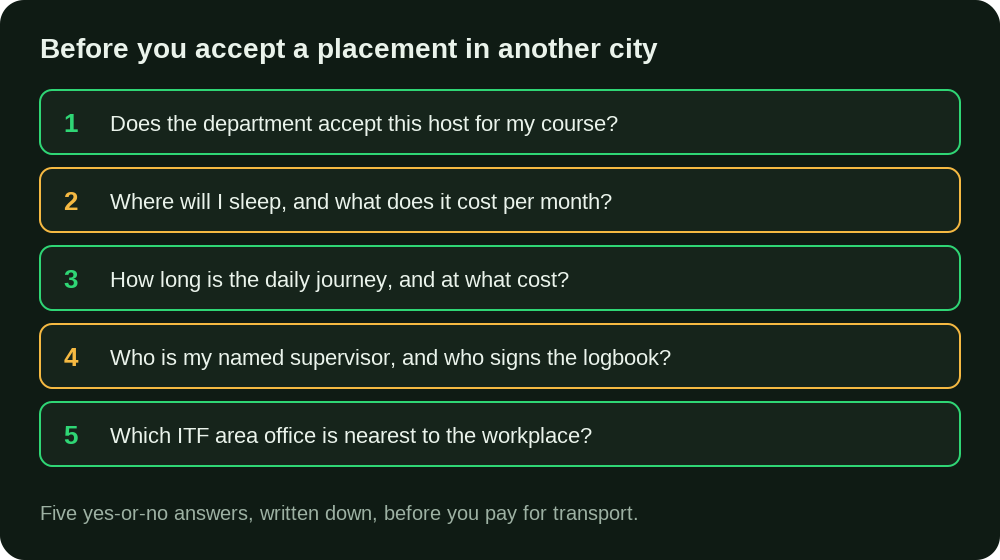
Moving to another city for SIWES is a real commitment. Settle these before you accept, and write down the answers.
Approval and paperwork
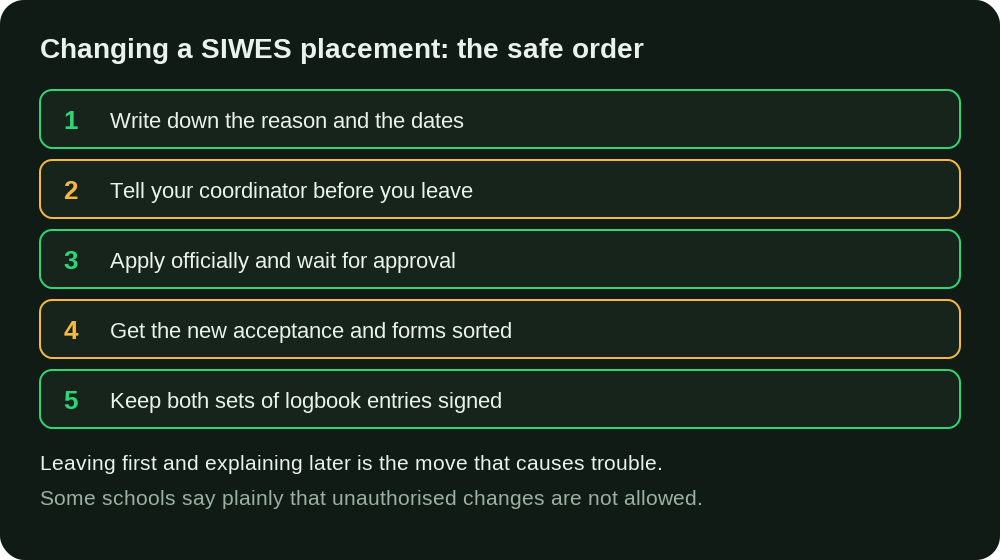
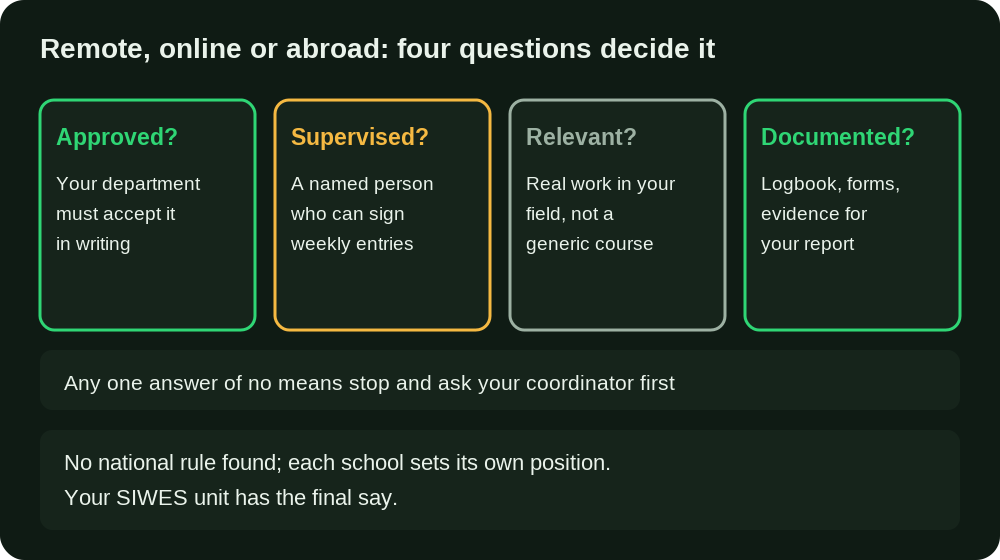
Does your department accept this host for your course? Some professions require placements to meet particular criteria, and the University on the Niger's published guidelines say departments approve student placements on programme relevance. If your department has not approved it, the placement may not count towards your assessment.
At some institutions you can submit paperwork remotely. The FUNAAB FAQ says students in distant locations can email scanned acceptance letters and SPE1 forms to their department coordinator. Do not assume your school allows this. Ask.
Duration and timing
Confirm the start date and how many weeks you will be there. The FUNAAB FAQ describes a 24-week scheme and warns that late acceptance letters can leave too little time to complete it. Check your own school's duration, which can differ by programme.
Accommodation and money
Work out monthly rent, transport and feeding. Allowances, where they apply, are modest and depend on your school submitting correct lists, so see the cautious note in what SIWES is before budgeting around any figure. If a relative or alumnus can host you for the first month, that removes the biggest risk.
Supervision and your logbook
Ask who your named supervisor is and whether they will sign your logbook weekly or at the end. A host that cannot answer this is a warning sign. Read how to fill your SIWES logbook before you accept, so you know what a good placement should let you record.
Safety and legitimacy
Visit the workplace if you can, or speak to someone who has been there. Never pay for a slot. If anyone asks for money, speak to your SIWES coordinator before sending anything.
A short template for asking your coordinator (illustrative)
This is an illustrative message with placeholders. Replace the brackets and keep it short.
Good day. I am [name], [matric number], [level] [course]. I have an offer from [organisation] in [city] for SIWES from [date] to [date]. The work would be in [department], with [supervisor's name or title] as my supervisor. Please can you confirm whether the department accepts this placement, whether I can submit my acceptance letter by email, and which ITF area office I should use? Thank you.
Keep the reply. If a rule matters later, you can show it.
Matching your discipline to a city
A quick way to narrow your choice:
- Computer science, software and data: Lagos first for the variety of firms, Abuja for regulators and agencies, Ibadan for university and small-firm settings. Our logbook examples for computer science show what good entries look like.
- Engineering (civil, electrical, mechanical): Lagos and Abuja for construction, power and manufacturing. See the engineering logbook examples.
- Agriculture, forestry and life sciences: Ibadan has the strongest cluster of research institutions.
- Health and laboratory sciences: teaching hospitals and approved laboratories in any of the three, subject to your department's list. The laboratory science guide covers the report side.
- Business, accounting and banking: Lagos for the density of firms, Abuja for public-sector finance.
- Public administration, political science and policy: Abuja, then state offices in Ibadan or Lagos.
Common mistakes when choosing a city
- Choosing the city before the host. A city is not a placement. You need a specific, approved host.
- Underestimating commute and rent. Students often accept in Lagos or Abuja and then cannot afford to stay.
- Assuming a famous name will give you good work. Relevance and supervision matter more.
- Moving before the department approves. You risk doing a placement that does not count.
- Forgetting the paperwork location. Forms go to the area office nearest your workplace, not your school.
- Not keeping evidence. Keep a copy of every letter, acceptance and message, because they feed your logbook and report.
After you are placed
Once you start, the placement turns into evidence. Your daily logbook entries become the raw material for your SIWES report, and how that work is assessed is explained in how SIWES is graded. When you are ready to draft, the free university format guides show what your school expects, and you can check an existing draft with the free formatting checker.
Where UniDraft fits in
When the placement is done, UniDraft turns your real logbook activities, your supervisor's instructions and your school's format into an editable Word report. Start your SIWES report with UniDraft and keep your own work at the centre of it.
Sources
- Students' SIWES FAQ, Federal University of Agriculture, Abeokuta: area offices, SPE1 forms, remote submission of acceptance letters, 24-week duration.
- University of Ibadan Industrial Training Coordinating Centre: commencement of industrial training: placement letter, SCAF form and the nearest ITF area office.
- SIWES guidelines and policy, University on the Niger: department approval of placements on programme relevance.